

Nova Posta, whose two depots have been significantly damaged by the Shaheds in the past three weeks, has resumed major construction projects started before the war, said Vyacheslav Klimov, co-owner of the postal operator.
“We launched our big construction projects before the war, now we have resumed them and are building very quickly,” he said at the Kiev International Economic Forum on Thursday.
Klimov assessed as a mistake the rapid downsizing of the network and staff in the first months of the war.
“Those were the hardest decisions we made then. We didn’t lay anyone off, but we were forced to suspend operations in many branches where there was no turnover or customers at the time. We later assessed that as a mistake: we squeezed harder than we needed to,” he said.
“In general, we came back very quickly. And in three to four months, the network has already taken a ‘pre-war’ look,” said the co-owner of “Novaya Posta.
According to him, attracting loans is not possible at current interest rates, so you have to rely on your own efforts.
“We asked the banks, it is impossible to work with such credit rates. I don’t know of businesses that can pull such rates… Generate your own EBITDA and build with your own money,” Klimov said.
The main focus for the company, he said, is employees.
“There are 2,500 Novopostovians on the front lines right now. We try to do as much as possible for these people,” Klimov pointed out, specifying that the company continues to pay them financial aid even after the permission to stop paying salaries, as well as provides other assistance, in particular, providing them with warm clothes.
“Nova Posta” is the largest participant of the Ukrainian logistics market: its network includes 10 thousand offices and 13 thousand post offices throughout Ukraine. The number of items in 2021 exceeded 372 million. Besides, NovaPay non-banking financial institution provides services for money transfers and e-money transactions. There were 388 million transactions in 2021.
The group also includes NovaPost Global, which is developing an international partner network to provide customers with express delivery services not only in Ukraine but also abroad. The company performs regular flights to the U.S., Europe and China and delivered 9.3 million international items in 2021.
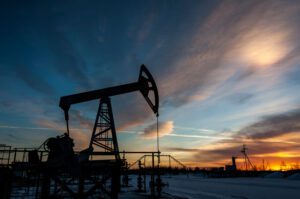
The value of January futures on Brent crude at London’s ICE Futures Exchange stood at $90.27 a barrel by 7:10 a.m. KSC on Friday, $0.49 (0.55%) above the previous session’s closing price. Those contracts fell by $3.08 (3.3%) to $89.78 a barrel at the close of trading on Thursday.
The price of WTI futures for December at electronic trades of NYMEX grew by that time by $0.67 (0.82%) to $82.31 per barrel. By the close of previous trading the cost of those contracts fell by $3.95 (4.6%) to $81.64 a barrel.
Since the beginning of this week Brent has lost about 6% and WTI – 7.5%.
Weak expectations of traders regarding the prospects for oil consumption contributed to the decline in prices. Experts don’t expect rapid recovery of demand for fuel in China, where there was renewed growth of COVID-19, notes Bloomberg agency. In addition, analysts at JPMorgan Chase & Co. forecast a “soft recession” in the U.S. economy next year due to the Federal Reserve’s (Fed) raising the benchmark interest rate.
“The oil market can’t ignore the deteriorating demand outlook in the world’s two largest economies,” said Edward Moya, chief energy sector analyst at Oanda Corp. – Demand remains low, even despite the approaching entry into force of the embargo on Russian oil supplies to the European Union.”
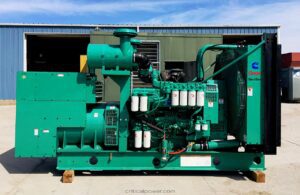
The Cabinet of Ministers, at a meeting on November 16, 2022, adopted a resolution simplifying the import of generators and other power equipment to Ukraine.
“The new regulation on importation into the customs territory of Ukraine temporarily (until the termination or cancellation of martial law and for the next 90 calendar days) provides for not applying to such goods the requirement for a declaration of conformity and marking with a mark of compliance with technical regulations,” the Ministry’s website says. economy on Thursday.
The document complements six previous Cabinet of Ministers resolutions on the approval of certain technical regulations, the effect of which may apply to the relevant goods.
“The adoption of the resolution will help to meet the needs of the domestic market with equipment for the restoration and stabilization of electricity and gas supply to consumers, which is caused by challenges in the energy sector in the context of martial law in Ukraine,” explained First Vice Prime Minister – Minister of Economy Yulia Sviridenko, whose words given on the site.
Earlier, the Cabinet of Ministers exempted generators, batteries and other equipment from import duties and VAT, helping to improve energy supply.
“However, at customs, importers faced problems with clearance of such goods. The current resolution should eliminate these inconsistencies,” the Ministry of Economy stressed.

The Motor (Transport) Insurance Bureau of Ukraine (MTIBU) has increased tariffs for Green Card policies for those traveling abroad by 6.9% since November 17, 2022, according to the Bureau’s website.
According to the MTIBU, the last change in tariffs was on October 3, 2022 downward by 5.5%, and before that (July 26) – upward by 26.3%.
Green Card policies have been implemented since 2009 in two types: all of Europe, Moldova. Also, from January 1, 2016, Ukrainian Green Card policies began to operate on the territory of Azerbaijan.
According to the MTIBU, the cost of a “Green Card” in Ukraine for 15 days for trips around Europe for cars rises to UAH 923 (previously – UAH 863), for buses – up to UAH 3,469 thousand (UAH 3,244 thousand), for trucks – up to UAH 2,178 thousand (UAH 2,037 thousand).
The cost of the “Green Card” for one month for cars is now UAH 1,470 thousand (against UAH 1,375 thousand earlier), buses – UAH 4,818 thousand (UAH 4,506 thousand), trucks – UAH 2,891 thousand (UAH 2,703 thousand). ).
Semi-annual and annual “Green Card” policies for cars will now cost 6,525 thousand rubles. hryvnia and UAH 8.079 thousand, respectively, for buses – UAH 16.866 thousand and UAH 31.323 thousand, for trucks – UAH 13.685 thousand and UAH 25.829 thousand.
The cost of policies for trips to Azerbaijan and Moldova for cars for 15 days will be UAH 672 (previously UAH 629), for one month – UAH 989 (UAH 925), for six months – UAH 2,268 thousand (UAH 2,121 thousand), for a year – UAH 3,230 thousand. (UAH 3,102 thousand)
The amounts of unified insurance payments under international compulsory civil liability insurance contracts for owners of land vehicles are established by the Resolution of the Cabinet of Ministers dated January 6, 2005 and are defined in euros.
“Green Card” – a system of insurance protection for victims of a traffic accident, regardless of their country of residence and the country of registration of the vehicle. The “Green Card” covers the territory of 44 countries of Europe, Asia and Africa.
According to the decision of the General Assembly of the Council of Bureaux of the International Motor Insurance System “Green Card”, adopted in Luxembourg in May 2004, Ukraine has been a full member of this system since January 1, 2005.
Geographical structure of foreign trade in goods in 2018-2022 (%)
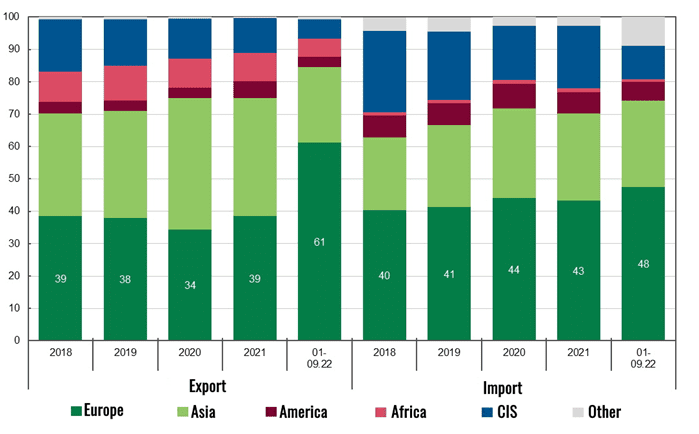
NBU
Ukrainian networks of filling stations have managed to master the European market of motor fuel after losing Russian and Belarusian fuel with the beginning of full-scale invasion of Russia thanks to the offer of competitive prices and fast contracts, Vasyl Danilyak, СЕО of OKKO group, said.
“Ukrainian companies did not enter their supply market, where everything was contracted a long time ago. Accordingly, they could outbid on price and fast contracts. Despite the unacceptable price, we started contracting 100 percent of possible resources in all corners of Europe,” he said at the Kiev International Economic Forum on Thursday.
At the same time, Danylyak noted that such decisions were made, among other things, emotionally, although they were not always economically justified.
He explained that the European chain of deliveries is much longer than the ones from the East and North directions, when “pipe deliveries were 3-4 days, by rail from the nearest Belarusian refineries to the average tank farm, the fuel took seven days at most.
“And in Europe the chain could stretch for two months or more. For example, we bought in the region of Amsterdam-Antwerp a fairly expensive resource. Supply logistics are complicated: first by small (because of the low level of the Rhine) barges to Germany, then it pours into big terminals, and then you wait for shipping windows because there are queues. So, in the middle of April we made an advance payment, and the last shipment arrived, if I’m not mistaken, in October,” Danilyak described the situation.
He noted, however, that even if the company had known in advance how difficult the delivery would be, it would still likely have made the contract.
“There was such a shortage that the decision was obvious. The fact that it would not be very profitable was not thought of then,” the CEO of “OKKO” assured.
He also stressed that changing the logistics of petroleum products as the war began was the biggest challenge not only for OKKO, but for the entire industry.
“It was the biggest challenge in the first month of the war that companies focused on. The whole market was confronted with the fact that on one day all deliveries were zeroed out, everyone fixed their losses at the time of February 24, who had prepayments, to whom the goods had not arrived in large quantities. Accordingly, everyone began to refocus on Western supplies. And in about three months, in June, the consumers felt a significant improvement, and in July everything was as if nothing had happened,” said Danilyak.
In addition, he expressed the opinion that dispersed business has more flexibility in crisis situations.
“Big and in one place is not always a good thing, although perhaps more cost-effective. Our business, where there are a lot of small businesses, has proven to be more resilient to stress than, for example, the steel industry, when the loss of two key businesses took out seventy percent of the business,” he argued his opinion.
In this connection Danilyak marked that “OKKO” would adhere to the policy of diversification in future too, that, in principle, the essence of the company business allows.
He also paid attention that war experience will teach many companies to follow fire safety rules strictly in accordance with all the requirements that “earlier they looked through the fingers” to some extent.



