
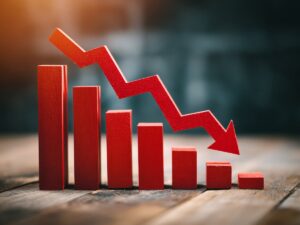
Romania’s economy contracted by 0.4% in the second quarter of 2026 compared to the same period in 2025, according to unadjusted data, whereas a year earlier, the country’s GDP had grown by 0.3%. This is according to preliminary data from the National Institute of Statistics of Romania (INS), published on September 7.
At the same time, compared to the first quarter of 2026, GDP remained virtually unchanged. According to seasonally adjusted data, the decline in the second quarter amounted to 2% on an annualized basis. Thus, this primarily reflects the economy’s shift to negative annual growth rather than a new quarterly decline.
In the first half of 2026, Romania’s GDP fell by 0.7% compared to January–June of the previous year based on unadjusted data and by 1.6% based on the seasonally adjusted series.
By comparison, in the first half of 2025, Romania’s economy grew by 0.3% year-over-year. In the second quarter of last year, GDP also increased by 0.3% according to unadjusted data, while the seasonally adjusted series showed growth exceeding 2% at that time. Thus, over the course of the year, the performance of Southeast Europe’s largest economy has noticeably deteriorated.
The main pressures on the economy in the first half of 2026 came from trade, transportation, the hotel and restaurant sector, manufacturing, IT and telecommunications, as well as the real estate market. Trade, transportation, warehousing, hotels, and restaurants—which account for about 21.6% of GDP—saw their output decline by 3.9% and made a negative contribution to GDP growth of 0.9 percentage points.
Manufacturing, which accounts for about 16% of the economy, contracted by 2.9% and reduced overall GDP growth by another 0.5 percentage points. The information and communications sector declined by 3.5%, and real estate transactions by 4.5%.
The decline was partially offset by construction. The volume of work in the sector increased by 12.3%, and its positive contribution to GDP amounted to 0.7 percentage points.
Individual indicators confirm the weakness of the industrial sector: Romania’s industrial production in January–June 2026 contracted by 3.3%, including a 4.4% decline in the manufacturing sector.
The deterioration in GDP growth is occurring against the backdrop of large-scale fiscal consolidation and persistently high inflation. In its spring forecast published on May 21, the European Commission projected that Romania’s economic growth in 2026 would amount to only 0.1%, following 0.7% in 2025. In 2027, Brussels forecasts that growth will accelerate to 2.3%.
According to the European Commission’s assessment, the slowdown is primarily due to a decline in real disposable income and consumption amid fiscal consolidation and high inflation. Average inflation in Romania in 2026 is forecast at 7%, and the government budget deficit is expected to shrink from 7.9% of GDP in 2025 to 6.2% of GDP this year. The economy is expected to be supported by investment projects—particularly those funded by the EU—as well as net exports.
On September 7, the Supervisory Board of PJSC “Ukrainian Fire and Insurance Company” (UPSK, Kyiv) suspended CEO Natalya Vorobyev from her duties due to the expiration of her contract.
According to official information from the insurer posted on the National Securities and Stock Market Commission’s (NSSMC) disclosure system, she had held this position since September 9, 2021.
In addition, it is noted that Oleksandr Linichenko has been appointed acting Chair of the Management Board; he has served as a member of the Management Board and Deputy Chair of the Management Board of UPSK PJSC for the past five years.
UPSK PJSC was registered in 1993. It specializes, in particular, in motor vehicle insurance, financial risk insurance, travel insurance, property insurance, cargo insurance, and baggage insurance.
According to the company, Alexander Mikhailov owns 99.999% of its shares.
According to data from the National Bank of Ukraine (NBU), the company ranks 16th among Ukraine’s non-life insurers in terms of premiums written in 2025.

On September 8, the Vehicle Fleet of the Administrative Office of the Verkhovna Rada of Ukraine announced a tender for the procurement of services for mandatory carrier liability insurance covering damage caused to the life and health of passengers and damage caused to baggage during transportation.
According to a notice posted on the Prozorro electronic government procurement system, the estimated cost of the services is 90,633 thousand UAH. The deadline for submitting bids is September 24.
liability insurance, Vehicle Fleet of the Administrative Office, Verkhovna Rada Secretariat

According to Experts.news, the structure of Ukraine’s dairy exports has changed significantly over the past year: the share of butter and other milk fats in foreign exchange earnings has more than halved, while dry and condensed milk have become the largest export category, according to an analysis by the Union of Dairy Enterprises of Ukraine (UDEU).
In August 2025, butter and other milk fats under commodity code 0405 accounted for 36% of the value of Ukraine’s dairy exports, whereas in August 2026, their share fell to 15%. At the same time, the share of dry and condensed milk increased from 24% to 37%, and that of whey from 5% to 11%.
The change in structure occurred gradually. Butter accounted for 36% in August 2025, falling to 25% in October, to 22% in March 2026, and to 15% in August. At the same time, the share of dry and condensed milk rose from 24% to 24%, then to 35% and 37%, respectively. Thus, the shift in the structure of Ukrainian dairy exports occurred primarily between the fall of 2025 and the spring of 2026.
According to the SMPU’s assessment, one of the factors was the situation on the global market for milk fats. Butter prices were under pressure, and the Global Dairy Trade index fell for nine consecutive auctions at the end of 2025. Since the export structure is calculated in value terms, the decline in butter’s share is linked not only to physical shipment volumes but also to changes in global prices.
At the same time, experts cite the growing role of whey as the most notable structural change. Its share of export revenue more than doubled over the year. By August 2026, dry milk, condensed milk, and whey together accounted for 48% of the value of Ukraine’s dairy exports.
The share of cheeses—which are considered higher-value-added products with potentially higher profit margins—remained virtually unchanged, at about 24% in August 2025 and 25% a year later. Thus, the structure of Ukraine’s dairy exports is shifting increasingly toward commodities and raw materials.
This trend is unfolding against the backdrop of a general deterioration in the dairy industry’s trade balance. According to data published by the Ukrainian Dairy Producers Association (SMPU) on September 2, Ukraine exported $176.9 million worth of dairy products in January–August 2026, which is 20.5% less than during the same period last year. At the same time, imports increased by 24.7% to $247.2 million.
In volume terms, butter exports fell by roughly half over the eight-month period, while shipments of dry milk and condensed milk decreased by 7%. At the same time, exports of fermented milk products rose by 28%, milk whey by 1.1%, and cheese by 0.9%.
As a result, Ukraine shifted from a trade surplus in dairy products to a trade deficit. For January–August 2026, the deficit totaled $70.3 million, whereas a year earlier the surplus had reached $24.1 million. The export-to-import ratio fell from 1.12 to 0.72.
On the import side, cheese remains the largest category, although its share in August fell year-over-year from 82.3% to 76.9%. At the same time, the share of imported milk and cream, whey, and butter increased, intensifying competition for Ukrainian processors in the domestic market.
The Union of Dairy Enterprises of Ukraine (SMPU) brings together Ukrainian milk producers and processors and represents the interests of companies in the industry. The organization was founded in 2001.
Original source: analysis by the Union of Dairy Enterprises of Ukraine on Ua Dairy

The Greek government plans to increase the tax on the transfer of residential real estate for buyers from countries outside the European Union fivefold—from 3% to 15%. The new measure is set to take effect in 2027 and may directly affect, in particular, buyers from Ukraine if they do not fall into the categories eligible for exemptions under the law.
Greek Prime Minister Kyriakos Mitsotakis announced this decision during a speech at the 90th International Fair in Thessaloniki. On September 7, the government published a detailed description of the tax changes. The authorities explain the increase by the need to limit additional demand for housing from buyers in third countries, which, according to their assessment, contributes to rising prices and reduces the affordability of real estate for permanent residents of Greece.
Currently, the base tax on real estate transfers in Greece is 3% of the property’s taxable value, and when the municipal surcharge is included, the effective rate reaches 3.09%. For homebuyers subject to the new rules, the rate will be 15%, or about 15.45% including the municipal surcharge. Thus, when purchasing an apartment worth 300,000 euros, the tax burden could increase from approximately 9,300 euros to 46,350 euros, and for a property worth 500,000 euros—from 15,450 euros to 77,250 euros.
The increased rate applies specifically to residential real estate. According to the government’s clarification dated September 7, it should not apply to commercial properties, land parcels, or other categories of real estate.
However, not all citizens of non-EU countries will be subject to the increased rate. Exceptions are provided, in particular, for individuals with long-term resident status in Greece, certain citizens of Greek origin, recognized refugees, and holders of specific categories of residence permits. Citizens of the EU and the European Economic Area will also be exempt from the increased rate.
For Ukrainians, the implications of this new measure will depend primarily on their legal and tax status in Greece. Ukraine is not a member of the EU or the EEA, so a Ukrainian citizen purchasing a home as a regular buyer from a third country is potentially subject to the 15% rate. The government’s published clarification does not specifically state whether there will be a special exemption for Ukrainians residing in the country under the temporary protection regime.
Mitsotakis described the tax increase as part of a broader policy to curb housing costs. At the same time, the government intends to extend a number of measures to support the domestic market, including exempting new buildings from VAT, providing tax incentives for long-term leases of vacant properties, and imposing restrictions on new short-term rental properties in certain areas of Athens and Thessaloniki. The government also announced a new €2 billion subsidized housing loan program called “Spiti Mou III.”

Risks in international trade often arise not with the direct counterparty but at subsequent levels of the supply chain. A company may have a reliable supplier that, in turn, depends on a single factory, logistics operator, technology owner, or subsupplier in another country.
That is why international risk management is gradually shifting from simple counterparty verification to the analysis of broader corporate and supplier relationships. This is particularly relevant for Ukrainian businesses because of the war, complicated logistics, sanctions regimes, and the high dependence of many industries on imported raw materials and equipment.
“A company may know its direct partner well and, at the same time, may not know on whom that partner’s operations critically depend. A single problematic subsupplier, a sanctions-related connection, or a production shutdown at the other end of the chain can disrupt a contract in Ukraine. Therefore, modern verification must answer not only the question ‘Who is our partner?’ but also ‘Who does our partner depend on?’” said Maksym Urakin, head of the D&B — Interfax-Ukraine business unit and Candidate of Economic Sciences.
Risk factors include the excessive concentration of procurement from a single supplier, dependence on a single region, opaque corporate relationships, sanctions risks, financial problems at a key company in the chain, or a sudden change of ownership.
For critical supplies, companies should develop a pool of alternative suppliers, determine minimum inventory levels, verify corporate groups, and reassess partners in the event of significant changes. This is particularly relevant to the energy sector, mechanical engineering, pharmaceuticals, the food industry, construction, and other sectors in which the disruption of a single component can block the entire production cycle.
D&B solutions in supplier intelligence and business risk management make it possible to work with global business data, corporate relationships, and risk signals. For Ukrainian companies, this information can provide a foundation for building more resilient supply chains.
In the long term, the verification of supplier relationships is becoming not a one-time procedure but part of a business’s operational resilience.
D&B — Interfax-Ukraine helps Ukrainian companies work with international business data and business identification tools.
Dun & Bradstreet is an international provider of business data and analytical solutions whose history began in 1841. D&B works with data on companies worldwide and provides tools for business identification, counterparty verification, credit and commercial risk assessment, compliance, and supply chain management.
The Interfax-Ukraine News Agency is the official representative of Dun & Bradstreet in Ukraine. The specialized D&B — Interfax-Ukraine division provides Ukrainian companies with access to international business data, helps them verify foreign counterparties, and assists them in working with D&B tools.
Questions can be submitted through the specialized D&B resource — dnb.ua, by email at Urakin@interfax.kyiv.ua, or by telephone at +38 (044) 270-65-74.
BUSINESS, D&B, INTERFAX-UKRAINE, RISK MANAGEMENT, SUPPLY CHAINS



