
The IDS Ukraine Group of Companies has restructured its logistics, reorganized distributor territories, and increased the number of transportation partners by 30% by incorporating small carriers and sole proprietors, said Marco Tkachuk, CEO of IDS Ukraine.
“Shelling poses additional challenges, as it destroys our partners’ logistics centers and warehouses. We have to constantly change routes and deliver water directly to stores more often. We’ve increased the number of partners by 30% by bringing in small carriers and sole proprietors who own several vehicles,” he said in an interview with the “Interfax-Ukraine” news agency.
When asked about the main challenges facing the company, aside from logistics and rising fuel prices, Tkachuk cited migration and, as a result, a decline in consumption. Declining household incomes and migration trends have forced the company to seek new business channels, which is why it was decided to launch the B2B platform e-Morshynska, which accounts for 10% of sales in traditional retail through direct ordering without the involvement of sales agents.
In addition, staffing remains a challenge. According to Tkachuk, because the reservation system covers only half of the employees, there is an acute shortage of drivers.
To improve planning amid uncertainty, IDS Ukraine is in the final stages of implementing an ERP system for inventory management, he added.
IDS Ukraine is a Ukrainian group of companies founded in 1996. It owns the “Morshynska,” “Myrhorodska,” “Alaska,” and “Aqua Life” brands. The group includes the Morshyn “Oscar” Mineral Water Plant, the Mirgorod Mineral Water Plant, the distribution company “IDS,” and the water delivery operator “IDS Aqua Service.”
According to Experts Club, Lithuania and Poland accounted for about 60% of all automotive gasoline imports to Ukraine in August 2026, according to data from a special study by the “A-95” Consulting Group and an analysis of that data conducted by Experts Club.
Lithuania retained its top position among supplier countries with a volume of 51,800 metric tons, accounting for 34% of Ukraine’s gasoline imports.
Poland ranked second with 40,1 thousand metric tons and a share of about 26%.
For comparison: in July, shipments from Lithuania totaled 56,1 thousand metric tons, and from Poland—51,7 thousand metric tons.
Over the year, the combined share of the two largest sources increased from 55% to 60%.
The key supplier from both markets is the ORLEN Group, which controls refining capacity in Lithuania and Poland. In August, the group supplied 78.8 thousand metric tons of gasoline to Ukraine—more than half of total imports.
Romania remains the third major source. However, shipments from Romania fell to 23,400 metric tons in August, down from 34,000 metric tons in July.
Imports from Germany totaled 18,200 metric tons, down from 20,900 metric tons the previous month, while imports from Greece totaled 15,000 metric tons, down from 24,900 metric tons.
Imports from Moldova fell from 5.8 thousand metric tons in July to 1.9 thousand metric tons in August.
In total, Ukraine imported approximately 152 thousand metric tons of gasoline in August, and 1.12 million metric tons since the beginning of 2026.
https://www.experts.news/posts/lytva-ta-polshcha-zabezpechyly-60-importu-benzynu-v-ukrayinu-u-serpni
Ukrainian steelmakers reduced steel production by 12.5% in January–August of this year compared to the same period last year, down to 4.3 million metric tons.
According to data from the “Ukrmetallurgprom” association, 277,000 metric tons of steel were produced in August, 457,000 metric tons in July, 690,800 metric tons in June, 629,400 metric tons in May, in April—517,300 metric tons, in March—702,300 metric tons, in February—515,000 metric tons, and in January—511,100 metric tons.
In 2025, Ukraine’s steel companies reduced steel production by 2.2% compared to 2024—to 7.409 million metric tons.
In 2024, Ukraine increased steel production by 21.6% compared to 2023—to 7.575 million metric tons. In 2023, steel production fell by 0.6% to 6.228 million metric tons, and in 2022, it fell by 70.7% to 6.263 million metric tons.
In 2021, before the war, 21.366 million metric tons of steel were produced, or 103.6% of the 2020 level.
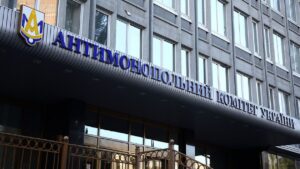
The Temporary Administrative Board of the Antimonopoly Committee of Ukraine (AMCU) fined DE TRADING LLC 50 million UAH for anti-competitive concerted practices that distorted the results of five electricity supply auctions.
According to a statement by the AMCU following its September 8 meeting, violations were found in the actions of “DE TRADING” and “Torgovaya Elektricheskaya Kompaniya” LLC. The total estimated value of the procurements covered by the committee’s decision exceeded 1.5 billion UAH.
For violating the legislation on the protection of economic competition, “DE TRADING” was fined 50 million hryvnias. The second party involved in the case—“Torgovaya Elektricheskaya Kompaniya”—was fined 60 million hryvnias. The total amount of sanctions amounted to 110 million hryvnias.
The primary business activity of “DE TRADING” LLC is electricity trading.
According to YouControl, 100% of the company’s authorized capital is owned by PJSC “Energoinvest Holding.” Its ultimate beneficial owners are listed as Andriy Zinatullin, with a 46% stake, and Alina Pylypenko, with a 40.52% stake.
Zinatullin is also one of the co-owners of “Torgovaya Elektricheskaya Kompaniya” LLC, holding a 24.9% stake in its authorized capital.
Original source: AMCU decision dated September 8, 2026.
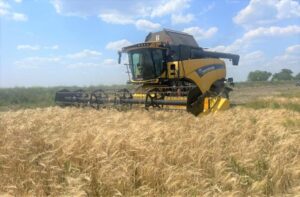
Ukrainian farmers have begun harvesting late-season oilseeds, and as of September 8, 89.3 thousand metric tons of sunflower seeds have been harvested from the first 56 thousand hectares—representing 1% of the projected area—with an average yield of 15.9 centners per hectare.
A total of 79.9 thousand metric tons of soybeans have been harvested from 45.3 thousand hectares (3% of the forecast) at a yield of 17.6 centners per hectare, according to the press service of the Ministry of Agrarian Policy and Food.
As of September 8, farmers across all regions had threshed 6.85 million hectares, or 59% of the projected area. The gross harvest of grain and legume crops reached 32.2 million metric tons, with an average yield of 47 ts/ha.
Farmers have nearly completed the wheat harvest and have fully finished harvesting barley and peas. Specifically, 24.91 million metric tons of wheat were harvested from an area of 5.04 million hectares (98% of the target) with an average yield of 49.4 centners per hectare.
The barley harvest is 100% complete across the entire area, or 1.48 million hectares. The gross harvest amounts to 6.4 million metric tons, with a yield of 43.4 tsentners per hectare.
The pea harvest is also complete—795.2 thousand metric tons were harvested from 298.2 thousand hectares, with a yield of 26.7 tsentners per hectare.
Millet yields totaled 34,000 metric tons, with 14,500 hectares (35% of the area) threshed at a yield of 23.4 centners per hectare. Buckwheat yields totaled 10,900 metric tons from 7,700 hectares (16% of the area) at a yield of 14.2 centners per hectare. The first 43.2 thousand metric tons of corn were harvested from 12.1 thousand hectares, with a yield of 35.9 centners per hectare.
Farmers in the southern and central regions lead in terms of gross grain harvest volumes.
In the Odesa region, a total of 4.82 million metric tons of grain was harvested from an area of 1.19 million hectares. Specifically, 3.22 million metric tons of wheat, 1.31 million metric tons of barley, and 284,900 metric tons of peas.
In the Dnipropetrovsk region, 2.69 million metric tons of grain were harvested from 650,600 hectares. This included 2.04 million metric tons of wheat, 574,600 metric tons of barley, and 37,000 metric tons of peas.
The Kirovohrad region harvested 2.42 million metric tons of grain from an area of 559,000 hectares. The harvest included 1.92 million metric tons of wheat, 412,500 metric tons of barley, and 82,000 metric tons of peas.
The highest yields were recorded in the Khmelnytskyi region—70.8 ts/ha, the Sumy region—59.7 ts/ha, and the Vinnytsia region—59.6 ts/ha.
The rapeseed harvest is complete, with a total volume of 3.8286 million metric tons.
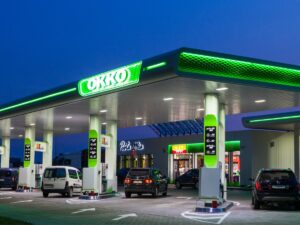
The OKKO network remains the largest importer of automotive gasoline into Ukraine: in August 2026, the company imported 46,100 metric tons of fuel, and 302,000 metric tons since the beginning of the year, according to data from the A-95 Consulting Group. OKKO accounts for about 27% of all Ukrainian gasoline imports since the beginning of the year.
The next group of largest suppliers consists of WOG, UPG, and “Ukrnafta.”
In August, WOG imported 20,200 metric tons of gasoline, UPG—20,000 metric tons, and “Ukrnafta” imported 19,400 metric tons.
Next are “BRSM-Nafta” with 7,000 metric tons, Amic with 3,400 metric tons, and “Avantage” with 3,100 metric tons.
Gaztrim and KLO each imported 2,400 metric tons, and Bars 2000 imported 2,200 metric tons.
Other market participants accounted for 26,100 metric tons.
In total, Ukraine imported 152,000 metric tons of motor gasoline in August.
The largest countries of origin for the fuel were Lithuania—51,800 metric tons—and Poland—40,100 metric tons. The ORLEN Group supplied more than half of August’s imports.



