
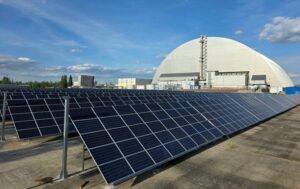
New 2-megawatt solar power plant has begun operating on the grounds of the Chernobyl Nuclear Power Plant and will supply electricity to critical infrastructure, Ukraine’s First Deputy Prime Minister for Energy, Denys Shmyhal, announced on Wednesday.
“This in-house power generation makes the Chernobyl NPP more resilient and less dependent on external power supplies, and is one of the essential conditions for nuclear and radiation safety,” he wrote on his Telegram channel.
In particular, the new solar power plant will supply electricity to the “New Safe Confinement,” radioactive waste management facilities, and spent nuclear fuel storage facilities.
The total budget for the project to construct the solar power plant on the Chernobyl site exceeds $825,000. It was made possible thanks to support from UNDP and the governments of Lithuania and Japan. Specifically, Lithuania provided 7,296 solar panels and 17 grid-connected inverters as part of its humanitarian aid, while UNDP, with funding from Japan, provided additional equipment and oversaw the installation and commissioning of the plant.
Each year, the plant will generate over 2 million kWh of clean electricity, which accounts for 5% of the industrial site’s annual consumption and will save approximately $365,000 per year.
“We will direct the savings toward the modernization, replacement, and upgrading of critically important equipment necessary for the safe decommissioning of the Chernobyl NPP,” Shmyhal noted.

The Kovel Porto Industrial Park (Kovel, Volyn Oblast) has signed a cooperation agreement with the Polish company Hanplast Sp. z o.o., which will serve as the general contractor and investor for the KovelEnergoPort project, with a total value of 42 million euros, according to the Kovel Porto Industrial Park.
The agreement was signed by the parties during the Ukraine Recovery Conference (URC 2026) in Gdańsk.
“We have signed an agreement with the Polish company Hanplast, the general contractor (EPC), which is also participating in the project as an investor with a 20% stake in the energy SPV,” the IP’s Facebook page states.
The project involves the construction of a 5.99 MW solar power plant, a 40 MWh energy storage system, and the generation of approximately 5,800 MWh of electricity per year. Solar panels will be installed on the roofs of industrial buildings.
The total budget for the logistics and energy segment is approximately 2 million euros.
It is noted that bringing in a contractor as a co-owner of the project is “a clear signal of the project’s banking attractiveness to international financial institutions.”
IP “Kovel Porto” adds that a memorandum was also signed in Gdańsk with UkraineInvest, paving the way for state support for the project under the significant investment regime.
For its part, the Polish company Hanplast announced on LinkedIn that the project will be co-financed by the Polish bank BGK, and Hanplast, as an investor, will receive a 20% stake in the project.
“The ‘Kovel Porto’ investment project is being built on one of the key transport routes connecting Ukraine with the EU. The development of such infrastructure opens up new opportunities for industry, logistics, and the further recovery of the Ukrainian economy. It is not often that we have the opportunity to participate in projects that contribute to Ukraine’s future. This makes us even more grateful for the trust placed in us,” Hanplast notes.
The investor reports that, as part of the project, the infrastructure supplies energy to the dry port, warehouses, and industrial park, and feeds surplus power into the grid.
“Kovel Porto” is a multimodal logistics and energy platform on a 25-hectare brownfield site, located 56 km by rail and 62 km by road from the EU border (the Yagodin-Dorohusk crossing).
The project has been designated as being of national importance and is integrated into the TEN-T core network.
The platform combines six areas of operation: a dry port and container terminal, a customs hub (Smart Customs Hub), warehouses and 3PL logistics, an industrial park, energy (KovelEnergoPort), and a data center.
The project operator is Kompressorna Technika LLC (the initiator of the “Kovel Porto” private enterprise), whose ultimate beneficiaries, according to YouControl, are businessman Ilya Koshkin (66.28%) and Angela Krapivianska (22.72%).
The Polish company Hanplast specializes, among other things, in the design and manufacture of molds, injection molding of plastics, as well as the production of photovoltaic modules and solutions.
The “Kovel Porto” industrial park was registered in July 2024, and in October of that same year, the park received 69.8 million UAH in government funding for the construction and modernization of its infrastructure.
Hanplast, INDUSTRIAL PARK, INVESTMENT, Kovel Porto, SOLAR POWER PLANT
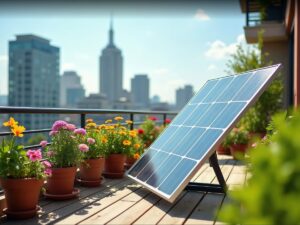
There are nearly 90,000 residential solar power plants in Ukraine operating under the “green” tariff, according to the National Commission for State Regulation of Energy and Public Utilities (NKREKP).
“As of May 25, universal service providers had signed 86,691 contracts with owners of residential solar power plants. This means that more than 86,000 Ukrainian families have become participants in the energy market—not only consuming electricity but also generating it,” the energy regulator’s website states.
According to NEURC estimates, during the first five months of 2026, private households in Ukraine generated 544.8 million kWh of electricity from renewable sources, which was fed into the power grid under the “green” tariff mechanism.
“In January–May 2026, more than 3.28 billion UAH was paid for electricity generated by private households,” the NEURC noted.
The largest number of residential solar power plants operate in the Kyiv, Dnipropetrovsk, Zakarpattia, Ivano-Frankivsk, Ternopil, Chernivtsi, Lviv, Odesa, Kirovohrad, and Khmelnytskyi regions.
According to the energy regulator, under martial law, residential generation takes on particular importance, as it helps increase the flexibility of the power system, maintain the reliability of electricity supply, and strengthen the energy resilience of communities.
“The NEURC provides the regulatory framework for the operation of the ‘green’ tariff mechanism and residential power generation. Thanks to the established rules, owners of solar power plants can connect their installations to the power grid and sell surplus electricity,” the commission emphasized.
The regulator noted that the European energy model envisions an active role for the “prosumer”—a market participant who both consumes and generates electricity. As it pointed out, Ukraine is gradually implementing such approaches, creating a more decentralized and resilient power system.
The NEURC did not specify the total capacity of residential solar power plants for security reasons, but market participants estimate it could be up to 2 GW. Before the war, the number of residential solar power plants was reported to be 40,000–45,000, with a combined capacity of up to 1 GW.
According to expert estimates published in open sources, Ukraine consumes approximately 60–65 billion kWh over a six-month period. Based on these figures, the electricity generated by residential solar power plants in January–May accounted for slightly more than 1% of consumption. It should be noted that grid-connected solar power plants without storage systems do not operate during power outages, which significantly affects their efficiency. At the same time, electricity stored in the battery is not accounted for by the grid.
ELECTRICITY, green tariff, HOUSEHOLD, NEURC, SOLAR POWER PLANT
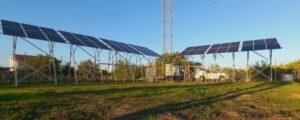
VF Ukraine (Vodafone Ukraine, VFU), Ukraine’s second-largest mobile operator, has completed the first phase of its project to deploy its own power generation capacity and has equipped 100 base stations with small solar power plants (SPPs) across 14 regions.
According to a press release from the mobile operator published on Friday, the projected savings in electricity drawn from the grid will amount to approximately 380 MWh per year, or nearly 30% of the consumption of the 100 base stations.
“This is roughly equivalent to the annual consumption of 150 average Ukrainian households,” the company noted.
Taking tariff trends into account, the financial savings are expected to exceed 100,000 euros per year. In addition, CO₂ emissions will be reduced by approximately 210 metric tons per year.
It is noted that the first phase began in the fall of 2025, and the company is now proceeding with the implementation of the second phase.
As previously reported, in May, Ukraine’s largest mobile operator, Kyivstar, announced the acquisition of six solar power plants with a combined installed capacity of 105 MW in the Lviv region for 3.6 billion hryvnia, or $80.8 million.
In the first quarter of this year, VFU increased its net profit by 12% compared to the same period last year—to 778 млн грн—while its revenue grew by 11%—to 7.3 млрд грн.
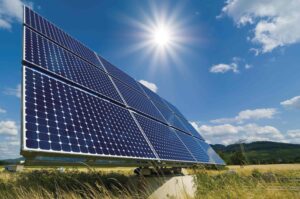
The unaudited EBITDA of six solar power plants (SPPs) with a total installed capacity of 105 MW in the Lviv region, which Ukraine’s largest mobile operator Kyivstar acquired for 3.6 billion UAH (or $80.8 million), amounted to UAH 596 million in 2025.
According to Kyivstar’s presentation on the acquisition, the revenue of these six SPPs, commissioned between 2017 and 2025, totaled UAH 682 million last year.
The operator noted that this investment, calculated at $0.77 million per 1 MW, aligns with one of its four priorities—capital investment in real assets that mitigate inflationary and/or currency risk.
“Renewable energy is one of the key areas of Kyivstar’s investment portfolio, as it opens up opportunities for the further use of ‘green’ electricity to cover part of the company’s energy needs,” Kyivstar CEO and President Oleksandr Komarov is quoted as saying in the press release.
The three other priorities listed are investments in infrastructure reconstruction and preventive network protection, the development of a digital ecosystem through adjacent acquisitions, and increasing the market share of fixed broadband through targeted acquisitions.
Taking into account the initial purchase last December of the 13-MW “Sunwin 11” solar power plant for $3 million in the Zhytomyr region, Kyivstar’s total “green” generation capacity has grown to 118 MW, which enables the production of electricity equivalent to approximately 30% of the company’s current annual consumption, according to the press release.
“Electricity from the acquired solar power plant group will be fed into Ukraine’s unified power grid in accordance with current market and regulatory rules, which will allow Kyivstar to partially hedge risks associated with fluctuations in electricity prices,” Kyivstar explained.
The mobile operator noted that these “green” projects also enable it to build a long-term energy consumption model, strengthen the country’s energy sector, and align with sustainable development goals.
Kyivstar’s stock price rose by 2.18% on May 26, the day the purchase of six solar power plants was announced, reaching $14.51 per share.
As reported, in March of this year, Kyivstar received approval from the Antimonopoly Committee of Ukraine (AMCU) to purchase six solar power plants in the Lviv region: Energo-Postach-Plus LLC, Lightful, Sunlight Generation, Ternovytsia Solar, Energy Space, and Ternovytsia Solar Plus.
In the first quarter of 2026, Kyivstar increased its EBITDA by 28.5% to UAH 7.5 billion, while revenue grew by 31.3% to UAH 13.9 billion.
In 2025, the Kyivstar Group increased its EBITDA by 30% to UAH 27 billion, with revenue growing by 30.3% to UAH 48.2 billion. In particular, in the fourth quarter of last year, EBITDA increased by 23.1% to UAH 7.2 billion, with revenue growing by 30.1% to UAH 13.5 billion.
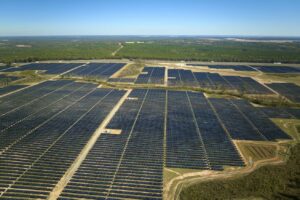
Kyivstar, Ukraine’s largest mobile operator, announced the acquisition of six solar power plants (SPPs) with a total installed capacity of 105 MW in Lviv Oblast for 3.6 billion UAH, or $80.8 million, according to a company statement on Tuesday.
“Renewable energy is one of the key areas of Kyivstar’s investment portfolio, as it opens up opportunities for the further use of ‘green’ electricity to cover part of the company’s energy needs,” Kyivstar CEO and President Oleksandr Komarov is quoted as saying in the release.
Taking into account the initial purchase last December of the 13-MW “Sunwin 11” solar power plant for $3 million in the Zhytomyr region, Kyivstar’s total “green” generation capacity has grown to 118 MW, enabling the company to generate electricity equivalent to approximately 30% of its current annual consumption, the press release states.
“Electricity from the acquired solar power plant group will be fed into Ukraine’s unified power grid in accordance with current market and regulatory rules, which will allow Kyivstar to partially hedge against risks associated with fluctuations in electricity prices,” Kyivstar explained.
The mobile operator noted that these “green” projects also enable it to build a long-term energy consumption model, strengthen the country’s energy sector, and align with sustainable development goals.
“Kyivstar will continue to invest in initiatives that combine technological efficiency, compliance with ESG principles, and support for the Ukrainian economy,” the company noted.
As reported, in March of this year, Kyivstar received approval from the AMCU to purchase six solar power plants in the Lviv region: Energo-Postach-Plus LLC, Lightful, Sunlight Generation, Ternovytsia Solar, Energy Space, and Ternovytsia Solar Plus.
In the first quarter of 2026, Kyivstar increased its EBITDA by 28.5% to UAH 7.5 billion, while revenue grew by 31.3% to UAH 13.9 billion.
In 2025, the Kyivstar Group increased its EBITDA by 30% to UAH 27 billion, with revenue growing by 30.3% to UAH 48.2 billion. In particular, in the fourth quarter of last year, EBITDA increased by 23.1% to UAH 7.2 billion, with revenue growing by 30.1% to UAH 13.5 billion.



