
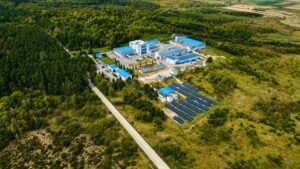
The Ukrainian group of companies Kormotech, a manufacturer of dog and cat food, continues to expand its on-site solar power generation at its production facility in Prylbychi, Lviv Region. The commissioning of a 366-kW ground-mounted solar power plant is scheduled for May, according to the company’s press service.
“The experience of leading European manufacturers confirms that on-site solar power generation at industrial facilities is becoming the industry standard. Kormotech is moving purposefully in this direction; our strategic goal by 2028 is to cover at least 15% of our electricity consumption through our own generation,” said Chief Power Engineer Yuriy Komprychevsky.
As previously reported, on July 2, 2024, Kormotech commissioned a 383 kW rooftop solar power plant. On June 6, 2025, the plant was modernized, after which its capacity increased to 442 kW. This made it possible to increase the volume of green electricity production.
At the same time, Kormotech’s energy team was seeking an external investor to build a ground-mounted solar power plant. Since May of last year, the company’s specialists have reviewed proposals from five companies. Following negotiations, Kormotech signed an agreement with Ecotech Invest. Under this model, the investor fully finances the construction of the plant, and the company purchases the generated electricity at a pre-agreed rate.
As of now, the company is completing the construction of a 366 kW ground-mounted solar power plant; after its launch, the total solar generation capacity at the Prilbychi facility will reach 808 kW.
According to Komprichevsky, on sunny summer days during lunchtime, the power plants will be able to cover up to 50% of the plant’s instantaneous consumption. On a monthly basis, the share of self-generated green electricity will account for about 13% of total consumption, and on an annual basis, about 8%.
Kormotech is an international family-owned company with Ukrainian roots, founded in 2003. It produces cat and dog food under the Optimeal, Club 4 Paws, Delickcious, Meow!, Woof!, and My Love brands. It has production facilities in Ukraine and the EU, and its product range includes over 650 items. The company’s products are available in 55 countries worldwide, both under its own brands and under the brands of partner companies.
According to published information, the company’s strategic goal is to become one of the top 30 global pet food manufacturers by 2029, with annual revenue of EUR 500 million, of which EUR 300 million is planned to come from European markets.
For the first time since the start of the full-scale war, the European Bank for Reconstruction and Development (EBRD) has provided the Kernel agricultural holding with $45 million in financing for a renewable energy project. The decision was approved by the bank’s Board of Directors and signed during the Ukraine-EU Business Summit in Brussels.
According to a statement from Kernel’s Communications, PR, and GR Department, the total cost of the project is estimated at $86 million. In addition to the EBRD, negotiations are ongoing with other international lenders, and Kernel will finance the remaining investment. The European Union will provide partial coverage of the first-loss risk under the Investment Facility for Ukraine (UIF).
The project involves the construction of a 106 MW solar power plant (SPP) in southern Ukraine and the installation of energy storage systems. The facility is expected to generate approximately 141 GWh of electricity from renewable sources annually and reduce carbon dioxide emissions by 82,500 tons. Once the transmission line is completed, the plant will be integrated into Ukraine’s Unified Energy System (UES) and will supply “green” electricity to the domestic market.
“The development of ‘green’ energy is one of Kernel’s key investment priorities. Today, Ukraine is acutely feeling a shortage of power generation, as large facilities remain vulnerable to attacks. Our response to these challenges is the development of distributed generation, particularly solar and wind power, as well as the implementation of energy storage systems. Connecting new capacity to the power grid is Kernel’s contribution to the stability and energy security of the entire country,” said Kernel CEO Yevgen Osipov.
Overall, Kernel’s strategy involves building a portfolio of green energy projects with a total capacity of up to 600 MW. The expected investment in this area is approximately $400 million.
The Ukraine Investment Framework (UIF) is an investment mechanism under the EU’s €50 billion Ukraine Facility program, aimed at rebuilding and modernizing Ukraine’s economy. Under the UIF, EBRD financing is backed by EU guarantees through the HI-BAR program, which reduces risks for investors and helps attract funding for renewable energy and climate technology projects.
Kernel Agri-Holding is the world’s largest producer and exporter of sunflower oil, Ukraine’s largest grain exporter, an operator of an extensive network of logistics assets, and a leading producer of grains and oilseeds in Ukraine. It is one of the largest producers and sellers of bottled oil in Ukraine. It is engaged in the cultivation and sale of agricultural products.
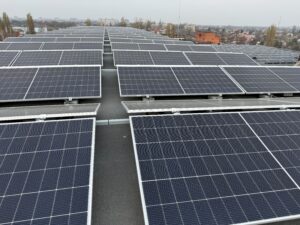
One of the largest steel mills in the Dnipropetrovsk region has completed a comprehensive energy independence project. The plant has commissioned the largest rooftop solar power plant for an enterprise in Ukraine, with a capacity of 4 MW, integrated with an industrial energy storage system (BESS) with a capacity of 4.2 MWh. The project, implemented by Rayton, will allow the plant to save approximately $1.5 million annually.
As of April 1, 2026, the full cost of electricity for industry (voltage class 2) in the region is 9–10 UAH/kWh, and during peak evening hours on the day-ahead market (DAM) it reaches 12–15 UAH/kWh. With the plant’s monthly consumption of 400–500 MWh, electricity bills amounted to 4–5 million UAH. Additionally, sudden power outages threatened to shut down the electric arc furnaces, which meant tens of thousands of hryvnias in direct losses every hour and the risk of damaging expensive equipment.
“For modern industry, especially an energy-intensive sector like metallurgy, on-site power generation and industrial batteries are no longer just an environmental trend but a basic requirement for survival and competitiveness,” commented Olga Lesko, director and co-founder of Rayton. “This complex in Dnipro has become one of the largest hybrid projects for industry in Ukraine and the largest existing rooftop station in Ukraine for self-consumption on a ballast mounting system. “We have created a system that not only generates kilowatts but also intelligently manages the consumption of the entire plant, protecting it from blackouts and price shocks in the electricity market.”
How the plant’s smart energy system works
The solar power plant complex (4,027 kW) and the storage system (4,180 kWh) operate as a single unit, addressing three key tasks:
Economic impact: payback in 3 years
The total investment in the modern energy complex amounted to approximately $3.9 million, of which $3 million was allocated to the construction of a solar power plant (SPP), and another $900,000 to the integration of energy storage systems (ESS).
The projected annual generation of the SPP is 4 million kWh, which, at an average tariff of 8 UAH, will generate approximately 32 million UAH (over $727,000) in annual revenue, returning at least one-third of the invested funds annually. Although storage systems slightly increase the cost of a “solar” kilowatt-hour, their use allows for maximum efficiency and generates $1.5 million annually (total savings from the solar power plant and ESS combined — ed.).
“The economic model of the solar power plant shows a payback period of less than three years, which is an unprecedented figure demonstrating the extremely high profitability of such solutions,” adds Olga Lesko. “Over the projected 30-year operational life, the solar power plant and the industrial system will generate over 1.9 billion UAH in net profit for the plant.”
Company Profile:
Rayton is a company committed to making solar energy accessible to everyone. We offer industrial enterprises turnkey solutions based on solar power plants and industrial energy storage systems.
The company has implemented over 300 projects with a total capacity of more than 100 MW of solar generation and over 40 MWh of energy storage systems (BESS). The project in the Dnipropetrovsk region ranks among the company’s top three largest completed projects.
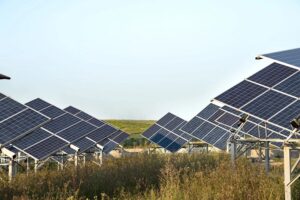
According to Serbian Economist, the municipality of Knyazhevats has begun the process of preparing a detailed regulation plan for the construction of the Knyazhevats solar power plant in the community, as follows from the decision to develop planning documentation.
The deadline for preparing the plan is set at 12 months. The municipal administration (urban planning and construction) has been designated as the project manager, Projektura d.o.o. (Belgrade) as the developer, and Central Europe Energy Company d.o.o. (Belgrade) as the initiator, which is also financing the preparation of the documentation.
The project involves the construction of Serbia’s largest solar park in Tresibabi with a capacity of 170 MW, with investments estimated at approximately €200 million.
Approximately 270 hectares of low-quality state-owned land have been leased for the project, with a lease rate of €1,050 per hectare per year, of which 40% goes to the community budget and 60% to the republican budget.
Central Europe Energy Company is registered in Belgrade, with Qin Zhang listed as the responsible person, according to CompanyWall data.
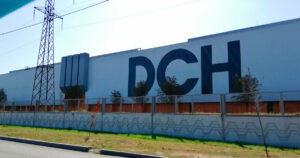
PJSC Dnipro Metallurgical Plant (DMZ), part of businessman Oleksandr Yaroslavsky’s DCH Steel group, has completed its transition to continuous casting, DCH Steel CEO Vitaliy Bash announced in the corporate newspaper on Thursday.
“DMZ has implemented solutions to maintain competitiveness in difficult economic conditions. The transition of rolling production to continuously cast billets, which we purchase from partners, has been completed, allowing us to reduce the cost of metal production. DMZ has expanded its scope of activities by providing laboratory research, repair, and manufacturing services for metal structures and equipment parts, which is already yielding certain economic results,” the CEO noted.
According to him, in 2025, the Sukha Balka mine continued to develop new horizons and updated its equipment fleet to improve safety and production efficiency. An important step was the construction of a solar power plant, which ensured the energy independence of the Frunze mine.
At the same time, he pointed to negative trends in the market, in particular the increase in imports of metal products to Ukraine and the growth of tariffs for state monopolies.
“Together with other metallurgical companies and industry associations, we are systematically working to solve these problems at the state level. Despite all the challenges facing the industry and the country as a whole today, our teams continue to work, plan, and build the future,” said the CEO of DCH Steel.
DMZ specializes in the production of steel, cast iron, rolled products, and products made from them, such as channels and angles, special profiles for mechanical engineering and the mining industry.
On March 1, 2018, the DCH Group signed an agreement to purchase the Dniprovsky Metallurgical Plant.
The Sukha Balka mine is one of the leading enterprises in the mining industry in Ukraine. It extracts iron ore using underground methods. The mine includes the Yuvileina and Frunze mines.
The DCH Group acquired the mine from the Evraz Group in May 2017.
DCH, metallurgical plant, Mine, SOLAR POWER PLANT, TECHNOLOGY
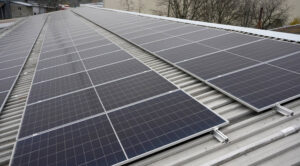
Argon Food, a company specializing in the production of bakery products and the storage and transportation of other food products, has installed a solar power plant with a peak capacity of 114 kW, according to Andriy Ocheretny, deputy mayor of Vinnytsia, on Facebook.
“A solar power plant with a peak capacity of 114 kW was installed on the roof of the enterprise. The station was put into operation at the end of May, and since then, thanks to its operation, the enterprise has covered almost all of its electricity needs,” he wrote on Facebook.
According to Ocheretny, the company has become one of the applicants for participation in the Procedure for partial compensation of expenses for the purchase of equipment used for the production of electricity from renewable energy sources within the city program.
“In the context of blackouts, the transition to ”green” energy is the path to energy independence. This strategic decision helps businesses reduce production costs, retain staff, and create new jobs, while contributing to the sustainable development of the community,” concluded the deputy mayor of Vinnytsia.



