
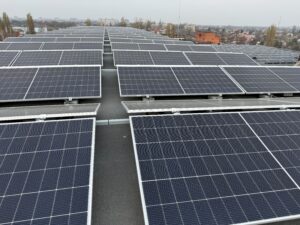
One of the largest steel mills in the Dnipropetrovsk region has completed a comprehensive energy independence project. The plant has commissioned the largest rooftop solar power plant for an enterprise in Ukraine, with a capacity of 4 MW, integrated with an industrial energy storage system (BESS) with a capacity of 4.2 MWh. The project, implemented by Rayton, will allow the plant to save approximately $1.5 million annually.
As of April 1, 2026, the full cost of electricity for industry (voltage class 2) in the region is 9–10 UAH/kWh, and during peak evening hours on the day-ahead market (DAM) it reaches 12–15 UAH/kWh. With the plant’s monthly consumption of 400–500 MWh, electricity bills amounted to 4–5 million UAH. Additionally, sudden power outages threatened to shut down the electric arc furnaces, which meant tens of thousands of hryvnias in direct losses every hour and the risk of damaging expensive equipment.
“For modern industry, especially an energy-intensive sector like metallurgy, on-site power generation and industrial batteries are no longer just an environmental trend but a basic requirement for survival and competitiveness,” commented Olga Lesko, director and co-founder of Rayton. “This complex in Dnipro has become one of the largest hybrid projects for industry in Ukraine and the largest existing rooftop station in Ukraine for self-consumption on a ballast mounting system. “We have created a system that not only generates kilowatts but also intelligently manages the consumption of the entire plant, protecting it from blackouts and price shocks in the electricity market.”
How the plant’s smart energy system works
The solar power plant complex (4,027 kW) and the storage system (4,180 kWh) operate as a single unit, addressing three key tasks:
Economic impact: payback in 3 years
The total investment in the modern energy complex amounted to approximately $3.9 million, of which $3 million was allocated to the construction of a solar power plant (SPP), and another $900,000 to the integration of energy storage systems (ESS).
The projected annual generation of the SPP is 4 million kWh, which, at an average tariff of 8 UAH, will generate approximately 32 million UAH (over $727,000) in annual revenue, returning at least one-third of the invested funds annually. Although storage systems slightly increase the cost of a “solar” kilowatt-hour, their use allows for maximum efficiency and generates $1.5 million annually (total savings from the solar power plant and ESS combined — ed.).
“The economic model of the solar power plant shows a payback period of less than three years, which is an unprecedented figure demonstrating the extremely high profitability of such solutions,” adds Olga Lesko. “Over the projected 30-year operational life, the solar power plant and the industrial system will generate over 1.9 billion UAH in net profit for the plant.”
Company Profile:
Rayton is a company committed to making solar energy accessible to everyone. We offer industrial enterprises turnkey solutions based on solar power plants and industrial energy storage systems.
The company has implemented over 300 projects with a total capacity of more than 100 MW of solar generation and over 40 MWh of energy storage systems (BESS). The project in the Dnipropetrovsk region ranks among the company’s top three largest completed projects.

In January of this year, ferrous metal scrap trading companies reduced their procurement of ferrous metal scrap by 18.5% to 97,100 tons from 149,000 tons.
According to data from the Ukrainian Association of Secondary Metals (UAVtormet), scrap collectors reduced their supplies of scrap to Ukrainian metallurgical plants by 26.7% compared to the same period last year, to 92.5 thousand tons from 126.2 thousand tons. At the same time, steel production during the same period decreased by 16.4% to 511 thousand tons from 611 thousand tons.
According to UAVtormet estimates, in the first month of the scrap export ban, more than 20-25% of companies in the industry partially suspended their operations, and another 12-15% completely stopped their activities. Experts predict that by April-May of this year, about 4-4.5 thousand workers in the scrap collection industry will lose their jobs.
As reported, according to data from the State Customs Service, Ukrainian scrap collection companies increased their exports of ferrous metal scrap by 45.3% in 2025 compared to the previous year, to 448,700 tons, and in monetary terms by 44.5%, to $131.9 million. In 2024, exports of these products increased by 60.7% in physical terms and by 73.2% in monetary terms.
Due to such a sharp increase in exports, the Cabinet of Ministers introduced a zero quota for exports of these products for 2026, whereas previously there was an export duty of EUR 180/ton, which, at the same time, was not paid when exporting to the EU, with which Ukraine has a free trade zone.
According to customs data, in January this year, Ukraine reduced exports of ferrous metal scrap by 40.7% compared to January last year, to 9.3 thousand tons, and compared to the December 2025 figure of 68.5 thousand tons, the decline was sevenfold. In monetary terms, scrap exports in January decreased by 38% compared to January 2025, to $2.73 million.
PJSC Dnipro Metallurgical Plant (DMZ), part of businessman Oleksandr Yaroslavsky’s DCH Steel group, has completed its transition to continuous casting, DCH Steel CEO Vitaliy Bash announced in the corporate newspaper on Thursday.
“DMZ has implemented solutions to maintain competitiveness in difficult economic conditions. The transition of rolling production to continuously cast billets, which we purchase from partners, has been completed, allowing us to reduce the cost of metal production. DMZ has expanded its scope of activities by providing laboratory research, repair, and manufacturing services for metal structures and equipment parts, which is already yielding certain economic results,” the CEO noted.
According to him, in 2025, the Sukha Balka mine continued to develop new horizons and updated its equipment fleet to improve safety and production efficiency. An important step was the construction of a solar power plant, which ensured the energy independence of the Frunze mine.
At the same time, he pointed to negative trends in the market, in particular the increase in imports of metal products to Ukraine and the growth of tariffs for state monopolies.
“Together with other metallurgical companies and industry associations, we are systematically working to solve these problems at the state level. Despite all the challenges facing the industry and the country as a whole today, our teams continue to work, plan, and build the future,” said the CEO of DCH Steel.
DMZ specializes in the production of steel, cast iron, rolled products, and products made from them, such as channels and angles, special profiles for mechanical engineering and the mining industry.
On March 1, 2018, the DCH Group signed an agreement to purchase the Dniprovsky Metallurgical Plant.
The Sukha Balka mine is one of the leading enterprises in the mining industry in Ukraine. It extracts iron ore using underground methods. The mine includes the Yuvileina and Frunze mines.
The DCH Group acquired the mine from the Evraz Group in May 2017.
DCH, metallurgical plant, Mine, SOLAR POWER PLANT, TECHNOLOGY



