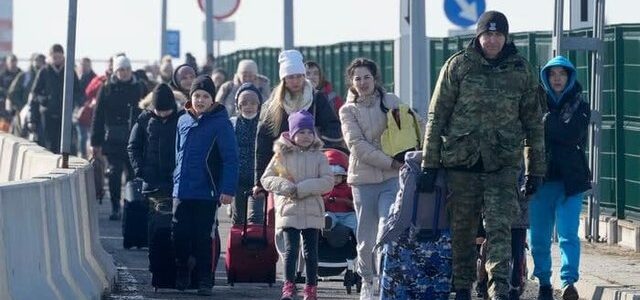
Passenger traffic across Ukraine’s western border during the week of November 7–13, following the end of the fall school break, fell by another 12.3%—to 455,000.
According to daily statistics from the State Border Guard Service, as tracked by the Interfax-Ukraine news agency, while the number of outbound border crossings decreased by 6.9%—to 229,000—the number of inbound crossings fell by 17.2%—to 226,000.
The number of vehicles passing through border checkpoints also decreased to 122,000 from 128,000, while the number of vehicles carrying humanitarian cargo increased to 495 from 419.
The heaviest outbound traffic was recorded on Saturday (36,000 per day), and the heaviest inbound traffic on Sunday (38,000), while the lightest outbound traffic was on Monday and Tuesday (30,000 each day), and the lightest inbound traffic on Thursday (27,000).
According to the State Border Guard Service, as of 12:00 p.m. on Saturday, the lines of vehicles at the border for outbound travel were minimal. The largest number of passenger cars—30—were waiting to cross the border with Poland at the “Ustyluh” border crossing point (BCP). At the “Shehyni” checkpoint, 15 cars were waiting in line, and at the “Krakivets” and “Rava-Ruska” checkpoints, 10 cars each.
At the border with Slovakia, there was a line of 10 cars at the “Uzhhorod” checkpoint.
At the border with Hungary, 15 vehicles were waiting to cross at the “Tisa” checkpoint and another 10 at the “Vylok” checkpoint, while at the borders with Moldova and Romania, according to the State Border Guard Service, there were no lines.
Last year, passenger traffic across the border during this week fell, but not as significantly—by 8.7%—so it was higher at 474,000, with outbound and inbound flows also being nearly equal.
Last year, passenger traffic remained at roughly this level for about a month before the traditional surge ahead of Christmas and New Year’s.
As reported, starting May 10, 2022, the outflow of refugees from Ukraine—which began with the start of the war—gave way to an inflow that lasted until September 23, 2022, totaling 409,000 people. However, since late September—possibly influenced by news of mobilization in Russia and “pseudo-referendums” in the occupied territories, followed by massive shelling of energy infrastructure—the number of people leaving has exceeded the number of those entering. In total, from the end of September 2022 until the first anniversary of the full-scale war, this figure reached 223,000 people.
In the second year of the full-scale war, the number of border crossings out of Ukraine, according to the State Border Guard Service, exceeded the number of crossings into the country by 25,000; in the third year, by 187,000; in the fourth, by 221,000; and since the beginning of the fifth year, by 88,000.
In its July inflation report, the National Bank maintained its estimate of 0.3 million people migrating from Ukraine last year due to the deterioration of the security situation at the end of the year and the easing of exit rules for young people, but noted that this figure will be less than 0.5 million in 2024. The NBU continues to forecast a net outflow of 0.2 million in 2026, while net returns, according to its forecast, will begin in 2027 and amount to about 0.1 million people, increasing to 0.5 million people in 2028.
According to UNHCR data, the number of Ukrainian refugees in Europe as of June 30, 2026, stood at 5.159 million, and globally at 5.687 million, compared to 5.213 million and 5.687 million, respectively, as of April 30.
In Ukraine itself, according to the latest UN data for July 2026, there were 3.80 million internally displaced persons (IDPs), compared to 3.70 million in January of this year and 3.34 million in July 2025.
BORDER, MIGRATION, PASSENGER TRAFFIC, State Border Guard Service of Ukraine, UKRAINE