

The Ukrainian Embassy in the Republic of Poland reminded that the Special Law on Assistance to Ukrainian Citizens of March 12, 2022, will cease to be in force on March 5.
“All key mechanisms of temporary protection have been transferred to systemic laws, primarily to the Act of June 13, 2003, on granting protection to foreigners on the territory of the Republic of Poland. The stay of a beneficiary of temporary protection is recognized as legal until March 4, 2027,” the embassy said in a statement on its Facebook page.
It is noted that for this period, the stay is recognized as legal if the person: entered Poland after February 24, 2022, as a result of armed conflict; received a PESEL number with UKR status; does not have temporary protection provided by another EU member state.
The embassy added that for persons who already had a PESEL number with UKR status at the time of the entry into force of the law of January 23, 2026, this status remains valid.
“UKR status is now regulated by the Population Registration Act (Ustawa o ewidencji ludnosći). An application for a PESEL number with UKR status must be submitted in person to any commune authority within 30 days of arrival. A photograph and fingerprints must be attached to the application… Until August 31, 2026, persons who have been granted UKR status on the basis of an application are required to confirm their identity with a foreign passport (if a passport was provided). If this requirement is not met, the status will be changed to NUE (which does not grant the right to legal residence or any social assistance from the state),” the diplomatic mission warned.
It is reported that persons with temporary protection now have access to medical care on terms similar to those of Polish citizens. Full access to medical services is provided if you have medical insurance and pay contributions to ZUS. People without insurance are entitled to free assistance only in cases of immediate threat to life and health, during pregnancy and the postpartum period, and until the age of 18.
Changes will be made to the provision of accommodation in collective accommodation centers.
“The Minister of Internal Affairs may provide accommodation and meals (in a collective accommodation center or financial assistance) according to the following rules: a maximum of 60 days from the date of first entry into Poland (for new arrivals); in total, no more than 12 months during the entire period of temporary protection. This limit is cumulative (total) — all time spent in the centers since 2022 is taken into account,” the statement said.
For vulnerable groups, collective housing with meals is provided by the Minister of Social Welfare. Vulnerable groups include: persons with disabilities (moderate/severe disability, as well as their caregivers); persons aged 60+ (women)/65+ (men) without a Polish pension, who are not working and do not have adult children receiving alimony; pregnant women or mothers with children under 12 months of age; persons from abroad who are under the care of institutions/families; persons who have just been discharged from hospital after hospitalization lasting at least 7 days and paid for by the NFZ.
It is reported that a special transition period is in effect until June 30, 2026: the voivode may allow everyone who already lives there to remain in the center (even if the 12-month limit has long been exceeded). This period has been introduced to give people time to finish the school year and find permanent housing. After June 30, 2026, persons who do not belong to vulnerable groups will lose their right to free accommodation in collective accommodation centers.
“Educational assistance 800+ and other family benefits are provided under the general conditions applicable to foreigners — that is, provided that the guardian is professionally active and the child fulfills their school obligations. The authority to supervise and control the expenditure of assistance for children from the foreign care system is entirely vested in the county authorities. In case of violation of the conditions, payments may be suspended,” the embassy informs.
Temporary protection is not granted and/or is terminated if the person: has a permanent residence permit, long-term EU resident status, temporary residence permit, refugee status, etc. (applies to all EU countries); has applied for international protection; has been granted temporary protection in another EU country; is a citizen of an EU member state; has provided false information or forged documents; has entered under the local border traffic regime.
Temporary protection is also terminated in the event of departure from Poland for a period exceeding 30 days, written refusal of protection, or acquisition of another legal status.
Temporary protection is valid until March 4, 2027. Further decisions on the extension or change of the legal stay of Ukrainian citizens in Poland are within the competence of the Government of the Republic of Poland.
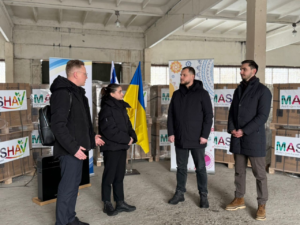
On February 25, the Embassy of the State of Israel in Ukraine, together with the Israeli Agency for International Development Cooperation (MASHAV), handed over more than 100 backup power supply and energy independence systems to the Kyiv Regional State Administration.
According to the embassy’s press service, the handover ceremony was attended by the head of the Kyiv Regional Military Administration, Mykola Kalashnyk, and the deputy head of the mission of the Embassy of the State of Israel in Ukraine, Mila Tsur.
“Hospitals must operate continuously. Schools and shelters must remain safe. Families must be able to stay in touch. Electricity is the foundation that allows communities to survive and recover,” Tsur emphasized.
Kalashnik thanked Israel for its support and assistance, noting that the portable power systems provided will help ensure the continuous operation of social institutions and support the residents of the Kyiv region in the event of power outages.
According to the embassy, Israeli Foreign Minister Gideon Saar had a phone chat with Ukrainian Foreign Minister Andriy Sybiga about giving humanitarian aid to the Kyiv region because of the tough energy situation.
The statement also notes that on February 24, the UN General Assembly adopted a resolution entitled “Supporting sustainable peace in Ukraine,” initiated by Ukraine within the framework of the 11th Emergency Special Session of the UN General Assembly, and the State of Israel, among 107 other countries, voted in support of Ukraine.

The Director General of the Ukrainian Red Cross (URC), Maksym Dotsenko, and the Minister of Foreign Affairs of Ukraine, Andriy Sibiga, discussed assistance to communities and children.
“During the meeting, the parties focused on the practical results of humanitarian initiatives that have already been implemented and on further expanding cooperation in the context of full-scale Russian aggression against Ukraine,” the UCC reported on its official Facebook page.
Among the key topics of discussion were the health and recreation of Ukrainian children abroad. This primarily concerns the children of military personnel, deceased and missing defenders, as well as children from frontline regions.
With the assistance of the Ukrainian Red Cross, more than 700 children were able to recover and relax outside Ukraine last year. The first trips for children took place in early 2026, and the program continues to expand. In the near future, it is planned to organize recreation for children from regions subject to constant shelling, in particular the Sumy and Chernihiv regions.
During the meeting, the parties also discussed support for the energy sustainability of communities and assistance to the population during the winter period.
A separate vector of dialogue was the prospects for the development of humanitarian cooperation outside Ukraine.

The Office of the United Nations High Commissioner for Refugees (UNHCR) has estimated the financial needs for assisting Ukrainian refugees in 2026 at $614 million, which is 23.6% less than the plan for 2025 ($803.6 million), according to a publication on the office’s website.
“In 2025, the intensification of hostilities, including increased air attacks and strikes on critical infrastructure, led to significant civilian casualties and new displacements – trends that will continue to shape needs both inside and outside Ukraine in 2026,” the UNHCR states, emphasizing the severity of the problem four years after the start of Russia’s full-scale invasion of Ukraine.
At the same time, according to the publication, last year the level of funding for the Ukrainian refugee assistance plan fell to 43.7% or $351.1 million, compared to 64% or $635.7 million in 2024. This is significantly less than 84% or $924 million in 2023 and 91.7% or $1.1 billion in the first year of Russia’s full-scale aggression.
According to the UN Human Rights Monitoring Mission report for December 2025, last year was the deadliest for civilians in Ukraine since 2022: 2,514 civilians were killed and 12,142 were injured as a result of war-related violence, which is 31% more than in 2024. By the end of 2025, there were 5.86 million refugees from Ukraine registered worldwide, of whom about 5.3 million were in Europe. Another 3.7 million people remained internally displaced in Ukraine, with 73% of them having been displaced for more than two years.
“According to the Humanitarian Needs and Response Plan (HNRP) for 2026, more than 10.8 million people in Ukraine will need humanitarian assistance and protection in 2026, with many people having been displaced multiple times and their vulnerability exacerbated by the ongoing war,” the document says.
It is estimated that by September 2025, more than 1.4 million refugees from Ukraine will have returned to their places of residence and remained in Ukraine for at least three months, including more than 0.3 million who did not return to their former homes.
“Changes on the front line continue to cause new displacements: from June to December 2025, more than 150,000 people were evacuated from frontline areas with the support of the government or humanitarian organizations, and even more people fled on their own,” the publication says.
It notes that an estimated 2.5 million displaced families in Ukraine still do not have access to adequate housing. At the same time, large-scale Russian strikes on energy infrastructure in the winter of 2025/26 left millions of people without reliable heating, water, and electricity in sub-zero temperatures.
“In refugee-hosting countries, some refugees continue to face barriers in accessing housing, decent work, health care, education, and social protection, while vulnerability continues to deepen over time as the full-scale war continues,” UNHCR adds.
According to the document, the plan for 2026 aims to help 2.1 million people in Ukraine and 482,000 Ukrainian refugees in other countries. Accordingly, the financial needs for assistance within Ukraine are estimated at $470 million, and outside Ukraine at $144 million, of which $64 million is in Moldova, $21.8 million in Romania, and $18.4 million in Poland.
The UNHCR specified that of these 2.1 million Ukrainians within the country, it wants to provide 955,000 with protection services, 652,000 with cash assistance, 325,000 with materials for housing repairs or settlement support, and another 178,000 with basic necessities.
According to the publication, in 2024, the UNHCR’s assistance plan in Ukraine was funded at 44% or $243 million, compared to 57% or $338.5 million in 2024. This led to a reduction in the number of services provided to 1.14 million as of November 2025, compared to 1.6 million for the same period in 2024.
As part of the 2025-2026 winter assistance, as of December 5, 176,000 people received cash support, which is 32% less than in 2024-2025, when 258,300 people received support.
It is noted that UNHCR works in Ukraine with 12 partners, 11 of which are local, and with 39 partners in 11 other countries, 33 of which are local.

The Metinvest mining and metallurgical group has extended its financial assistance program for newlyweds and employees who have had a child until 2026: UAH 5,000 (after tax) to employees who are getting married for the first time and UAH 8,000 (before tax) to employees who have had a child.
According to information released by the company on Thursday, this program has been in place for many years, but was temporarily suspended at the start of the full-scale war and then resumed in May 2024 when the economic situation allowed.
It is specified that since then, more than 900 Metinvest employees have already taken advantage of the financial support program: 593 received financial assistance after the birth of a child, and another 332 employees received assistance in connection with marriage. The total amount of payments for 2024-2025 exceeded UAH 8.4 million.
In 2026, the program will continue under the same conditions. If both newlyweds work at the company, both will receive the payment of their choice.
CEO Yuriy Ryzhenkov recently noted that the number of Metinvest employees has decreased from 113,000 to approximately 50,000 since the start of the war.
As reported, from January 1, 2026, the state payment for the birth of a child has increased to UAH 50,000, and assistance for caring for a child under one year of age has been introduced – UAH 7,000 per month, and for families raising a child with a disability – UAH 10,500.
According to the Ministry of Justice, the number of births in Ukraine in 2025 decreased by 7,900, or 4.5%, compared to 2024, to 168,780, while the number of marriages increased by 10.2%, or 15,380, to 165,590.
Metinvest is a vertically integrated group of mining and metallurgical enterprises. Its enterprises are located in Ukraine – in the Donetsk, Luhansk, Zaporizhzhia, and Dnipropetrovsk regions – as well as in European countries. The main shareholders of the holding are SCM Group (71.24%) and Smart Holding (23.76%). Metinvest Holding LLC is the managing company of the Metinvest Group.
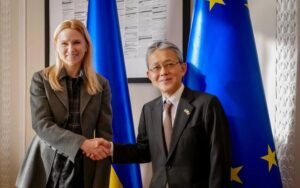
In 2026, Ukraine will receive $6 billion from the Japanese government for humanitarian and technical support, according to Deputy Speaker of the Verkhovna Rada Olena Kondratiuk.
“The Rada at our first official meeting with Japanese Ambassador to Ukraine Masashi Nakagome… Japan has already provided Ukraine with more than 2,500 electric generators of various capacities, more than 65 transformers and 10 electric generator sets, and other critical equipment to support and restore the power system,” she wrote on her Facebook page on Wednesday.
Kondratyuk also expressed gratitude for the allocation of approximately $149 million in the supplementary budget approved by the Japanese parliament at the end of 2025 for projects under the Emergency Recovery Program for Ukraine.
She noted that Japan’s total financial and humanitarian assistance has already exceeded $15 billion.
In addition, Japan is assisting with the rehabilitation of Ukrainian military personnel, has joined the International Coalition for the Return of Ukrainian Children, and has voted in favor of recent pro-Ukrainian resolutions at the UN. In particular, Japan co-authored and supported the resolution “Return of Ukrainian Children.”
“It is important that Japan, as a G7 country, is putting sanctions pressure on Russia and supporting the prosecution of the aggressor country. This includes through the mechanism of the Special International Tribunal. I am convinced that only joint sanctions by all G7 countries, including the US and Europe, can force Russia to engage in peace talks,” Kondratyuk added.
As for the meeting itself, the parties discussed interparliamentary cooperation and the situation with the announcement of early parliamentary elections in Japan, which are scheduled for February 8, 2026.
In turn, Ambassador Masashi Nakagome noted that the vast majority of Japan’s key political forces support Ukraine. According to him, Japan will continue to provide financial and humanitarian assistance to Ukraine.



