
Canada has the highest balance of positive and negative attitudes among Ukrainians—not only among the countries represented in the Americas and Australia, but also among all countries covered by the study: in August 2026, it stood at 73.8 percentage points. Australia scored 61.6 percentage points, the U.S. — 38.4 percentage points, and Brazil — 19.4 percentage points. These findings are based on the results of the third wave of the study “Ukrainians’ Attitudes Toward Countries Around the World,” conducted by Active Group in collaboration with Experts Club, according to the Experts Club Information and Analytical Center.
Canada is viewed positively by 76.3% of Ukrainians surveyed, negatively by only 2.5%, neutrally by 19.2%, and another 2% were undecided. As a result, the balance of positive and negative assessments stands at 73.8 percentage points—the highest value among Ukraine’s 50 largest trading partners included in the study.
Australia ranks second in this regional group: 63.8% of respondents expressed a positive attitude toward it, 32.1% were neutral, only 2.2% were negative, and another 2% were undecided. The balance of positive and negative assessments stands at 61.6 percentage points, which also indicates a predominantly positive perception of the country among the Ukrainian audience.
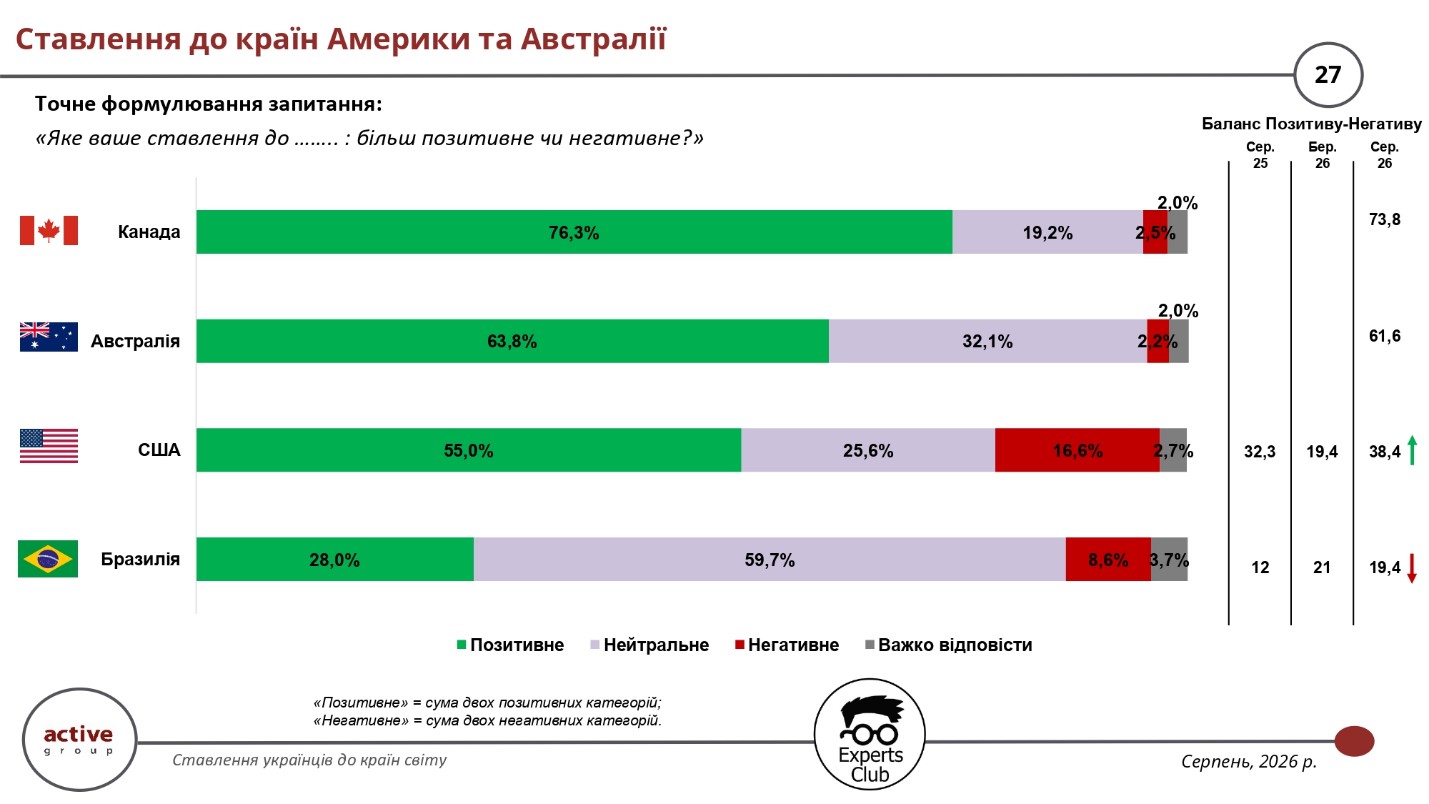
Fifty-five percent of respondents view the U.S. positively, 16.6% negatively, 25.6% neutrally, and another 2.7% were unable to answer. The balance stands at 38.4 percentage points. At the same time, this figure has improved significantly compared to the previous survey wave: in March 2026, the figure was 19.4 percentage points, while in August 2025, it was 32.3 percentage points. Thus, over the course of five months, the balance of attitudes toward the U.S. has increased by 19 percentage points.
Brazil is viewed much more neutrally. Twenty-eight percent of Ukrainians expressed a positive attitude, while 59.7% chose a neutral response, 8.6% expressed a negative attitude, and another 3.7% were undecided. The balance of positive and negative assessments stands at 19.4 percentage points, compared to 21 percentage points in March 2026 and 12 percentage points in August 2025.
Thus, the data reveal significant differences within the group: Canada and Australia are characterized by a high level of established positive attitudes; in the U.S., positive assessments also predominate and have increased noticeably compared to March, while a neutral stance dominates regarding Brazil. Overall, Canada tops the entire ranking of the surveyed countries with a balance of +73.8 percentage points
Maksym Urakin, founder of the Experts Club Information and Analytical Center, deputy director of the Interfax-Ukraine news agency, and candidate of economic sciences, emphasized the need for systematic communication between foreign countries and Ukrainian society.
The survey was conducted in August 2026 using self-administered online questionnaires in the SunFlowerSociology panel among 800 Ukrainian citizens aged 18 and older. According to the organizers, the sample is representative in terms of age, gender, and region; the maximum theoretical statistical margin of error for indicators at the 50% confidence level is ±3.5 percentage points. This is the third wave of the study, following surveys conducted in August 2025 and March 2026.
ACTIVE GROUP, AMERICA, AUSTRALIA, BRAZIL, CANADA, EXPERTS CLUB, PUBLIC OPINION, SOCIOLOGY, the U.S., UKRAINE, URAKIN
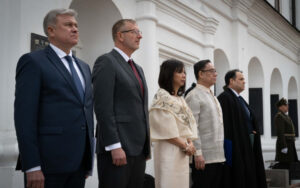
Ukrainian President Volodymyr Zelenskyy presided over a ceremony to receive the credentials of new diplomatic representatives from foreign countries and discussed issues of international security and support for Ukraine.
The newly appointed ambassadors who presented their credentials to Zelenskyy are Ahmed Ouail of Algeria, Alan Deniega of the Philippines, Jeff Bowan of Australia, and Victor Kirile of Moldova. The President congratulated them on the start of their diplomatic missions and thanked them for supporting Ukraine’s independence.
During the meeting, they discussed Russia’s war against Ukraine, the protection of citizens, as well as the situation in the Middle East and the Gulf region. According to Zelenskyy, partners emphasize the importance of Ukraine’s security mission and cooperation with countries currently under attack by the Iranian regime.
“Our goal is absolutely clear: we must enhance security everywhere and do everything possible to end the war and ensure reliable protection. We are counting heavily on coordination and mutual support. Ukraine is open to cooperation with everyone who truly values peace,” the president emphasized.
ALGERIA, AMBASSADOR, AUSTRALIA, MOLDOVA, PHILIPPINES, ZELENSKYY
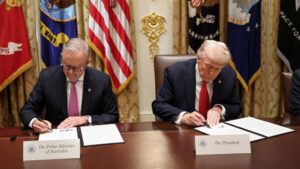
US President Donald Trump and Australian Prime Minister Anthony Albanese signed an agreement on Monday on joint projects for the extraction of rare earth metals.
“Over the next six months, the US and Australia will jointly invest more than $3 billion in projects involving critical metals, with the value of the resources that can be extracted estimated at $53 billion,” according to a White House press release.
It does not specify where exactly the extraction is planned to take place.
In addition, the Pentagon plans to invest in the construction of a gallium processing plant in Western Australia with a capacity of 100 tons per year, the US administration noted.
Earlier, the Experts Club information and analytical center analyzed the global market for rare earth metals in the world and Ukraine. The video is available here: https://youtu.be/UHeBfpywpQc?si=0L-2nSUrLlIbqVZ5?si=Fk6Oi_13NKpEW81K

Against the backdrop of rapid growth in international gold prices, residents of a number of Asian countries really did rush to buy bullion — and in the first half of the day, stores sometimes closed by noon. Vietnamese people in a number of cities lined up at dawn when legislation finally abolished the state monopoly on gold trading.
Meanwhile, the price of gold has already surpassed $4,300 per ounce and continues to hit historic highs.
Growing expectations of a Fed interest rate cut and tensions in US-China relations have pushed investors toward “safe havens” — gold has become a safe asset. Against the backdrop of inflationary pressure and market volatility, the precious metal is once again in the spotlight for investors.
In Australia, at the peak of gold price growth, areas and rivers traditionally used by amateur gold miners (washing gold in river streams) are once again attracting attention. Some people are earning hundreds of dollars in just a few hours. This phenomenon is being covered by the media as a “gold renaissance” not only in the corporate sector, but also among mass investors.
Earlier, the Experts Club analytical center presented an analysis of the world’s leading gold-producing countries in its video on YouTube channel — https://youtube.com/shorts/DWbzJ1e2tJc?si=YuRnDiu7jtfUPBR9
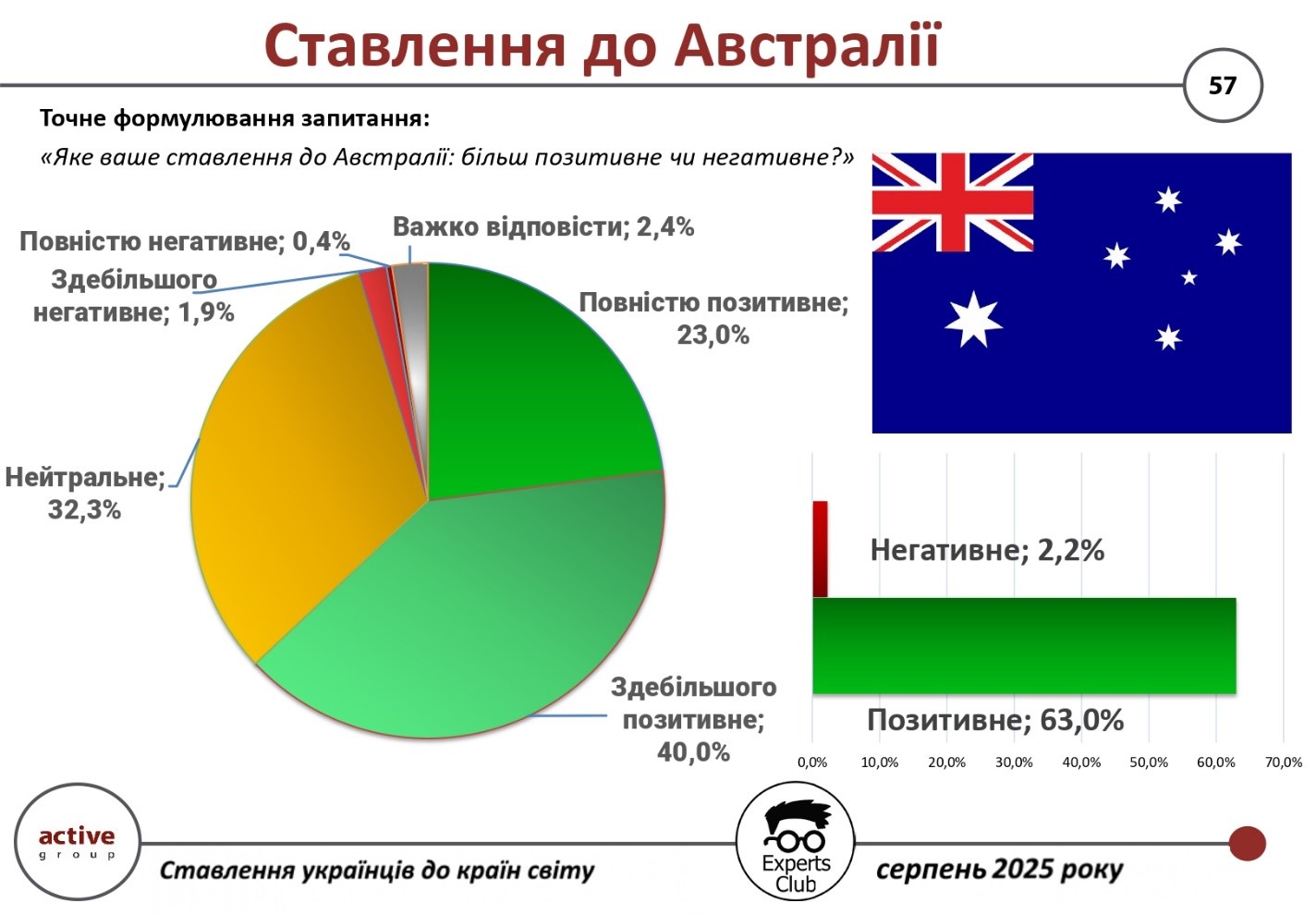
According to the results of a study conducted by Active Group in collaboration with Experts Club in August 2025, Ukrainians’ attitude towards Australia is predominantly positive. 63.0% of respondents expressed a positive attitude towards this country, while only 2.2% of respondents had a negative attitude. At the same time, 32.3% took a neutral position, and 2.4% admitted that they found it difficult to answer this question.
The largest share of positive responses fell into the “mostly positive” category – 40.0%, while 23.0% of respondents expressed a “completely positive” attitude. On the other hand, 1.9% of respondents had a “mostly negative” attitude, and only 0.4% had a “completely negative” attitude.
In 2024, trade turnover between Ukraine and Australia amounted to US$157.4 million. At the same time, exports of Ukrainian goods to Australia amounted to only US$6.4 million, while imports of Australian products amounted to US$151.0 million. The negative balance for Ukraine was recorded at US$144.6 million.
“The main areas of Australian exports to Ukraine traditionally include mineral raw materials, industrial goods, and agricultural products. In contrast, Ukrainian exports to Australia have a limited range and are mainly concentrated in the agricultural and metallurgical sectors,” notes economist and founder of Experts Club Maksim Urakin.
The full video can be viewed at: https://www.youtube.com/watch?v=YgC9TPnMoMI&t
You can subscribe to the Experts Club YouTube channel here: https://www.youtube.com/@ExpertsClub
ACTIVE GROUP, AUSTRALIA, EXPERTS CLUB, Pozniy, SOCIOLOGY, TRADE, UKRAINE, URAKIN

Australia has handed over JDAM-ER (Joint Direct Attack Munition Extended-Range) glider bombs to Ukraine after they were retired from the Royal Australian Air Force (RAAF), Australian Defense reports.
“The Department of Defense’s Guided Weapons and Explosive Ordnance Plan, released on October 30, states that Australia will retire its 500-pound Australian-made Mk.82 JDAM-ER munitions in 2021, in conjunction with the retirement of the F/A-18A/B Classic Hornet fleet. The ADM can now confirm that at least some of these weapons were later transferred to Ukraine as part of Australia’s support to the warring nation. However, it is unclear when the ammunition was transferred to Ukraine,” the newspaper notes.
The first known use of the JDAM-ER in Ukraine was by the Ukrainian Air Force MiG-29 in March 2023, but this weapon was supplied by the United States. Only in April 2024 did Australia confirm that it had supplied unspecified air-to-ground munitions to Ukraine.
In July 2024, the Ministry of Defense announced further transfers of unspecified air-to-ground weapons as part of a $250 million package.
The JDAM-ER kit was developed by the Defense Science and Technology Group (DSTG) in the early 2000s in cooperation with Boeing and Ferra Engineering. Ferra Engineering currently manufactures the kit under an agreement with Boeing that expires in 2028.



