
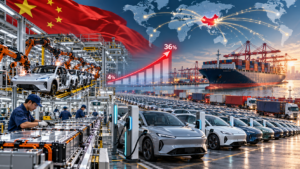
Over the past 25 years, China has increased its share of global automobile production approximately ninefold—from 4% in 2000 to 36% in 2025—transforming itself from a relatively small manufacturer into the world’s largest automotive hub. This was reported by the Experts Club information and analytical center, citing a study by the consulting firm Strategy Partners.
According to analysts’ estimates, around 2 million vehicles were produced in China in 2000, while by 2025 production exceeded 34 million vehicles per year. Thus, over a quarter of a century, the volume of Chinese automobile production increased approximately 17-fold.
China’s position strengthened particularly rapidly after 2010. The country not only formed the world’s largest domestic automobile market, but also created a large-scale manufacturing base covering virtually the entire value chain — from components and batteries to vehicle manufacturing and software.
One of the main factors behind the further growth of China’s automotive industry was the transition to electric vehicles and hybrid models. Chinese manufacturers gained strong positions in the new energy vehicle segment — NEV, which includes fully electric vehicles and plug-in hybrids.
At the same time, Chinese companies are actively increasing their presence abroad. China has become the world’s largest automobile exporter, while local manufacturers are expanding sales and creating their own production capacities in Europe, Asia, Latin America and other regions.
As a result, the structure of the global automobile market has also changed. While in the early 2000s it was shaped primarily by manufacturers from the United States, Japan and Western Europe, by the mid-2020s China had become the industry’s largest individual manufacturing hub.
The growth of China’s automotive industry is accompanied by the strengthening of its own national brands. BYD, Geely, Chery, SAIC, Great Wall Motor and other manufacturers are increasingly competing with European, American, Japanese and South Korean automotive groups not only in China’s domestic market but also in export markets.
China’s own battery manufacturing base has become a significant competitive advantage. Chinese companies hold leading positions in the global production of traction batteries, while the country controls a significant share of global production chains related to raw material processing and the manufacture of components for electric vehicles.
According to Strategy Partners, the transformation of China’s automotive industry demonstrates the country’s transition from a model of catching-up industrial development to technological leadership in certain segments of the industry.
If current trends continue, competition between Chinese and traditional global automakers will increasingly shift into the areas of electric vehicles, battery technologies, software, autonomous driving and production costs.
auto industry, AUTOMOBILE, CHINA, Electric vehicle, PRODUCTION
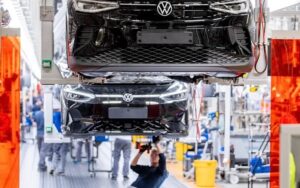
Tens of thousands of workers in Germany’s auto industry are taking part in protests, demanding that the government and company executives preserve their jobs, The Guardian reported on Monday.
Workers at Volkswagen, BMW, Mercedes-Benz, and a number of other automakers are participating in the protests.
Volkswagen previously announced plans to cut 100,000 jobs over the next three years. BMW and Mercedes are also reducing their workforces.
The protesters are calling on the government to support the industry, particularly through subsidies.
The Guardian notes that the crisis in the German auto industry is linked, in part, to the growth of China’s electric vehicle industry, whose vehicles are cheaper and often equipped with more advanced features compared to their German counterparts.
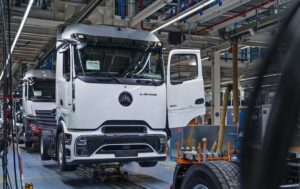
Amid an industrial downturn and challenges in the automotive sector, Germany is indeed accelerating the reorientation of some of its production capacity toward defense products; however, this does not mean a complete abandonment of the automotive industry, but rather a significant strengthening of the defense-industrial sector. The Wall Street Journal reports on this, and other international media outlets have previously confirmed specific examples of this shift.
According to the WSJ, Berlin is attempting to utilize idle capacity, engineering expertise, and the workforce of traditional industries—primarily the automotive sector—to expand the production of defense-related goods. The newspaper links this shift to the industrial downturn, rising defense spending in Germany and Europe, as well as heightened security threats amid Russia’s war against Ukraine and Europe’s declining confidence in long-term U.S. guarantees.
Part of this trend has already been confirmed at the level of specific companies. For instance, Reuters previously reported that Rheinmetall intended to repurpose two of its automotive plants in Germany for primarily defense production, retaining only a portion of civilian output. Additionally, Volkswagen is exploring the possibility of using its site in Osnabrück to manufacture military equipment, though it emphasized that no final production decisions have been made yet.
Another example is the negotiations regarding the potential production of components for the Iron Dome air defense system at one of Volkswagen’s German plants. However, Reuters separately noted that the automaker itself ruled out the production of weapons per se and spoke only of exploring options for utilizing the facility and producing components.
At the same time, pressure on the German auto industry is mounting. Reuters reported in February that nearly half of the auto suppliers surveyed were cutting jobs in Germany, and the industry association VDA described the situation as a crisis. Against this backdrop, the defense sector is becoming one of the few growing markets with a long-term order horizon for some manufacturers.
An additional factor has been the sharp intensification of Germany’s own defense policy. Following changes to budget rules and an expansion of borrowing capacity, Berlin has gained the leeway to significantly increase military spending in the coming years. Reuters previously reported that Germany’s total defense spending could rise from €95.1 billion in the 2025 draft budget to €161.8 billion by 2029, while the total volume of potential borrowing for defense in 2025–2029 was estimated at €380 billion.
auto industry, CRISIS, DEFENSE SECTOR, GERMANY, MANUFACTURING, reorientation



