
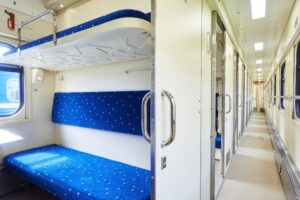
“Ukrzaliznytsia” has added six new passenger cars, manufactured at a Ukrainian plant, to its train fleet, according to a company announcement on Telegram on Saturday.
“As is customary, the new cars are equipped with powerful batteries to ensure maximum autonomy when needed. In the event of a power outage, the batteries will keep the restrooms, lighting, air conditioning, and other systems running. So even if the car continues to travel under a diesel locomotive, all amenities will remain operational for as long as possible,” Ukrzaliznytsia noted.
It did not specify exactly which cars were being referred to, but the illustration shows a compartment car.
“Every new car, in the face of enemy attacks on rolling stock, is an opportunity to keep moving,” the company emphasized.
As previously reported, as part of a state funding program, Ukrzaliznytsia has contracted for 368 passenger cars since 2021. The main supplier is PJSC “Kryukiv Railway Car Building Works” (KVZ).
In late August of this year, Ukrzaliznytsia signed a contract with KVZ for the delivery of 10 new-generation passenger cars by the end of 2029, with a total value of 1.091 billion UAH including VAT, thereby bringing the total number of cars ordered in 2026 to 102.
In late May of this year, Ukrzaliznytsia reported that approximately 1,450 passenger cars are in service, of which 933 are air-conditioned sleeper cars and 100 are high-speed train cars.
CAR, MANUFACTURING, RAILROAD, TRANSPORTATION, UKRZALIZNYTSIA
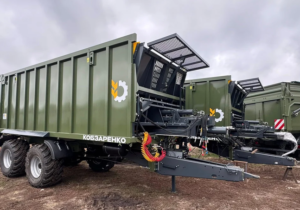
The Ukrainian Kobzarenko Group, a manufacturer of trailed agricultural equipment, has launched a new production facility in Kovel, Volyn Oblast, and plans to increase its capacity to approximately 350 machines per year by 2028.
The facility will produce equipment for handling liquid fertilizers and other liquids, including precision fertilizer applicators, mixing and filling stations, and tanks for transporting water and liquid fertilizers. The first units of equipment at the new facility have already been manufactured.
The company intends to invest approximately 40 million UAH annually in production development. As the facility reaches its planned capacity, it is expected to create about 100 new jobs.
The launch of the plant is also significant from the perspective of the geographical expansion of the Ukrainian machine-building industry. The group’s main production facilities have historically been located in the Sumy region. The company also has sites in Lipova Dolyna and Romny, and outside Ukraine, its Polish plant, Kobzarenko Sp. z o.o., manufactures equipment and simultaneously serves as a service center for the European market.
At the same time, the company continues to expand its presence in the EU. In 2026, Kobzarenko participated in industry trade shows in Romania, the Czech Republic, Slovenia, and Poland. Following the AGRA 2026 exhibition in Slovenia, the manufacturer announced negotiations to expand its dealer network in Austria and the search for a new partner in Slovenia.
Thus, the company is simultaneously developing its European sales network and increasing its production capacity in Ukraine.
The Kobzarenko Group has been operating since 1993 and specializes in the manufacture of agricultural machinery, specifically tractor trailers, grain transfer devices, tankers, fertilizer application equipment, and other machinery.
Source: Kobzarenko’s official website.
AGRICULTURAL MACHINERY, INVESTMENTS, MANUFACTURING, mechanical engineering, Кобзаренко
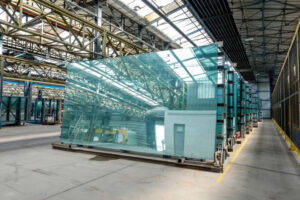
NovaSklo, a subsidiary of the Ukrainian investment group EFI Group, has moved on to the next practical phase of implementing the project for Ukraine’s first modern float glass plant, valued at approximately 250 million euros—the company has begun the selection process for a general contractor for the construction of the facility.
The tender was announced on September 18, 2026. NovaSklo is seeking a contractor capable of performing the full scope of construction work for a large industrial facility.
The project is being implemented in Velyka Dymerka, Kyiv Oblast, approximately 25 km from Kyiv. According to materials from the International Finance Corporation (IFC), the future plant is designed to produce approximately 800 metric tons of glass per day. The facility will manufacture clear, ultra-clear, and energy-efficient coated glass, as well as tempered glass.
The IFC is providing advisory support for the project in collaboration with Japan. The corporation estimates the project’s total cost at €250 million, with construction scheduled to begin in late 2026 and the plant set to begin operations in 2028.
The international component of the project extends beyond IFC’s financing and advisory services. NovaSklo’s technology partner is Pilkington Technology Management, a subsidiary of Japan’s NSG Group, one of the world’s largest manufacturers of architectural and automotive glass.
NSG specialists will support the project during the design, construction, and production line launch phases, including technology optimization, energy efficiency, and industrial safety systems.
Once it reaches its designed capacity, the plant is expected to create more than 300 jobs and become Ukraine’s first large-scale float glass production facility.
The economic impact of the project could extend far beyond the plant itself. Ukraine remains dependent on imported flat glass, while the reconstruction of housing, commercial real estate, and infrastructure in the coming years is expected to generate significant domestic demand.
The establishment of domestic production will make it possible to replace a portion of imports and create a local raw materials and processing supply chain for manufacturers of windows, facade systems, insulated glass units, and other building materials.
At the same time, NovaSklo is establishing an international supply chain even before the plant’s launch. In June 2026, NovaSklo Trade signed an exclusive agreement to distribute Pilkington architectural glass in Ukraine.
Thus, the project brings together Ukrainian industrial capital, the technology of Japan’s NSG Group, the expertise of the IFC, and support from Japan, and is one of the largest new industrial projects currently being prepared for construction in Ukraine.
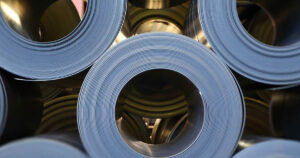
The situation in Ukraine’s metallurgical sector is currently catastrophic; in particular, shelling at Metinvest Group facilities has destroyed five furnaces, and two furnaces at ArcelorMittal Kryvyi Rih (AMKR, Dnipropetrovsk Oblast)—the plants are not operating, said the head of the office of Metinvest Group CEO
Oleksandr Vodovyz, at the Economic Resilience Forum organized by Forbes Ukraine in Kyiv on Wednesday.
“Absolutely all the plants have been destroyed. These include Arcelor, Metinvest, the Petrovsky Plant (Yaroslavsky DMZ), and Interpipe. They were hit several times. Many people were killed. We are not operating. I know that Arcelor is not operating. As far as I know, the Petrovsky Plant has also been shut down. And Interpipe, as far as I know, hasn’t repaired its transformer either,” said Vodoviz.
According to him, there was a week in September when Ukraine did not produce a single metric ton of steel for the first time in 100 years, and Metinvest’s facilities remain shut down.
“We’re at a standstill, assessing (the possibilities for resuming operations). We tried to restart production at Zaporizhstal: we fired up the furnace, it ran for 10 hours, and then—a second failure. Just so you understand, starting up the furnace costs $50 million, and the furnace itself costs $0.5 billion. Repairing it in any way would require enormous funds,” the top manager explained.
He added that the company had reached out to various ministries for help in this situation, but the assistance offered amounted to only 2–5 million hryvnias.
Vodoviz, while agreeing with the need to support small businesses, also emphasized that large businesses are the foundation upon which small businesses operate.
“They supply us with water, cables, and perform various services. We have 50,000 contractors. Unfortunately, there is currently no solution for large businesses. One respected individual asked the Ministry of Economy: ‘What’s the plan?’ Have any of you heard this plan? I haven’t. There is no plan right now. That’s why we’d like to hear what the plan is. What’s next? Should we lay off people or not? We’re all just waiting to see what happens,” said the head of the CEO’s office at Metinvest.
According to him, the group is currently planning its actions no more than a month in advance.
“No one is looking further than six months ahead. Everyone is sitting back and watching to see what happens. My view is this, and we see for ourselves that the economic situation is extraordinary. And extraordinary decisions are needed. You can’t live in an extraordinary situation and make decisions that are made as usual,” the expert believes.
When asked about the amount of investment needed for recovery, Vodoviz noted that the group has not yet calculated this.
“We haven’t calculated it yet, but as an example, I mentioned that one furnace costs $500 million if built from scratch, and all five of our furnaces are damaged. Arcelor has two damaged ones. That’s billions of dollars. But we’re assessing the situation. Right now, we definitely won’t be investing in reconstruction because we don’t understand how the situation will develop further,” the top manager explained.
He noted that if the situation changes in any way within a month or two, then appropriate decisions will be made, but for now, there are none. He clarified that at Metinvest, decision-making depends on three factors, and not all of them are military in nature. Although the main one—the first—is shelling and attacks on industrial facilities.
“The second is the ports. Right now, we’re not shipping out or exporting, even though we were the country’s largest exporter until 2026. And the third factor, strange as it may seem, is our European partners, who have completely blocked our exports of steel products. They imposed SWAM; they imposed quotas. And yet they promised us this wouldn’t happen. We held negotiations with both the Ministry of European Integration and the Ministry of Economy. But the EU implemented these measures anyway,” Vodoviz stated.
According to him, these are the three main major problems that need to be resolved.
Regarding state aid, the manager stated: “We don’t turn to the government; we don’t ask for any grants; we don’t want the government to finance us. We simply want a level playing field. There is, for example, the Ukraine Facility program. I know that some funds are being allocated through the Ukraine Facility. Unfortunately, we don’t have access to this program, although we would like to,” said the top executive.
As for ideas about raising taxes, in his opinion, “they won’t lead to anything good.”
“I’m sure any business would say here: don’t get in our way,” concluded Vodoviz.
“Metinvest” is a vertically integrated group consisting of mining and metallurgical enterprises. The group’s enterprises are located primarily in the Donetsk, Luhansk, Zaporizhzhia, and Dnipropetrovsk regions. The holding’s main shareholders are the SCM Group (71.24%) and Smart Holding (23.76%), which jointly manage it. Metinvest Holding LLC is the management company of the Metinvest Group.
MANUFACTURING, METALLURGY, METINVEST, mining and metallurgical complex, STEEL
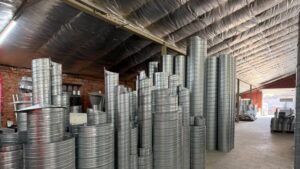
The Lviv Ventilation Plant (LVP) has completed construction of the second phase of its production facilities and plans to install equipment by the end of 2026 that will allow the plant to double its production volume, according to Dmytro Kysilevsky, deputy chair of the parliamentary committee on economic development.
“The Lviv Ventilation Plant has completed construction of the second phase of its production facilities. The equipment has already been purchased and, according to the plan, will be installed by the end of 2026. The investment in the plant’s second phase totaled approximately $1.5 million,” he wrote on Facebook on Wednesday.
Kisilevsky noted that to implement the project, the plant utilized tools from the “Made in Ukraine” policy, specifically the “5-7-9” affordable loan program, as well as a grant for equipment for the processing industry. In addition, the plant is preparing to participate in the state program that compensates 15% of the cost of Ukrainian-made equipment.
According to the MP, in 2025, production volumes at the Lviv Ventilation Plant increased by 30% and have remained at the same level this year.
“The company has a full production cycle and currently processes about 55 metric tons of sheet metal per month. Investments totaling $2.5 million are planned for the construction of the plant’s third phase,” he added.
Kysilevsky also noted that the plant’s investors previously engaged in importing ventilation equipment but have now shifted their focus to developing production in Ukraine—the launch of the plant’s first phase, with investments of approximately $1 million, took place in 2022, a few months after the full-scale invasion.
The Lviv Ventilation Plant manufactures air ducts, sound absorbers, and components for ventilation systems designed for use in industry, retail, hotels, and business centers.
According to data from YouControl, in 2025 the plant increased its net sales revenue by 20% compared to the previous year—to 50.1 million UAH—while net profit decreased by 34.6%—to 1.6 million UAH. In the first half of this year, net revenue amounted to 19.6 million UAH, and net profit was 0.71 million UAH.
Serhiy Vozgomenchuk, a resident of the Rivne region, owns 100% of the company’s shares and serves as its CEO.

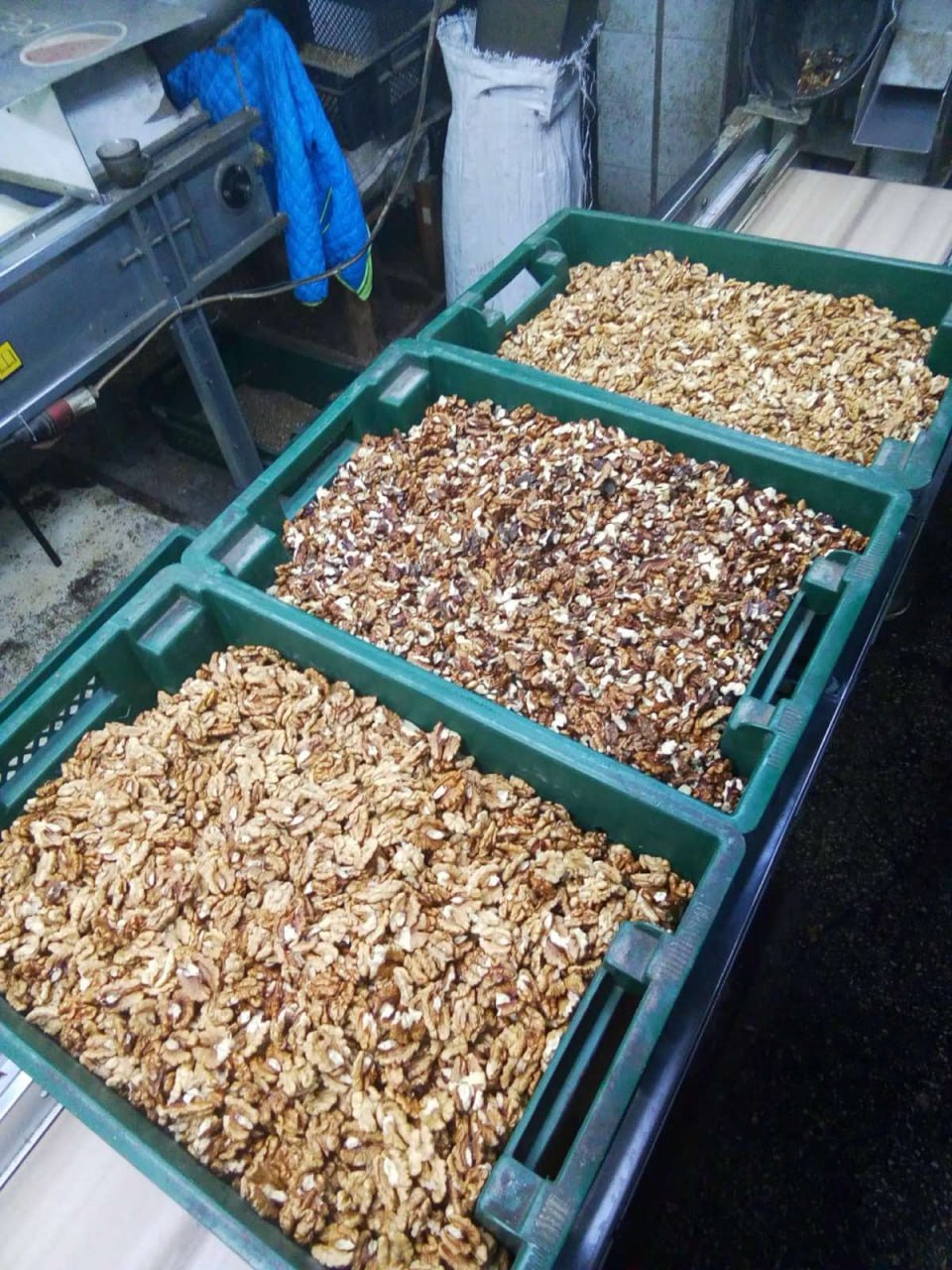
A fully operational set of nut processing equipment is offered for sale—from initial cracking and cleaning to calibration, sorting, and drying of the kernels. The facility is equipped with everything necessary to organize a complete production cycle and may be of interest to both existing processors looking to expand their capacity and entrepreneurs considering launching a turnkey nut processing business.
The cost of the complete equipment set is $27,000.
The core of the production line is a system with a capacity of 60–80 kg per hour, costing $15,000. It includes an impact machine for cracking nuts, a small aspiration unit that removes up to 15% of impurities, a vertical conveyor, a cracking machine with millstones, a large aspiration system for primary cleaning that removes up to 80% of debris and shells, as well as two conveyor sorting tables.
The owner has extended the large conveyor table to facilitate manual sorting of the product. On the small table, nut fragments are separated from the remaining shells.
To increase productivity, the line has been supplemented with a vibrating hopper for uniform feed of raw materials, costing $1,000.
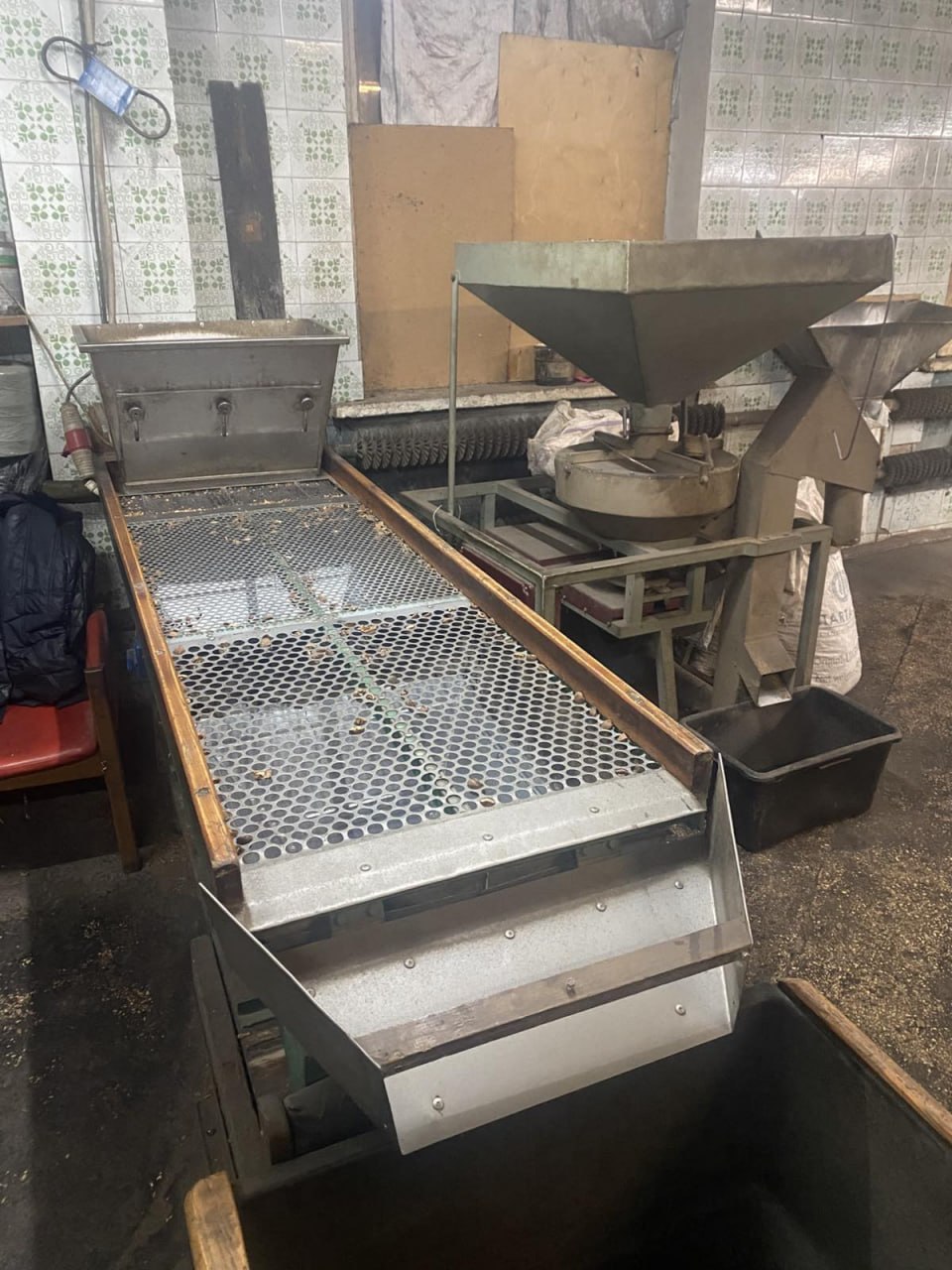
Another unit, costing $1,500, includes a vibrating hopper to separate shells from uncracked nuts and an additional large-capacity dust extraction system. Afterward, the uncracked nuts can be fed to a separate machine for re-cracking, costing $1,000.
For product sorting, the set includes a calibrator with 5 mm, 13 mm, and 19 mm openings—$1,000.
The set also includes a kernel drying unit with a capacity of up to 200 kg per load. The set includes the drying unit itself and a heat gun. The cost of the equipment is $500.
A separate advantage of the complex is a refrigeration unit costing $4,000, which has seen virtually no use and allows for the proper storage of finished kernels and the maintenance of product quality.
For waste processing, there is a machine worth $500 that grinds eggshells into a fine powder. This not only reduces the volume of production waste but also allows the eggshells to be treated as a separate product for further use or sale.
Along with the main equipment, the buyer receives a substantial set of production inventory with a total estimated value of approximately $1,500. This includes two scales, a hydraulic pallet jack, about 150 plastic crates, 40–50 pallets,two containers or devices for transferring products, bags and consumables, ties, lubricants, fasteners, cables, a spare engine for the drying cannon, a capacitor for the calibrator, tools, and other small items necessary for operation.
Additionally, the complex may include a nut dryer for nuts in the shell, valued at $1,000. It is currently located at the supplier’s orchard. This equipment also offers an additional commercial advantage: the supplier uses the dryer and, in return, sells the owner of the complex a harvest of premium-grade nuts. Thus, along with the equipment, it is potentially possible to retain the already established relationships with the raw material supplier.
If necessary, the price can be reduced to $25,500 by excluding the in-shell nut dryer and the shell crusher from the deal. The remaining equipment forms a single production line and is essential for full-scale, streamlined processing.
In fact, the buyer receives not a set of individual machines, but a ready-to-use production line: raw material feed → cracking → aspiration cleaning → re-cracking → sorting → grading → drying → storage of finished kernels.
The complex is suitable for processing your own harvest, purchasing nuts from farms and orchardists, producing kernels for wholesale and retail sales, as well as for the further development of shell processing operations.
The price of the complete complex is $27,000.
Optimized configuration: $25,500.
Main production line capacity: 60–80 kg/hour.
Kernel dryer loading capacity: up to 200 kg.
+380639425723
Dmytro
BUSINESS, EQUIPMENT, MANUFACTURING, NUTS, PROCESSING, PRODUCTION



