
Commercial fishermen in Ukraine’s water bodies harvested 5.1 thousand metric tons of aquatic biological resources from January through August 2026, according to the State Agency for the Development of Land Reclamation, Fisheries, and Food Programs (State Fisheries Agency).
Silver crucian carp accounted for the largest share of the catch—1,500 metric tons, or 31% of the total. Other major species caught included bream—1,100 metric tons, roach—793 metric tons, silver bream—448 metric tons, pikeperch—272 metric tons, and herbivorous species, including silver carp and white amur, — 212 metric tons, perch — 123 metric tons, and Black Sea herring — 103 metric tons.
The largest volumes of aquatic biological resources since the beginning of the year were harvested in the Kremenchuk Reservoir—2,300 metric tons—and the Kamyanskoe Reservoir—over 1,000 metric tons. In the lower Dniester, including the lakes and the Turunchuk branch, as well as the Dniester Estuary, the catch totaled 445 metric tons.
In the Dnipro Reservoir, 416 metric tons of aquatic biological resources were harvested; in the Kyiv Reservoir, 306 metric tons; and in the Kaniv Reservoir, 294 metric tons. In the waters of the Dnipro-Bug estuary system and the Danube River, the catch totaled 118 and 117 metric tons, respectively.
The smallest catch volumes were recorded in the Berezan and Tiligul estuaries—23 and 21 metric tons, respectively—as well as in the Chernihiv region: 9 metric tons in the Dnipro River and 5 metric tons in the Desna River, including lakes.
Due to the Black and Azov Seas being blocked as a result of Russia’s military aggression, fishing for marine species—including sprat, glos, mullet, anchovy, rapana, shrimp, and pilengas—is currently virtually nonexistent; these species accounted for a significant share of the fish market in the pre-war years, the report states.
BIOLOGICAL RESOURCES, CATCH, FISH, State Agency for Fisheries, UKRAINE
In January–June 2026, Ukraine’s commercial fishermen caught more than 1.92 thousand metric tons of aquatic biological resources in inland waters, according to the press service of the State Agency for the Development of Land Reclamation, Fisheries, and Food Programs.
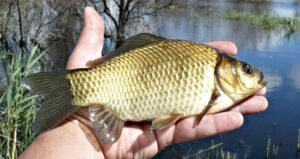
As is traditional, silver crucian carp accounted for the largest share of the catch—857 metric tons, or about 45% of the total.
In addition, 360 metric tons of bream, 139 metric tons of roach, 103 metric tons of Black Sea herring, 95 metric tons of flathead, 83 metric tons of herbivorous fish (silver carp and white amur), 66 metric tons of pikeperch, and 49 metric tons of perch were caught.
The State Fisheries Agency noted that due to the blockade of the Black and Azov Seas resulting from Russia’s military aggression, commercial fishing for most marine fish species has effectively ceased, so the main burden falls on inland waters.
The largest catch volumes in the first half of the year were recorded in the Kremenchuk Reservoir—over 536 metric tons. In the lower Dniester region, including the lakes, the Turunchuk branch, and the Dniester Estuary, 400 metric tons of aquatic biological resources were harvested; in the Kamyanske and Dnipro Reservoirs, 373 metric tons and 230 metric tons, respectively.
In addition, the catch in the Danube River totaled 105 metric tons; in the Kaniv Reservoir, 101 metric tons; in the Kyiv Reservoir, 71 metric tons; and in the Dnipro-Bug estuary system, 64 metric tons. In the waters of the Tiligul and Berezan estuaries, 17 metric tons and 15 metric tons of aquatic biological resources were caught, respectively. The lowest catch volumes were recorded in Chernihiv Oblast—5 metric tons in the Dnipro River and 3 metric tons in the Desna River, including lakes.
BIOLOGICAL RESOURCES, CATCH, crucian carp, FISH, State Fisheries Agency
The catch of fish and other aquatic biological resources by Ukrainian fishing companies in 2025 amounted to 44.7 thousand tons, according to the State Agency for Land Reclamation and Fisheries (Derzhrybangentstvo).
“These figures confirm that the Ukrainian fishing industry remains capable of operating systematically both in national waters and in fishing areas of the World Ocean. Our task is to combine economic efficiency with unconditional adherence to the principles of sustainable use of biological resources,” said the agency’s head, Ihor Klymenok.
The largest catch was recorded in waters outside Ukraine’s jurisdiction—20.16 thousand tons. In particular, Ukrainian vessels caught 19.5 thousand tons of biological resources in the Antarctic region, of which more than 18.8 thousand tons were Antarctic krill. In addition, for the first time since 2006, a Ukrainian business entity resumed fishing in the northwestern part of the Atlantic Ocean (NAFO zone), where 637 tons were caught.
The aquaculture segment showed positive dynamics: the catch and sale of commercial products increased by 17.5% compared to 2024, to 10.78 thousand tons. Experts attribute this to the growing demand for domestic fish in the domestic market. At the same time, special commercial fish farms (SCFF) provided 2.26 thousand tons of biological resources.
In the fishery water bodies of Ukraine, industrial fishing was carried out by 126 entities, which in total caught almost 11.5 thousand tons. The main volume was provided by the Dnipro reservoirs (10.2 thousand tons), which exceeded the previous year’s figures by 3%.
The catch of fish and other aquatic biological resources by fisheries of Ukraine in January-April 2021 increased by 4.8% compared to January-April 2020, to 23,210 tonnes, of which ocean catch on the territory of other states increased by 11%, to 18,280 tonnes.
According to a press release of the State Fisheries Agency of Ukraine on Tuesday, during the specified period, the catch of fish and other aquatic biological resources increased in the reservoirs of the Dnipro River by 9%, to 988 tonnes, the Azov Sea – 827 tonnes (more by 48%), the Danube River – 325 tonnes (more by 70%), the Black Sea – 300 tonnes (more by 41%), and the Dnipro-Bug Canal – 174 tonnes (more by 22%).
The State Fisheries Agency said that industrial fisheries caught 497 tonnes of aquatic biological resources in the lower reaches of the Dniester River with the estuary and the Kuchurhan reservoir and 10 tonnes of aquatic biological resources were caught in the Black Sea estuaries.
The agency said that special fisheries combining elements of aquaculture and industrial fish catch operate in Ukrainian lakes and water reservoirs, which have caught 1,100 tonnes of aquatic biological resources in the first four months of 2021, which is 32.4% less than in the first four months of 2020.



