
On October 22–23, Kyiv will host the 24th Ukrainian CFO Forum—the premier professional event for CFOs, CEOs, business owners, investors, and heads of key business functions.
Interfax readers can take advantage of a special offer: 15% off registration using the promo code BraveInterfax
This year’s program focuses on the decisions Ukrainian companies must make today as they develop their financial models and strategies for 2027 amid the war and high uncertainty. The Forum’s two-day program will feature 16 hours of professional content: 10 sessions in the form of panel discussions, interviews, and practical case studies featuring over 50 speakers from market-leading companies.
Ukrainian businesses are entering the 2027 planning cycle without a single baseline scenario. Destruction and loss of assets, attacks on energy and logistics infrastructure, high cost of capital, labor shortages, regulatory changes, and the acceleration of digital transformation are shortening the planning horizon and constantly changing the conditions under which businesses must make decisions.
For CFOs, this means simultaneously ensuring liquidity and business continuity, revising financial models, managing capital and risks, and not postponing investment and transformation decisions on which the company’s future depends.
The program of the Ukrainian CFO Forum 2026 is dedicated to these very issues—from the 2027 financial model and capital management to decisions following asset losses, adaptive planning, digital transformation, and the interaction between the CFO, CEO, and owner.
The 24th Ukrainian CFO Forum will bring together over 700 participants—CFOs of leading companies in the Ukrainian market, CEOs, business owners, international business executives, and representatives of banks, investment funds, technology companies, and government institutions.
▪️ The 2027 Financial Model: What to Include in the Budget When There Is No Base Case Scenario. Scenarios, triggers for revising the financial model, the cost of money, access to capital, and foreign exchange regulations. The forum will open with a strategic dialogue between Serhiy Nikolaychuk, First Deputy Governor of the NBU, and Andriy Dligach, founder and chairman of Advanter Group.
▪️ Business After Asset Loss: Rebuild or Restructure the Model. Replacement CAPEX, relocation, asset decentralization, recovery financing, insurance, and compensation for war risks. Practical experience will be shared by Rozetka-EVO, Nova Poshta, VARUS, Biosphere Corporation, Starlight Media, and Philip Morris Ukraine.
▪️ Strategy in the Face of Uncertainty: Decisions a CEO Must Still Make for Years to Come. Investments, scaling, production, team, and logistics amid a constantly shifting planning horizon. Panelists: Odgers Ukraine, Imperial Brands Ukraine, YASNO, and BGV Group Management.
▪️ Adaptive Planning: How to Manage a Business When the Annual Budget Is No Longer a Reliable Guide. Scenario planning, rolling forecasts, CAPEX, OPEX, liquidity, and working capital. Practical approaches will be presented by KSE, Danone, British American Tobacco Ukraine, FOKSTROT, and Metinvest Group.
▪️ Digital transformation with measurable business results. ERP, AI in finance, SAF-T UA, and data quality through the lens of deadlines, budget, and financial impact. The program features case studies from Farmak / Business Evolution, MTI, “Avtomagistral-Pivden” / SMART business, British American Tobacco Ukraine / Innoware, ALVIVA GROUP / ABM Cloud, D.TRADING / IT-Enterprise, and EBS.
Specific practical sessions at the Forum will focus on capital and liquidity management, identifying “hidden EBITDA” without new CAPEX, human capital, financial monitoring, and the CFO’s interaction with the CEO and owner.
“For CFOs, 2027 begins right now. Businesses cannot wait for certainty to emerge: decisions must be made today on whether to restore an asset or restructure the business model, invest in CAPEX or preserve liquidity, where to raise capital, and what scenarios to factor into the budget. That is why this year we are structuring the forum’s program around concrete solutions and case studies from companies that are already navigating these dilemmas,” — Ihor Solovykh, CEO of FAService and organizer of the Ukrainian CFO Forum.
The Ukrainian CFO Forum 2026 program features CFOs and CEOs of market-leading companies, representatives of the National Bank of Ukraine (NBU), and leading experts from major Ukrainian and international companies. Participants will receive up to 16 ACCA CPD units for attending the Forum.
Event partners: Pivdenny Bank, Odgers Ukraine, PUMB, Innoware, Done, SMART business, EBS, Business Evolution, Payoneer, IT-Enterprise, Advance Finance Alliance, Vchasno, ABM Cloud, ACCA, Silpo Voyage Pro, Bayadera Group, CFO Club, CEO Club, Board.
Main media partner: Starlight Media.
Ukrainian CFO Forum 2026 | October 22–23 | Kyiv + online
A special offer is available for Interfax readers through October 9: 15% off registration with the promo code BraveInterfax
Details and registration: cfo.ua/cfoforum
The Ukrainian CFO Forum is organized by FAService.
https://cfo.ua/cfoforum/?utm_source=Interfax&utm_medium=website&utm_campaign=cfoforum2026
Open4Business is the forum’s information partner.

The intensification of Russian attacks on Ukraine’s production, logistics, retail and digital facilities is increasingly affecting not only individual companies, but also the growth potential of the economy as a whole. The destruction of enterprises and critical business infrastructure leads to downtime, disruptions in supply chains, higher logistics costs and the need to direct investment resources toward recovery instead of development, reports the Experts Club information and analytical center.
According to the UN Human Rights Monitoring Mission in Ukraine, in August 2026 alone, at least 32 attacks on facilities belonging to Fozzy Group, Epicentr, Nova Poshta, Rozetka, Aurora and Varus were recorded, compared with 11 in July. This figure concerns only the specified group of companies and does not reflect the total number of attacks on Ukrainian businesses.
Warehousing and transport logistics remain among the most vulnerable segments. In August, large distribution and logistics complexes belonging to Rozetka, NOVUS, MTI Group and EVA were destroyed or seriously damaged as a result of attacks. On August 31, a strike on a Nova Poshta terminal in Odesa destroyed a key sorting line. In September, production, warehouse and digital facilities of a number of companies were also damaged.
Experts Club founder and Candidate of Economic Sciences Maksym Urakin notes that the economic effect of such attacks significantly exceeds the book value of the destroyed property.
“When a distribution center, factory or data center is destroyed, economic losses cannot be calculated solely on the basis of the value of the facility itself. Along with it, part of production output temporarily disappears, supplies to dozens or hundreds of other companies are disrupted, inventories are lost, logistics and insurance costs increase, and businesses are forced to create backup capacity,” Urakin noted.
According to the joint RDNA5 assessment by the Government of Ukraine, the World Bank, the European Commission and the UN, as of the end of 2025, direct damage to Ukraine from the war amounted to $195.1 billion, while recovery needs over the next decade were estimated at $587.7 billion. Direct damage to trade and industry amounted to $19.2 billion, about 85% of which was attributable to industry. At the same time, these estimates do not yet take into account the new destruction of 2026.
The deterioration of the situation has already affected macroeconomic forecasts. In September, the European Bank for Reconstruction and Development lowered its forecast for Ukraine’s real GDP growth in 2026 from 2.2% to 1.5%. Among the factors, the EBRD cited intensified attacks on enterprises, energy infrastructure and Black Sea ports, as well as labor shortages, weak business confidence and logistical constraints. The IMF had previously forecast growth of the Ukrainian economy in 2026 at 1–1.6%.
Experts Club emphasizes that the downgrade of forecasts cannot be explained solely by the physical destruction of enterprises. GDP is affected by the duration of downtime, the volume of lost production, the possibility of relocating production to other sites, the state of the energy sector and the speed of restoring logistics links.
Of particular concern is the displacement of investment in development by recovery expenditures. Enterprises have to simultaneously finance repairs, generators and electricity storage systems, backup warehouses, servers and the relocation of production facilities. This supports business continuity but limits the ability to invest in modernization, capacity expansion and the creation of new jobs.

Schneider Electric reported a roughly 30% increase in net income attributable to the company’s shareholders to EUR2.49 billion for the first half of 2026, while revenue reached a record EUR21.23 billion.
A year earlier, revenue stood at EUR19.34 billion. Organic sales growth in the first half of 2026 was 14%.
Adjusted EBITA rose to EUR4.09 billion from EUR3.51 billion, representing organic growth of 22%. The margin for this metric reached 19.3%.
The company’s free cash flow more than tripled, reaching approximately EUR 1.6 billion.
The second quarter was particularly strong, with Schneider Electric’s revenue reaching a record EUR 11.5 billion, an organic increase of 17%. The Energy Management segment grew by 18%, and Industrial Automation by 11%.
The company cites the data center market as one of the main drivers. Demand for electrical infrastructure for data centers is growing rapidly amid the development of artificial intelligence, which significantly increases computing density, power consumption in server racks, and demands on cooling and backup power systems.
North America posted organic growth of 23%, while China and East Asia saw growth of 20%.
Following a strong first half of the year, Schneider Electric raised its forecast for the full year 2026. The company expects organic growth in adjusted EBITA of 14–19%, up from its previous forecast of 10–15%.
Organic revenue growth is projected at 10–13%.
Schneider Electric’s results reflect a broader investment cycle in energy infrastructure. AI data centers require not only servers and graphics processing units (GPUs), but also transformers, distribution equipment, UPS systems, automation systems, cooling systems, and digital energy management solutions.
Thus, energy infrastructure is gradually becoming one of the key constraints on the further scaling of AI.
For Ukraine, this trend is significant in the long-term context of rebuilding digital infrastructure and constructing new data centers. Future facilities will require significantly more connected power capacity and a more complex power supply architecture than traditional server centers.
Schneider Electric has been operating in Ukraine for over 30 years. Globally, the company is present in more than 100 countries and employs approximately 160,000 people.

Ukrainian businessman, former member of parliament, and one of the most prominent major investors in Ukraine’s metallurgical industry, Vadim Novinsky, has been granted Serbian citizenship, according to the Serbian business portal Parametar.
According to Parametar, the decision to grant Novinsky citizenship of the Republic of Serbia was made by the country’s government on September 24, 2026, and published in the official “Službeni Glasnik.” The document was signed by Serbian Prime Minister Džuro Matsut.
Novinsky was born on June 3, 1963, in Staraya Russa, in what is now Russia, but he has built a significant portion of his business career in Ukraine. He obtained Ukrainian citizenship in 2012.
In Ukraine, Novinsky is best known as the founder of Smart Holding and a long-time partner of Rinat Akhmetov’s SCM Group in the mining and metallurgical group Metinvest. Smart Holding held a 23.76% stake in Metinvest. The group’s business interests also spanned shipbuilding, the agricultural sector, real estate, and other areas.
In late 2022, Novinsky announced that he had transferred his assets to a trust. Metinvest subsequently stated that Novinsky is not a beneficiary of the company and does not exercise actual control over it.
Novinsky was also involved in politics. From 2013 to 2022, he served as a member of the Ukrainian Parliament for several terms, first as part of the Party of Regions faction and later as part of the “Opposition Bloc.”
In December 2022, Ukraine imposed personal sanctions against Novinsky. In January 2025, the State Bureau of Investigations and the Security Service of Ukraine reported that the former People’s Deputy was suspected of high treason and inciting religious hatred. Ukrainian media identified the suspect as Vadym Novinsky. The businessman himself denied the charges against him and called them politically motivated.
In June 2025, Ukrainian law enforcement agencies also reported an investigation into possible tax evasion totaling more than 4 billion UAH involving the former lawmaker, whom the media identified as Novinsky. At this point, these are allegations and investigations, not final, legally binding convictions.
After the start of Russia’s full-scale invasion of Ukraine, Novinsky publicly spoke out against the war.
Serbian authorities have not yet publicly disclosed the specific reasons for granting Novinsky citizenship, nor have they reported on any potential investment projects by the businessman in Serbia.
Source: Serbian business portal Parametar.

A fully operational set of nut processing equipment is offered for sale—from initial cracking and cleaning to calibration, sorting, and drying of the kernels. The facility is equipped with everything necessary to organize a complete production cycle and may be of interest to both existing processors looking to expand their capacity and entrepreneurs considering launching a turnkey nut processing business.
The cost of the complete equipment set is $27,000.
The core of the production line is a system with a capacity of 60–80 kg per hour, costing $15,000. It includes an impact machine for cracking nuts, a small aspiration unit that removes up to 15% of impurities, a vertical conveyor, a cracking machine with millstones, a large aspiration system for primary cleaning that removes up to 80% of debris and shells, as well as two conveyor sorting tables.
The owner has extended the large conveyor table to facilitate manual sorting of the product. On the small table, nut fragments are separated from the remaining shells.
To increase productivity, the line has been supplemented with a vibrating hopper for uniform feed of raw materials, costing $1,000.
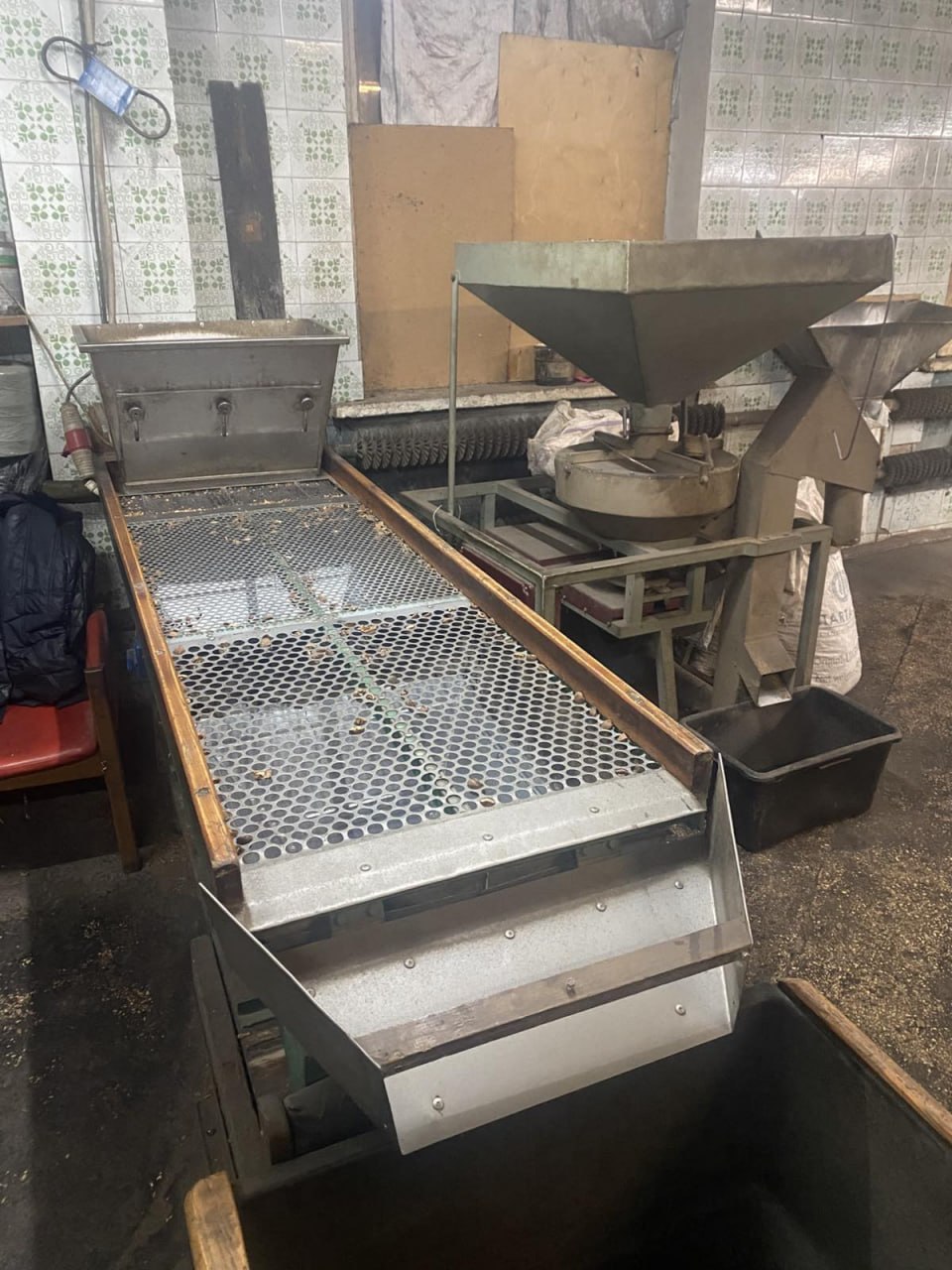
Another unit, costing $1,500, includes a vibrating hopper to separate shells from uncracked nuts and an additional large-capacity dust extraction system. Afterward, the uncracked nuts can be fed to a separate machine for re-cracking, costing $1,000.
For product sorting, the set includes a calibrator with 5 mm, 13 mm, and 19 mm openings—$1,000.
The set also includes a kernel drying unit with a capacity of up to 200 kg per load. The set includes the drying unit itself and a heat gun. The cost of the equipment is $500.
A separate advantage of the complex is a refrigeration unit costing $4,000, which has seen virtually no use and allows for the proper storage of finished kernels and the maintenance of product quality.
For waste processing, there is a machine worth $500 that grinds eggshells into a fine powder. This not only reduces the volume of production waste but also allows the eggshells to be treated as a separate product for further use or sale.
Along with the main equipment, the buyer receives a substantial set of production inventory with a total estimated value of approximately $1,500. This includes two scales, a hydraulic pallet jack, about 150 plastic crates, 40–50 pallets,two containers or devices for transferring products, bags and consumables, ties, lubricants, fasteners, cables, a spare engine for the drying cannon, a capacitor for the calibrator, tools, and other small items necessary for operation.
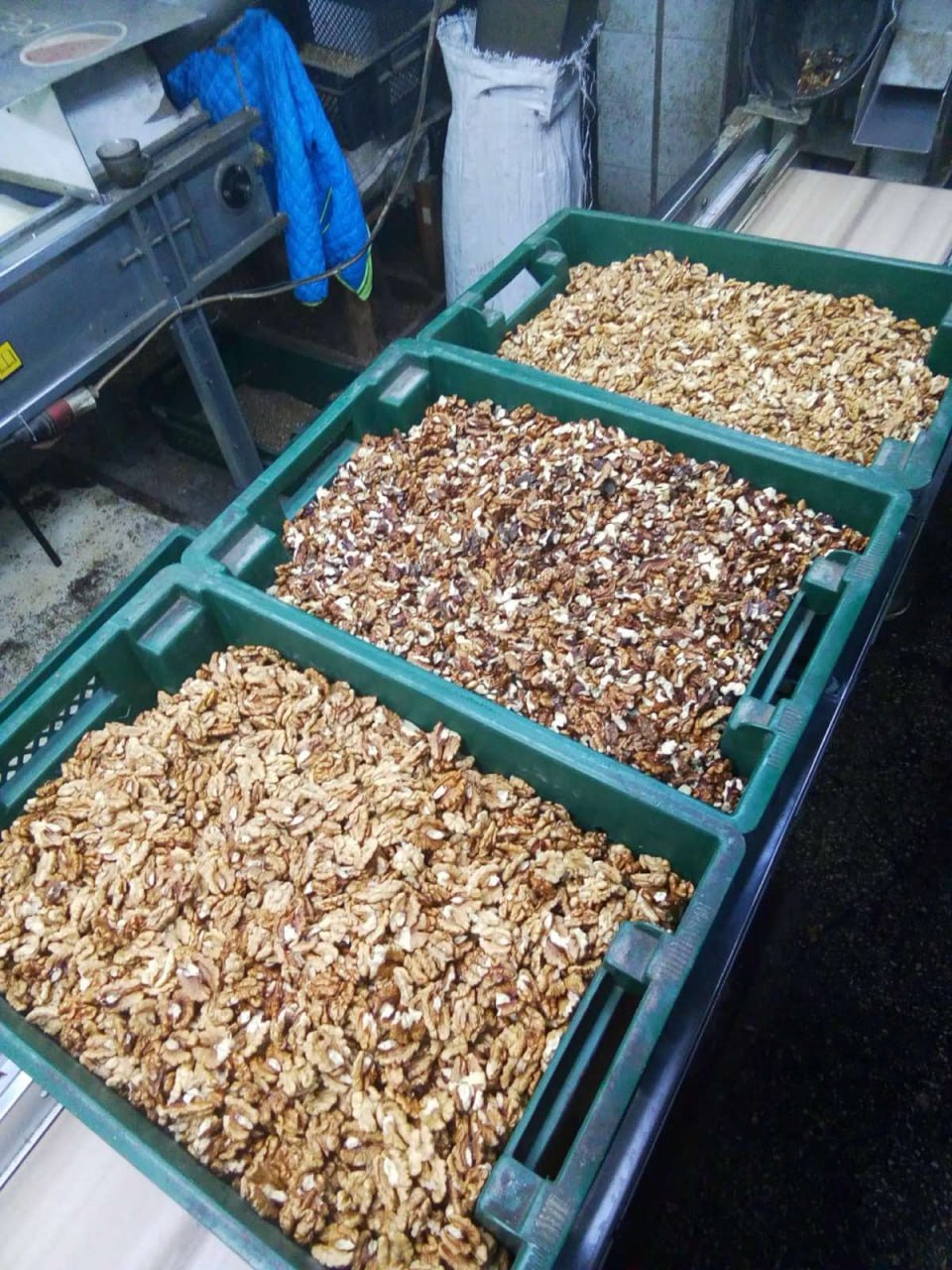
Additionally, the complex may include a nut dryer for nuts in the shell, valued at $1,000. It is currently located at the supplier’s orchard. This equipment also offers an additional commercial advantage: the supplier uses the dryer and, in return, sells the owner of the complex a harvest of premium-grade nuts. Thus, along with the equipment, it is potentially possible to retain the already established relationships with the raw material supplier.
If necessary, the price can be reduced to $25,500 by excluding the in-shell nut dryer and the shell crusher from the deal. The remaining equipment forms a single production line and is essential for full-scale, streamlined processing.
In fact, the buyer receives not a set of individual machines, but a ready-to-use production line: raw material feed → cracking → aspiration cleaning → re-cracking → sorting → grading → drying → storage of finished kernels.
The complex is suitable for processing your own harvest, purchasing nuts from farms and orchardists, producing kernels for wholesale and retail sales, as well as for the further development of shell processing operations.
The price of the complete complex is $27,000.
Optimized configuration: $25,500.
Main production line capacity: 60–80 kg/hour.
Kernel dryer loading capacity: up to 200 kg.
+380639425723
Dmytro
BUSINESS, EQUIPMENT, MANUFACTURING, NUTS, PROCESSING, PRODUCTION

According to Experts.news, more than 551,000 companies registered in Ukraine have at least one signatory in addition to the CEO, and the total number of such authorized persons has exceeded 603,000, according to data from the Unified State Register analyzed by Opendatabot.
According to an Opendatabot study published on September 21, 2026, 551,328 companies—or 38% of all registered companies in Ukraine—have an additional signatory. Another 897,893 companies—or 62%—do not have such representatives. Thus, the total database used for the calculation comprises approximately 1.45 million companies.
As of September, there were 603,304 signatories listed in the Unified State Register. In some cases, a single individual has the right to represent several legal entities at once. The record-holder among signatories currently represents 246 companies.
A signatory is a person authorized to perform certain legally significant actions on behalf of a company. Specifically, this includes signing contracts, submitting documents for state registration, and other actions provided for by the powers granted to them.
However, the mere fact that a person is listed in the registry as a signatory does not imply unlimited authority. The Unified State Register may separately specify permitted transactions, restrictions, maximum contract amounts, and other conditions of representation. Therefore, when verifying a counterparty, it is important to assess not only the presence of a signatory but also the specific scope of their rights.
According to Opendatabot’s assessment, the institution of additional signatories has taken on particular practical significance since the start of the full-scale war. Mobilization, communication disruptions, shelling, executives being abroad, or other circumstances may temporarily hinder a director’s ability to perform their duties.
Having another authorized representative allows a company to avoid concentrating all operational processes on a single executive and to continue entering into contracts, completing registration procedures, and performing other actions necessary for business operations.
At the same time, the significant number of companies that a single person may represent increases the importance of verifying such individuals when entering into agreements. It is advisable for a counterparty to verify the validity of a representative’s authority, any restrictions regarding the amount or type of contract, and whether there have been any changes in the Unified State Register.
You can verify the signatories of a specific company and the scope of their registered powers through services that use open data from the Unified State Register.
BUSINESS, COMPANY, signatory, Unified State Register, Опендатабот



