
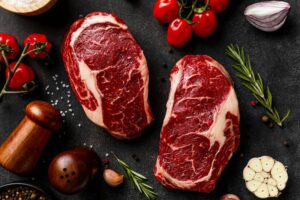
In January 2026, Ukraine reduced exports of beef and cattle amid a seasonal lull, rising logistics costs, and declining demand, according to the Milk Producers Association (MPA), citing data from the State Customs Service.
The industry association noted that live cattle exports in January amounted to about 958 tons, which is 36% less than in December 2025 and 33% less than in January 2025. Foreign exchange earnings in this segment fell to $1.82 million, which is 46% less than in December 2025.
Exports of fresh or chilled beef in January this year decreased by 32% compared to December, to 292 tons, but significantly exceeded the volume of January last year, when it amounted to 21 tons. Revenue for this product in the reporting period amounted to $2.22 million.
The actual volume of frozen beef exports amounted to 966 tons, which is 34% less than in December and 31% less than in January 2025. The monetary proceeds amounted to almost $4.62 million.
“The decline in exports in January is likely due to increased shelling of port infrastructure, which led to higher logistics costs due to risk insurance and route changes. In addition, the market saw a traditional decline in demand at the beginning of the year after active purchases at the end of 2025,” said Georgiy Kukhiashvili, an analyst at the association, whose words are quoted in the report.
According to the UMA, beef imports also declined. In particular, purchases of chilled meat fell to 6 tons (-54% compared to the previous month), and frozen meat to 81 tons (-18%).
The foreign trade balance in January 2026 remained positive and amounted to $7.82 million, the UAA concluded.

Agricultural LLC (STOV) “Ratnivsky Agrarian” (Ratne, Volyn region) intends to obtain a permit for pollutant emissions for a reconstructed livestock complex in the village of Yakushiv (Kovel district), according to the website of the Ministry of Economy, Environment, and Agriculture.
According to the official announcement, the project provides for the loose housing of cattle on deep litter in four cowsheds. Each of them is designed for 1,000 head, which will provide a total capacity of 4,000 head at a time.
It is expected that the complex will house 1,525 cows, 1,670 calves of various age groups, and 805 other cattle and bulls. During the warm season, the animals will be kept on pastures. The total time spent in the cowsheds will be no more than five months per year. Heat will be supplied to the cowsheds by a wood-fired boiler (200 kW). In addition, to ensure a reliable power supply, the complex is equipped with four diesel generators, each with a capacity of 50 kW.
The project has already undergone an environmental impact assessment (EIA), following which the Volyn Regional State Administration’s Department of Ecology and Natural Resources issued a positive conclusion at the end of December 2025. Since the capacity of the complex exceeds the threshold of 1,000 places for cattle, the facility falls under the second category of activities that may have a significant impact on the environment.
At the same time, calculations confirmed that there were no exceedances of the maximum permissible concentrations of pollutants, so no measures to forcibly reduce emissions are planned.
Ratnivsky Agrarian LLC was registered in 2011. It specializes in cattle breeding and fattening of breeding breeds using modern technologies.
According to data from the Opendatabot service, at the end of 2024, the company received income of UAH 259.1 million, net profit of UAH 17.53 million, has debt obligations of UAH 126.16 million, and assets are estimated at UAH 1.04 billion. According to the results of the first three quarters of 2025, its activities are characterized by further growth in assets: UAH 204.98 million in revenue, UAH 40.56 million in net profit, UAH 222.95 million in debt obligations, and assets increased to UAH 1.27 billion.
The authorized capital of STOV “Ratnivsky Agrarian” is UAH 48.144 million, and the ultimate beneficiary is Vita Shevchuk.
According to the Law “On Air Protection,” facilities are divided into three groups: the first includes enterprises that are required to implement the best available technologies (permission is issued by the Ministry of Economy); the second includes facilities on state registration, regulated at the OVA level; the third group includes entities with minimal impact. The EIA procedure is mandatory for livestock complexes with more than 1,000 head of cattle.

Ukraine has opened three new markets for cattle exports to Algeria, according to a press release from the State Service of Ukraine for Food Safety and Consumer Protection. According to the report, the State Service for Food Safety and Consumer Protection, together with the Ministry of Foreign Affairs of Ukraine, Ukrainian diplomatic institutions, and relevant ministries, have agreed on three forms of veterinary documents with the veterinary service of the Ministry of Agriculture, Rural Development, and Fisheries of the People’s Democratic Republic of Algeria. These include, in particular, a veterinary health certificate form for the export of meat and breeding cattle, as well as cattle for fattening.
“The opening of three new export destinations for cattle to Algeria is an important result of the systematic work of the State Service of Ukraine for Food Safety and Consumer Protection. In total, five new markets for Ukrainian animal products have been opened since the beginning of the year, which creates additional opportunities for domestic producers and contributes to strengthening Ukraine’s position in the international trade arena,” emphasized Sergey Tkachuk, head of the State Service of Ukraine for Food Safety and Consumer Protection.
The agency emphasized that the opening of these export markets is an important step in deepening trade and economic cooperation between Ukraine and Algeria and confirms the compliance of Ukrainian products with the veterinary requirements of the importing country.
The agreed forms of veterinary certificates have already been published on the official web portal of the State Service of Ukraine for Food Safety and Consumer Protection in the section “International Cooperation” – “Veterinary and Safety” – “Certificates for export from Ukraine” at https://dpss.gov.ua/mizhnarodne-spivrobitnictv/veterinariya-ta-bezpechnist/sertifikati-na-eksport-z-ukrayini.

In Ukraine, in January-October 2025, the volume of cattle slaughter for beef in farms of all categories amounted to 286.2 thousand tons, which is 8% less than in the same period of 2024, according to the Association of Milk Producers (AMP).
The industry association specified that cattle slaughter volumes at agricultural enterprises decreased to 106.9 thousand tons (-3%), and at private farms – to 179.3 thousand tons (-11%) compared to January-October 2024.
The largest share (57%) of cattle slaughtered at agricultural enterprises was in the Kyiv (15.41 thousand tons), Poltava (13.33 thousand tons), Cherkasy (11.72 thousand tons), Vinnytsia (9.73 thousand tons), and Chernihiv (9.36 thousand tons) regions, according to the AVM.
As of November 1, 2025, there were 2.2 million head of cattle in Ukraine’s private and industrial sectors, including 1.11 million cows, which is 3% and 1% less than in October of this year and 10% and 10% less than in the same period last year, according to the Association of Milk Producers (AMP), citing data from the State Statistics Committee.
The industry association specified that about 47% of animals are kept on industrial farms, and 53% on private farms.
According to the AMU, the industrial sector has 947,100 head of cattle, which is 2,000 head more (+0.2%) than on October 1, 2025. The number of cows is 384,100, an increase of 500 head (+0.1%) over the last month. Over the past year, the number of cattle on farms has increased by 28,600 (+3%), and the number of cows has increased by 8,800 (+2%).
At the same time, there are 1.74 million head of cattle in the private sector, which is 64 thousand head (-6%) less than on October 1, 2025. As of November 1, 2025, the number of cows in private households was 721,200, which is 17,000 (-2%) less than a month ago. Over the past year, the number of cattle in private households has decreased by 253,000 (-19%), and the number of cows has decreased by 137,000 (-16%).
AVM analyst Georgy Kukhaleishvili noted that the number of cows is declining mainly in the private sector. The decline in cattle numbers is a long-standing problem in Ukraine due to the lack of an effective state program to support dairy farming. The war has only exacerbated the situation.
The expert recalled that most farms in Ukraine were built in the 1970s and 1980s and no longer meet the requirements for keeping animals. The lack of premises suitable for keeping cows creates the conditions for a further reduction in livestock numbers. Many farmers are not investing in increasing their cow herds during the war and are experiencing a shortage of working capital. Farmers’ production costs are rising faster than the prices of finished products due to the increase in the cost of feed, the cost of electricity, the devaluation of the hryvnia, and the decline in the purchasing power of the population.
However, dairy farms in relatively safe regions of Ukraine are modernizing existing facilities and building new ones. They are also increasing their high-yielding cow herds. According to AVM estimates, as of November, at least 40 farms are modernizing and expanding their facilities.
However, in October, the growth rate of the cow herd in the industrial sector also slowed down, which may be related to the continuing “bearish trend” in the dairy market and the decline in prices for exchange-traded commodities and raw milk. Over the past month, the number of cows has not changed and has not grown on dairy farms in 14 regions, not only in the frontline regions, but also in relatively safe areas of central and western Ukraine, such as Ivano-Frankivsk, Chernivtsi, Zhytomyr, Cherkasy, and Kirovohrad regions, the AVM summarized.
Cattle slaughter in July 2025 amounted to 14.8 thousand tons, which is 6 thousand tons more (+63%) than in June 2025 and 1 thousand tons more (+7%) than in July 2024, according to the Association of Milk Producers (AMP).
The industry association noted that in July 2025, enterprises produced 50% of beef from the total slaughter volume, and private farms produced 50%.
Cattle slaughter volumes in January-July 2025 amounted to 98.5 thousand tons, which is 4 thousand tons less (-4%) compared to the same period in 2024.
The AVM noted that in July, cattle slaughter volumes at agricultural enterprises amounted to 7.4 thousand tons, which is 1 thousand tons more (+16%) compared to June 2025 and 300 tons more (+4%) compared to July 2024. In January-July 2025, cattle slaughter volumes at agricultural enterprises amounted to 46 thousand tons, which is 1.3 thousand tons more (+3%) compared to the same period last year.
In private households, cattle slaughter volumes in July amounted to 7.4 thousand tons, which is 5 thousand tons more (+174%) than in June of this year and 700 tons more (+10%) than in July 2024. In January-July 2025, cattle slaughter in private households amounted to 52.5 thousand tons, which is 5.7 thousand tons less (-10%) than in the same period last year.
At the same time, the largest share (59%) of animals slaughtered was sold by agricultural enterprises in the Kyiv (35.8 thousand head), Poltava (24.6 thousand head), Cherkasy (18 thousand heads), Chernihiv (16.4 thousand heads), and Vinnytsia (14.9 thousand heads) regions.



