
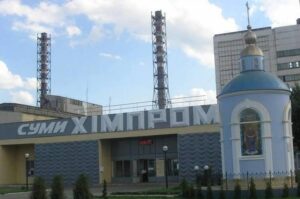
A 99.9952% state-owned stake in one of Ukraine’s largest chemical companies, Sumykhimprom JSC, will be put up for an electronic auction on the “Prozorro.Sales” trading platform on October 13, 2026.
This decision was made by the auction commission chaired by Vitaliy Kovalenko, deputy head of the State Property Fund of Ukraine, the Fund announced on Facebook.
The State Property Fund of Ukraine (SPFU) noted that on July 8 of this year, the government approved the terms and the starting price for the sale of this stake at 1.005 billion UAH.
As previously reported, the repeat online auction for the privatization of “Sumykhimprom,” scheduled for January 13, 2026, with a price reduced by 9.3% to 1 billion 88.081 million UAH (excluding VAT), did not take place due to a lack of participants, just like the previous auction on June 11, 2025.
“Sumykhimprom represents a unique opportunity to acquire nearly 100% of the shares in an operating, high-capacity chemical complex with a wide range of products and significant production facilities for further modernization and development of export potential,” emphasized the State Property Fund of Ukraine (SPFU).
According to the terms of the tender, the new owner was required to maintain the company’s core business activities and invest at least 150 million hryvnias in technical re-equipment and production modernization. In addition, the winner must settle wage arrears and budget debts within six months, as well as overdue accounts payable—excluding debts owed to individuals and legal entities subject to sanctions and their associated parties, as well as creditors whose beneficiaries are citizens or residents of the Russian Federation and/or Belarus. The buyer must comply with social guarantees for employees in accordance with labor law requirements and prevent their dismissal for six months following the acquisition of the asset.
“Sumykhimprom” is one of the largest domestic enterprises producing compound mineral fertilizers, titanium dioxide, sulfuric acid, and other inorganic chemicals. The enterprise is among the top three revenue-generating enterprises in Sumy and the region. It produces more than 30 brands of NPK fertilizers with varying nutrient ratios for different soil and climatic zones.
For over 10 years, the plant was managed by a group of companies affiliated with Group DF, owned by businessman Dmytro Firtash. In November 2023, the Commercial Court of Sumy Oblast granted the motion filed by the State Property Fund of Ukraine (SPFU) and the Ministry of Justice and closed the proceedings in the bankruptcy and reorganization case of “Sumykhimprom.”
The SPFU had planned to sell the company to a private investor even before the full-scale war began. However, privatization was delayed due to the stance of minority shareholder Firtash, who in 2010 acquired 0.005% of the company’s shares and gained control over its management. “Sumykhimprom” accumulated debt, which led to the formation of a creditors’ committee and the initiation of a reorganization procedure.
Since 2015, the State Property Fund of Ukraine (SPFU) had been trying through the courts to halt the company’s bankruptcy proceedings, but was only able to do so in 2023, which cleared the way for privatization.
In March 2022, Russian forces shelled the plant, causing an ammonia leak. As a result, the plant was shut down for a year and resumed operations in the spring of 2023. As of June 2025, the front line was less than 30 km from “Sumykhimprom.”
According to the 2025 report, the company’s accounts payable at the end of the year amounted to 4.135 billion UAH, of which 1.292 billion UAH was debt related to the bankruptcy case initiated by the Commercial Court of Sumy Oblast in October 2011, based on the court-approved register of the JSC’s creditors.
“The company’s lack of working capital, unprofitable operations, and production downtime are causing its accounts payable to rise,” the report states.
Sumykhimprom’s revenue in 2025 amounted to 129.2 million UAH (compared to 395.9 million UAH the previous year), gross profit to 53.3 million UAH (9.9 million UAH), and net loss to 405.7 million UAH (600.2 million UAH).
“The main reason for Sumykhimprom’s unprofitable operations in 2025 was the forced shutdown of production facilities from November 2024 through July 22, 2025, and the shutdown of all structural units in the fourth quarter of 2025. In 2025, Sulfuric Acid Plant No. 5 operated for only two months,” the report states.
According to the report, due to the escalation of the dangerous situation in the region, the regional military administration did not grant permission to purchase ammonia, which prevented the company from launching its production program for complex mineral fertilizers, as envisaged in the approved financial plan for 2025.
AUCTION, CHEMICALS, PRIVATIZATION, State Property Fund of Ukraine, SUMYKHIMPROM

The Global Environment Facility (GEF) will provide Ukraine with $350,000 in grant assistance as part of the project to improve the situation with hazardous chemicals in the country. According to the GEF’s report released on Tuesday, April 17, the project aims to monitor and assess the real situation throughout Ukraine regarding the quantity and condition of hazardous chemicals, update the national implementation plan for Ukraine’s international obligations on the management of unsuitable chemicals, and ensure the reporting by the Ministry of Ecology and Natural Resources of Ukraine to the Stockholm Convention on Persistent Organic Pollutants.
The GEF noted that on September 5, 2007, Ukraine ratified the Stockholm Convention on Persistent Organic Pollutants, recognizing the need to draw up a national plan for the implementation of its obligations, which should be regularly submitted to the Secretariat of the Convention.
Despite the preparation of such a plan and the beginning of the export of unsuitable chemicals for destruction to EU countries since 2007, Ukraine continues to struggle with a number of problems, among them the impossibility of a reliable assessment of the status of treatment and the quantity of extremely hazardous chemicals available through their storage in unsuitable places and limited access to them.
The GEF said that according to the latest assessment of the treatment of obsolete and banned pesticides in Ukraine, in January 2013, there were 11 tonnes of unsuitable chemicals in the country located on the territory of 1,200 storage facilities.
Under the provisions of the Stockholm Convention, developing countries and countries with transition economies are able to obtain additional funds for the development and updating of the National Implementation Plan. Under such a mechanism, the GEF announced the provision of respective grants at the 5th meeting of the Conference of the Parties. Ukraine has become one of the beneficiaries of the program.



