
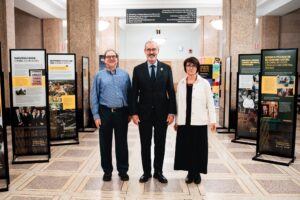
The Canadian Institute of Ukrainian Studies (CIUS) at the University of Alberta is celebrating its 50th anniversary. During this time, the institute has awarded at least 1,742 research honors, grants, and scholarships. Of these, 883—or about 51%—were awarded to Ukrainian scholars and institutions.
To mark the anniversary, the institute will host an international symposium titled “Recentring the Humanities: Ukraine and the World” (Recentring the Humanities: Ukraine and the World). It will take place October 28–30, 2026, in Edmonton, with the option to participate online upon prior registration.
Among the confirmed participants are Oleksandra Matviychuk, director of the Center for Civil Liberties; Refat Chubarov, chairman of the Mejlis of the Crimean Tatar People; historians Serhii Plokhy and Yaroslav Hrytsak; philosopher Volodymyr Yermolenko; and Metropolitan Borys Gudziak.
Participants will discuss how Ukraine’s experience—particularly its resistance to Russian aggression—is shaping international debates on history, human rights, democracy, and cultural identity.
A highlight of the symposium will be a lecture by Metropolitan Boris Gudziak titled “The World Has Never Been So Ukrainian: Challenges and Opportunities for the Global Ukrainian Community.” It will take place on October 28 at the Horowitz Theater at the University of Alberta to mark the 25th anniversary of the Bohdan Bociurkiw Memorial Lecture Series.
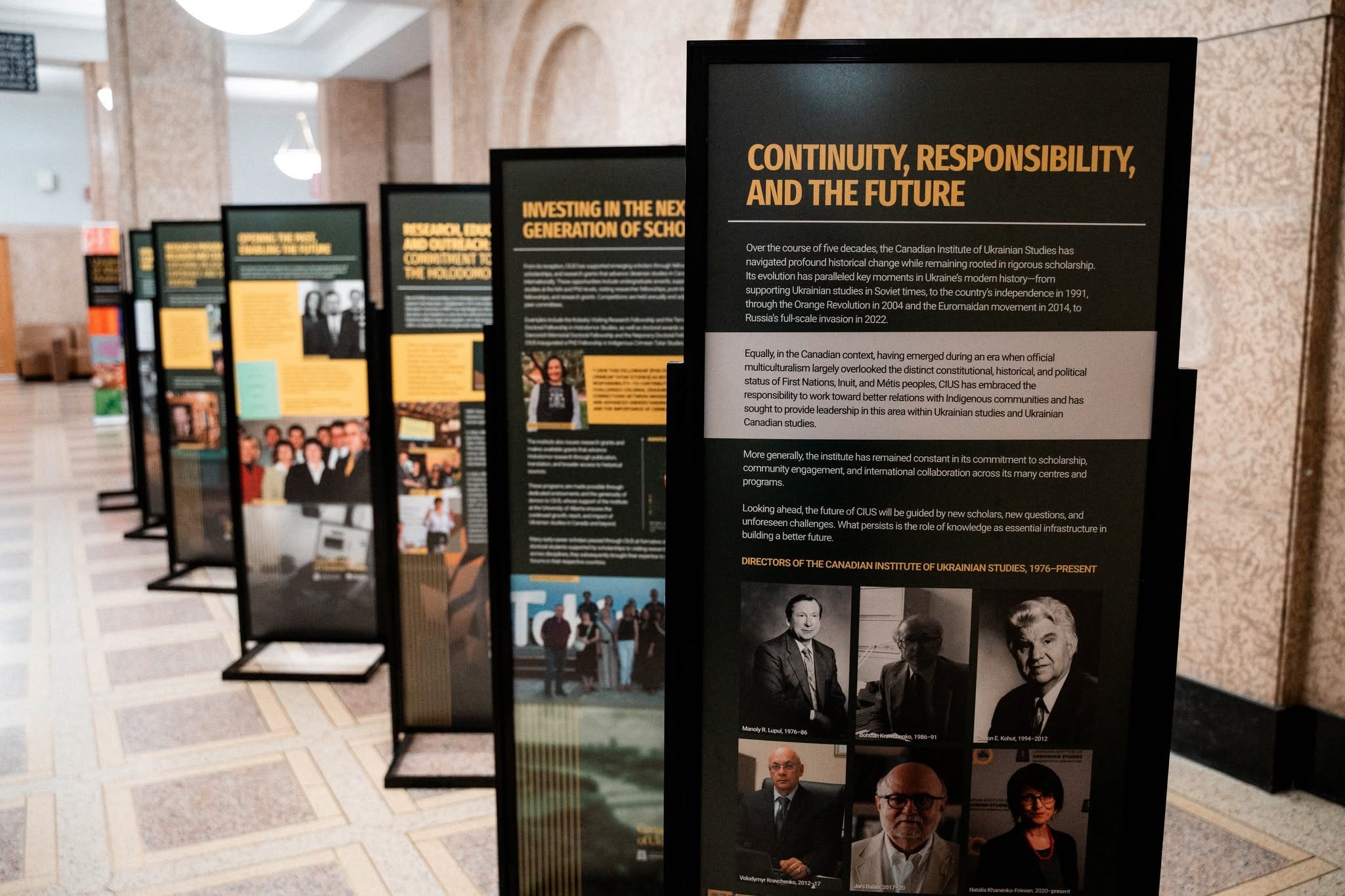
The program will be complemented by exhibitions on the history of the Ukrainian Canadian Institute of Studies (UCIS), the connection between George Orwell’s work and the Holodomor, and childhood on the Canadian prairies in the 1930s.
The symposium will open on October 28 at the University of Alberta. The main discussions on October 29–30 will take place at the Edmonton Convention Center.
The CIUS’s contribution to the development of Ukrainian humanities cannot be overstated: the CIUS currently comprises 11 research centers and programs. They study the Holodomor, medieval and early modern Ukrainian history, contemporary social processes, the Ukrainian language and methods of teaching it, as well as the history of Ukrainians in Canada and other countries.
One of the key areas of focus concerns the history of Ukrainian statehood. The Petro Yatsyk Center for Ukrainian Historical Studies, led by historian Frank Sysyn, is working on fundamental historical projects. The Institute also supports research on Baturyn, the former capital of the Hetmanate, as well as the publication and preservation of its historical heritage.
Crimean Tatar studies constitute a separate area of focus. Over the past two years, the KIUS has allocated more than half a million Canadian dollars—from its own funds and external grants—to their development. This work helps to present the history of Crimea through the lens of the peninsula’s indigenous people and to counter Russian imperial interpretations.
Among the institute’s long-term projects is the English-language Internet Encyclopedia of Ukraine. It provides an international audience with scholarly, verified information on Ukrainian history, culture, and society. Through the Petro Yatsyk Program for the Study of Contemporary Ukraine and other academic initiatives, KIUS supports Ukrainian researchers, their publications, and international scholarly exchanges.
History and Interesting Facts
KIUS was founded in 1976 with the support of the provincial government, the University of Alberta, and the active participation of the Ukrainian community in Canada. Its mission is to study the history, language, culture, and society of Ukraine, as well as the Ukrainian experience beyond its borders.
The institute made its first payment to an institution in Ukraine in 1987–1988. The Central Scientific Library in Kyiv received $1,000 for catalogs of its newspaper collections.
As early as 1989–1990, the KIUS hosted nearly 100 scholars from Ukraine. The Institute became one of the hubs through which Ukrainian researchers established contacts with the academic community in North America. As early as 1989–1990, the KIUS hosted nearly 100 scholars from Ukraine. The Institute became one of the hubs through which Ukrainian researchers established contacts with the North American academic community. After 1990, Ukraine accounted for approximately 60% of all the Institute’s research awards, grants, and scholarships.
Cooperation also encompassed legislative reforms and the development of democratic institutions. Through the KIUS, a legislative project worth 4 million Canadian dollars was implemented from 1996 to 2000, and the CULIP program, worth approximately 4 million, was carried out from 2000 to 2003. A significant portion of the funding for both initiatives was provided by the Canadian International Development Agency (CIDA). Other areas of support included the Petro Yatsyk Program in Lviv, worth 1 million Canadian dollars, and a project to ensure the transparency of the 2004 elections, worth 250,000 Canadian dollars.
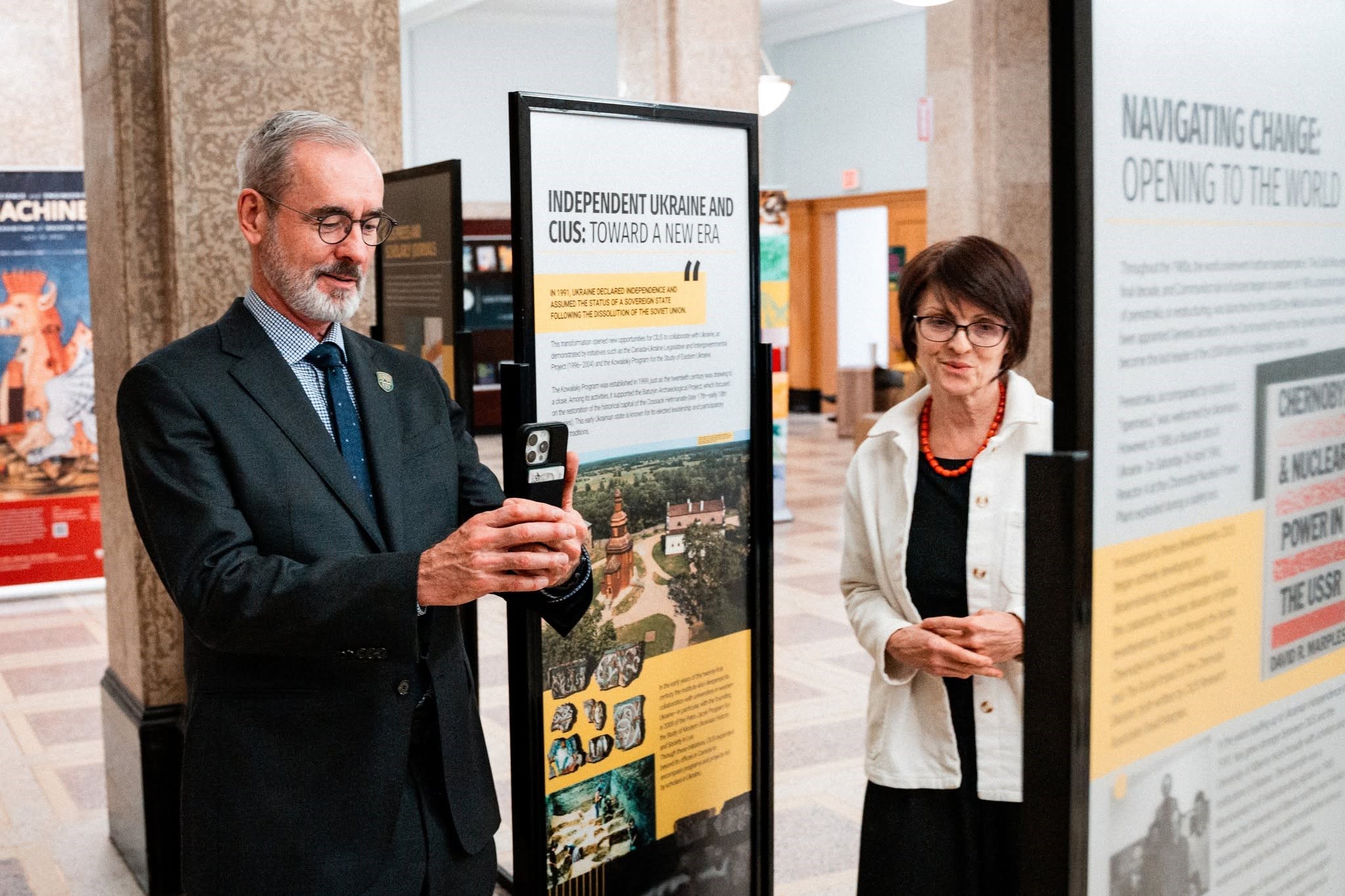
Natalia Hanenko-Friesen, Director of the Canadian Institute of Ukrainian Studies, and Serhiy Tsipko, Deputy Director for Research, gave a tour of the exhibition dedicated to the 50th anniversary of CIUS to Bill Flanagan, President of the University of Alberta
Natalia Hanenko-Friesen, Director of the Canadian Institute of Ukrainian Studies, leads a tour of the exhibition dedicated to the 50th anniversary of CIUS for Bill Flanagan, President of the University of Alberta.



