
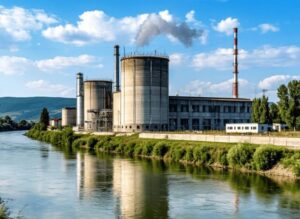
According to The Serbian Economist, on July 28, the Romanian state-owned company Nuclearelectrica conducted a controlled shutdown of Power Unit No. 1 at the Cernavodă Nuclear Power Plant due to abnormally low water levels in the Danube caused by a prolonged drought.
The decision was made in accordance with safety procedures to protect equipment related to the plant’s cooling system. The unit is scheduled to be reconnected to the national power grid once hydrological conditions improve. If water levels continue to drop, a shutdown of Unit No. 2 may be considered.
In the Romanian section of the Danube, the lowest water level in the last 30 years was recorded at the end of July. The drought has already led to restrictions on irrigation, the suspension of some ferry services, and the grounding of grain barges.
Low water levels have also disrupted passenger shipping. Near the Romanian town of Salca, a Swiss-flagged passenger ship running from Drobeta-Turnu Severin to Vidin, Bulgaria, ran aground. There were 186 passengers and 52 crew members on board. Several attempts to refloat the vessel were unsuccessful.
The problems have also spread to the international river cruise market. Several cruise ships were detained north of Budapest, and tourist cruises on certain sections of the Danube were suspended. The Hungarian company MAHART-PassNave reported an 18% drop in bookings in July and suspended sightseeing routes north of Budapest.
Cruise operator Avalon Waterways canceled several Danube cruises, including select sailings on the “Danube Dreams” and “Danube from Romania to Germany” itineraries.
The shallowing of the Danube has affected more than just Romania and Hungary. In Serbia, due to reduced inflow, production at the largest hydroelectric power plant, “Džerdap-1,” has fallen to 5,000 MWh of electricity per day—or one-third of its usual volume. In certain sections, cargo ships and fuel barges are being loaded to only 30–40% of their usual capacity.
Thus, the prolonged drought has simultaneously created risks for the energy sector, freight transport, and the tourism industry in the countries of the Danube region. The resumption of full-scale operations at nuclear power plants, as well as river cruises and cargo navigation, will depend on precipitation in the upper part of the basin and a steady recovery of water levels.



