
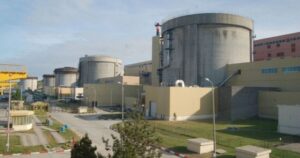
On August 13, the Romanian state-owned company Nuclearelectrica began a controlled shutdown of the second power unit at the Cernavodă Nuclear Power Plant due to a prolonged drop in the water level of the Danube, leaving the country’s only nuclear power plant temporarily without any operating reactors.
Nuclearelectrica’s official announcement was sent to the Bucharest Stock Exchange on August 13. The company notes that the decision was made due to a “significant and prolonged drop in water levels in the Danube,” based on forecasts from Romania’s National Institute of Hydrology and Water Management (INHGA).
The procedure for the controlled reduction of Unit 2’s output began this morning. Nuclearelectrica Director Romeo Urian previously reported that output is expected to drop to zero around noon, after which the unit will be disconnected from the national power grid.
Chernavoda’s Unit 1 was shut down for the same reason on July 28. At that time, Nuclearelectrica also attributed this decision to the unprecedentedly low water level in the Danube caused by a severe drought.
Each of the two operating CANDU-type reactors has a capacity of about 706 MW. Together, under normal operating conditions, they account for approximately 20% of Romania’s electricity production.
The water situation remains extremely challenging. According to INHGA data as of the morning of August 13, the Danube’s flow rate at its entry into Romania near Băziaș was only 1,350,000 cubic meters per second.
The long-term average for August is about 3,900 cubic meters per second. Thus, the current flow rate corresponds to only about 35% of the typical August level.
Most importantly, the official hydrological forecast does not yet predict a significant recovery.
This means that even if the Danube’s level stabilizes at current levels, there is still insufficient basis for a rapid return of the nuclear units to operation.
Prior to the shutdown of Unit 2, Romanian authorities took extraordinary engineering measures to divert more water toward Cernavodă.
In one section, controlled blasting was carried out on a rocky obstacle, the riverbed was deepened, and four barges loaded with rocks were deliberately sunk to partially redirect water from the Bala branch into the main channel of the Danube.
These measures yielded temporary results. After the barges were sunk, the water level in the Cernavodă area was approximately 8 cm higher than the projected trajectory, which allowed the second reactor to remain operational for several more days.
However, in the long term, it was not possible to compensate for the lack of water through engineering measures.
For the recovery of Cernavoda, what matters is not so much local precipitation directly near the plant as it is rainfall across a large area of the upper and middle Danube basin—primarily in Germany, Austria, Slovakia, Hungary, and further downstream.
The current 10-day forecast shows the first noticeable change in weather in the upper part of the basin on August 18. Thunderstorms are forecast for Vienna on August 17, and rain on August 21. Heavy rain is expected in Bratislava on August 17, followed by localized thunderstorms on August 18.
However, further downstream, the situation is less favorable. No significant precipitation is currently forecast for Budapest through August 22. Belgrade is also expected to experience mostly dry and hot weather.
In Černavoda itself, the forecast through August 22 is almost entirely dry, and after August 17, temperatures may rise above 30 degrees again.
Based on a combination of hydrological and meteorological forecasts, no significant improvement is expected by August 20.
Optimistic scenario: Heavy rainfall will occur in Austria and Slovakia on August 17–18, a new weather front will arrive around August 21, after which the Danube’s water level will begin to rise noticeably. In that case, the technical conditions for preparing the restart may be met around August 23–26.
The baseline scenario is that precipitation will be moderate and will only halt the further decline in water levels. In that case, a restart is more likely in the last week of August, around August 26–31.
The negative scenario is that rains will be localized, and the heat will persist in the middle and lower reaches. In that case, both units may remain offline into early September.
To compensate for the lost generation, the authorities will utilize several sources.
The Ministry of Energy is counting on an increase in wind power generation: in the coming days, average capacity is estimated at approximately 525 MW, and during certain periods it may reach 1.56 GW.
In addition, the 330-MW Rovinari 4 coal-fired power unit has been placed on standby, and Hidroelectrica is expected to provide at least about 300 MW of available additional capacity within the limits of existing hydropower resources. Romania has also begun purchasing electricity from Ukraine.
The total cross-border transmission capacity of the Romanian power grid for imports is approximately 4 GW. The authorities are considering, in particular, electricity supplies from southern Europe via Bulgaria.
At the same time, the shutdown of “Cernavodă” increases price risks.
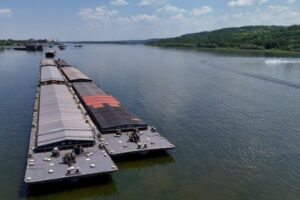
Romanian authorities plan to conduct a controlled sinking of four barges loaded with rocks in the Bala branch of the Danube to redirect more water to the Cernavodă Nuclear Power Plant and prevent the shutdown of its only operating reactor unit.
The operation is scheduled to begin on August 5 after 2:00 p.m. The barges are intended to form a temporary underwater dam and divert part of the flow from the Bala branch to the Old Danube, from where water enters the nuclear power plant’s cooling system. Authorities expect to raise the water level near the plant by 10–12 cm.
Currently, only Power Unit No. 2 is operating at “Cernavodă.” The first of the two reactors was shut down last week due to critically low water levels in the Danube. Under normal conditions, the plant’s two units account for about one-fifth of Romania’s electricity production.
Before flooding the barges, the Romanian military carried out a controlled demolition of part of the Pirjoaia underwater rock formation, which had been hindering the redistribution of the river’s flow. Following this intervention, the drop in water levels near the plant temporarily ceased. Previously, the Danube’s water level in this area had been falling by approximately 2–3 cm per day.
As of the morning of August 5, the water flow at the Danube’s entry into Romania was approximately 1,450 cubic meters per second. By August 7, this figure could drop to 1,400 cubic meters per second—nearly one-third of the long-term average for August, which stands at 3,900 cubic meters.
As early as August 1, representatives of the National Administration “Waters of Romania” warned that without emergency measures, the second power unit would be able to operate at its maximum capacity for only four to five days. If the water level drops below operational thresholds, the reactor will be shut down in a controlled manner in accordance with safety procedures.
At the same time, dredging operations are continuing in the Old Danube–Bala Branch section. Specialists must remove some of the debris left over from the explosion and secure the submerged barges, as the current could displace them and reduce the effectiveness of the temporary dam.
Romania has declared a state of energy readiness for August. Due to reduced output at nuclear power plants and other power stations, the country has increased electricity imports and called on businesses, government agencies, and the public to reduce consumption during peak-load hours.
The critically low water level of the Danube is causing problems not only for Romania. The Paks Nuclear Power Plant in Hungary has also sharply reduced production: three of the four turbines were shut down, and the remaining one was operating at only a fraction of its capacity.
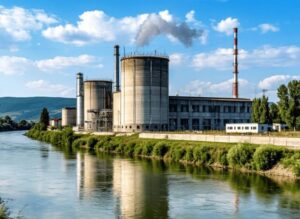
According to The Serbian Economist, on July 28, the Romanian state-owned company Nuclearelectrica conducted a controlled shutdown of Power Unit No. 1 at the Cernavodă Nuclear Power Plant due to abnormally low water levels in the Danube caused by a prolonged drought.
The decision was made in accordance with safety procedures to protect equipment related to the plant’s cooling system. The unit is scheduled to be reconnected to the national power grid once hydrological conditions improve. If water levels continue to drop, a shutdown of Unit No. 2 may be considered.
In the Romanian section of the Danube, the lowest water level in the last 30 years was recorded at the end of July. The drought has already led to restrictions on irrigation, the suspension of some ferry services, and the grounding of grain barges.
Low water levels have also disrupted passenger shipping. Near the Romanian town of Salca, a Swiss-flagged passenger ship running from Drobeta-Turnu Severin to Vidin, Bulgaria, ran aground. There were 186 passengers and 52 crew members on board. Several attempts to refloat the vessel were unsuccessful.
The problems have also spread to the international river cruise market. Several cruise ships were detained north of Budapest, and tourist cruises on certain sections of the Danube were suspended. The Hungarian company MAHART-PassNave reported an 18% drop in bookings in July and suspended sightseeing routes north of Budapest.
Cruise operator Avalon Waterways canceled several Danube cruises, including select sailings on the “Danube Dreams” and “Danube from Romania to Germany” itineraries.
The shallowing of the Danube has affected more than just Romania and Hungary. In Serbia, due to reduced inflow, production at the largest hydroelectric power plant, “Džerdap-1,” has fallen to 5,000 MWh of electricity per day—or one-third of its usual volume. In certain sections, cargo ships and fuel barges are being loaded to only 30–40% of their usual capacity.
Thus, the prolonged drought has simultaneously created risks for the energy sector, freight transport, and the tourism industry in the countries of the Danube region. The resumption of full-scale operations at nuclear power plants, as well as river cruises and cargo navigation, will depend on precipitation in the upper part of the basin and a steady recovery of water levels.

Due to the drought observed in Ukraine, autumn winter crops have already been partially lost, at the same time, the prolonged lack of precipitation intensifies the pace of the harvesting campaign and contributes to high quality corn grain, according to the analytical cooperative “Pusk”, established within the framework of the All-Ukrainian Agrarian Rada (VAR).
“The forecast model does not show precipitation in Ukraine in the near future. Therefore, the moisture content of corn grain remains low, averaging 17-20%, while in the past season it was 30-35%. This will help reduce the cost of corn grain, as one drying cycle is enough for the harvested crop,” analysts said.
They noted that in early October, agrarians will intensify the collection of corn, because they will complete the harvesting of sunflower and soybeans.
At the same time, it is noted that the shelling of ports in Odessa and Danube region hinders the export of corn. At the same time, this product is in demand from China exclusively on CIF basis with delivery in October-December at a conditional price of $250/ton.
“On all bases weekly price tags for Ukrainian corn lose 3-5$/ton. The supply of its grain is high, but logistical problems are and will continue to be a factor in the fall of prices, especially in the deployment of the harvesting campaign”, – explained in the CAP and added that in a week we can expect the following level of prices for 1 ton of corn: SRT river ports – 140-150$, DAP border – 145-155$.

French Minister of Environmental Transformation Christophe Béchou said on Franceinfo that a drought prevention committee was convened Thursday, to be followed on Monday by a meeting of all the prefects of the national territory.
“This winter is the driest since 1959,” the minister recalled, answering questions from the channel on Wednesday.
He said that France was on “drought alert.” The country has not had any significant rain for 31 days, although precipitation is expected in some places starting Feb. 22.
A meeting with prefects is expected to “look at territory by territory, what things are like,” Beshu noted.
He confirmed that strict restrictive measures on water use could be announced Monday, to begin in March, “to avoid catastrophic situations this summer.”
In view of this prospect, the minister urged that efforts to conserve water be made “already now.” To date, restrictions are already in force in parts of the eight departments of the country. In four departments, emergency water control is in place.
Climatologists are very concerned about the insufficient level of underground water reserves. The French aquifers are “two months late, in terms of filling,” according to Béchu. “It’s fixable, but we need a rainy March, we have two months ahead of us,” the minister explained.
He said that an “extensive water plan” of about fifty measures will be presented in the coming days. The French, in particular, will be encouraged to moderate the use of drinking water for technical and agricultural purposes. The minister also advocated a greater use of treated wastewater in agriculture.
In the summer of 2022, many regions in France experienced a historic drought.
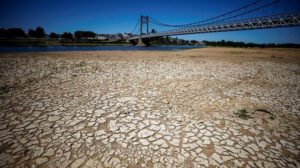
A number of EU regions will experience an unprecedented drought for another three months, the Associated Press reported on Wednesday, citing an EU report.
Drought and high air temperatures are expected in the western Mediterranean until November 2022, the report says.
It is noted that in particular this will affect Portugal and Spain.
Nearly half of the EU countries currently have a drought warning in place. In addition, the deterioration of the situation is observed in Belgium, France, Germany, Hungary, Ireland, Luxembourg and others.
Earlier it was reported that, according to the Joint Research Center of the European Commission, the current drought seems to be perhaps the worst in the last 500 years. Final data at the end of the season may confirm this preliminary estimate.
The countries of Europe, which this summer are suffering from wildfires associated with abnormal heat and drought, broke a sad record in 2022: 662.8 thousand hectares were devastated by fire.
Among the states most affected by fires this year are Spain (246 thousand hectares of burned forests), Romania (150 thousand hectares), Portugal (75 thousand hectares) and France (61 thousand hectares).



