
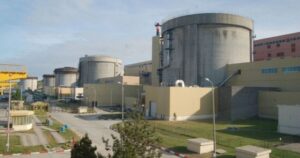
On August 13, the Romanian state-owned company Nuclearelectrica began a controlled shutdown of the second power unit at the Cernavodă Nuclear Power Plant due to a prolonged drop in the water level of the Danube, leaving the country’s only nuclear power plant temporarily without any operating reactors.
Nuclearelectrica’s official announcement was sent to the Bucharest Stock Exchange on August 13. The company notes that the decision was made due to a “significant and prolonged drop in water levels in the Danube,” based on forecasts from Romania’s National Institute of Hydrology and Water Management (INHGA).
The procedure for the controlled reduction of Unit 2’s output began this morning. Nuclearelectrica Director Romeo Urian previously reported that output is expected to drop to zero around noon, after which the unit will be disconnected from the national power grid.
Chernavoda’s Unit 1 was shut down for the same reason on July 28. At that time, Nuclearelectrica also attributed this decision to the unprecedentedly low water level in the Danube caused by a severe drought.
Each of the two operating CANDU-type reactors has a capacity of about 706 MW. Together, under normal operating conditions, they account for approximately 20% of Romania’s electricity production.
The water situation remains extremely challenging. According to INHGA data as of the morning of August 13, the Danube’s flow rate at its entry into Romania near Băziaș was only 1,350,000 cubic meters per second.
The long-term average for August is about 3,900 cubic meters per second. Thus, the current flow rate corresponds to only about 35% of the typical August level.
Most importantly, the official hydrological forecast does not yet predict a significant recovery.
This means that even if the Danube’s level stabilizes at current levels, there is still insufficient basis for a rapid return of the nuclear units to operation.
Prior to the shutdown of Unit 2, Romanian authorities took extraordinary engineering measures to divert more water toward Cernavodă.
In one section, controlled blasting was carried out on a rocky obstacle, the riverbed was deepened, and four barges loaded with rocks were deliberately sunk to partially redirect water from the Bala branch into the main channel of the Danube.
These measures yielded temporary results. After the barges were sunk, the water level in the Cernavodă area was approximately 8 cm higher than the projected trajectory, which allowed the second reactor to remain operational for several more days.
However, in the long term, it was not possible to compensate for the lack of water through engineering measures.
For the recovery of Cernavoda, what matters is not so much local precipitation directly near the plant as it is rainfall across a large area of the upper and middle Danube basin—primarily in Germany, Austria, Slovakia, Hungary, and further downstream.
The current 10-day forecast shows the first noticeable change in weather in the upper part of the basin on August 18. Thunderstorms are forecast for Vienna on August 17, and rain on August 21. Heavy rain is expected in Bratislava on August 17, followed by localized thunderstorms on August 18.
However, further downstream, the situation is less favorable. No significant precipitation is currently forecast for Budapest through August 22. Belgrade is also expected to experience mostly dry and hot weather.
In Černavoda itself, the forecast through August 22 is almost entirely dry, and after August 17, temperatures may rise above 30 degrees again.
Based on a combination of hydrological and meteorological forecasts, no significant improvement is expected by August 20.
Optimistic scenario: Heavy rainfall will occur in Austria and Slovakia on August 17–18, a new weather front will arrive around August 21, after which the Danube’s water level will begin to rise noticeably. In that case, the technical conditions for preparing the restart may be met around August 23–26.
The baseline scenario is that precipitation will be moderate and will only halt the further decline in water levels. In that case, a restart is more likely in the last week of August, around August 26–31.
The negative scenario is that rains will be localized, and the heat will persist in the middle and lower reaches. In that case, both units may remain offline into early September.
To compensate for the lost generation, the authorities will utilize several sources.
The Ministry of Energy is counting on an increase in wind power generation: in the coming days, average capacity is estimated at approximately 525 MW, and during certain periods it may reach 1.56 GW.
In addition, the 330-MW Rovinari 4 coal-fired power unit has been placed on standby, and Hidroelectrica is expected to provide at least about 300 MW of available additional capacity within the limits of existing hydropower resources. Romania has also begun purchasing electricity from Ukraine.
The total cross-border transmission capacity of the Romanian power grid for imports is approximately 4 GW. The authorities are considering, in particular, electricity supplies from southern Europe via Bulgaria.
At the same time, the shutdown of “Cernavodă” increases price risks.



