
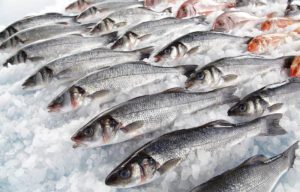
Ukraine continues to be an import-dependent state in the market of fish and fish products with a negative trade balance, while the Russian full-scale invasion has only worsened the situation in the industry.
The relevant conclusions were announced by members of the Verkhovna Rada Committee on Agrarian and Land Policy during off-site committee hearings in Izmail (Odesa region) on Thursday, according to the website of the parliamentary committee.
According to it, due to the aggression of the Russian Federation, Ukrainian producers in the Azov-Black Sea basin actually did not work in 2022 due to violations of logistics, the destruction of warehouses of frozen products by enemy shelling, the debt of retail chains for the supply of fish products and the absence of fish in the list of critical imports.
The committee also emphasizes that, in addition to military factors, the fishing industry in Ukraine suffers from systemic problems that have accumulated over the years. These are the lack of effective management for many years, in particular the lack of a strategy and program for the development of fisheries; outdated regulatory framework in the industry; the difficulty of obtaining the right to conduct aquaculture and commercial fishing, unequal access to a common limited resource and the existence of shadow fisheries.
Based on the results of the hearings, draft recommendations have been prepared, which will be considered at the committee meeting.

Last year, Ukraine increased the import of fish, crustaceans and shellfish by 28.6% compared to 2020, to $874 million, according to the website of the Institute for Agrarian Economics National Research Center on Monday.
According to the institute, Norway retained its status as the largest supplier of these products with a share of 35.2% ($307.6 million) of total imports. Norway has been holding a leading position in the import of fish and seafood to Ukraine for 15 years.
Other major suppliers of these products were Iceland with a market share of 13.2% ($113.6 million), the United States – 7.7% ($67.3), Canada – 5.6% ($49 million), Great Britain – 4.7% ($41.1 million) and Spain – 4.4% ($38.4 million). These six countries combined accounted for 71% of fish and seafood imports in 2021.
“Fish and seafood are traditionally in the top three main types of agricultural food imported to Ukraine. In 2021, the share of products of this group in the structure of foreign supplies of agricultural raw materials to Ukraine turned out to be the largest and amounted to about 11%,” expert Bohdan Dukhnitsky said.
The organization clarified that Ukraine buys mainly frozen, as well as fresh and chilled fish, fish fillets and crustaceans.
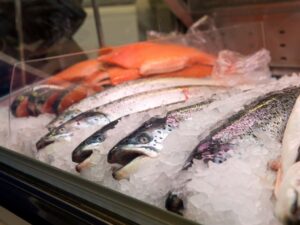
Production of ready-to-use fish products and canned fish products in Ukraine increased in January-July 2021 by 36% compared to January-July 2020, to 8,300 tonnes, the State Fisheries Agency said on the website on Thursday evening.
The agency said with reference to the State Statistics Service that production of jerked, dried, salted or unsalted fish; salted fish (but not dried); fish in brine (except for smoked fish, fish fillets, fish heads, tails and bellies) in January-July 2021 amounted to 5,990 tonnes (more by 4% compared to January-July 2020). During this period, production of jerked and dried fish amounted to 2,820 tonnes (more by 9%), fish caviar – 2,140 tonnes (more by 30%), smoked fish – 2,370 tonnes (more by 10%), ready-to-use products and canned food from herring – 1,790 tonnes (more by 1%), and salted fish (except for herring) – 1,170 tonnes (more by 1.2%).
Export of fish and other aquatic biological resources by Ukraine in January-April amounted to 3,650 tonnes, revenue from their sales abroad increased by 28% compared to the same period in 2020, to $13.9 million, the State Agency for Land Reclamation and Fisheries reported on its website on Friday.
According to the ministry, in the first four months of this year, the largest buyers of Ukrainian fish products in monetary terms were Germany, which exported products worth $4.18 million (603 tonnes), Moldova – $1.99 million (876 tonnes) and Denmark – $1.98 million (420 tonnes). Significant deliveries were made to Lithuania – $1.01 million (377 tonnes), Israel – $0.83 million (100 tonnes), the Netherlands – $0.54 million (91 tonnes), Azerbaijan – $0.54 million (215 tonnes) and the United States – $0.51 million (130 tonnes).
The State Fisheries Agency said that since the beginning of the year Ukraine had exported most of the finished or canned fish – 1,180 tonnes, fillets of fish and other fish meat (including minced meat) – 1,020 tonnes, live fish – 320 tonnes and molluscs – 290 tonnes.
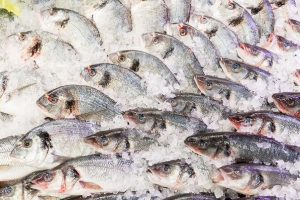
Imports of fresh or chilled fish in 2020 in physical terms increased by one third compared to the previous year, from 23,000 tonnes to 30,000 tonnes, and in U.S. dollar terms it grew by 15.4%, from $141 million to $162 million, the State Customs Service has reported. At that time, according to the data, the import of frozen fish in the past year amounted to 271,000 tonnes worth $365 million, decreasing by 5.1% and 3.1%, respectively.
Due to a general reduction in imports, the share of fresh or chilled fish of it in 2020 increased to 0.30% from 0.23% a year earlier, frozen – from 0.62% to 0.67%, the State Customs Service said.
According to the data, the export of frozen fish in 2020 amounted to only 440 tonnes for $1.1 million, having almost halved.
The State Customs Service said that the largest three countries-suppliers of fresh and chilled fish to Ukraine are Norway with the share of 82%, Turkey with 9% and Iceland with 4%, frozen – the United States with 19%, Iceland with 18%, and Norway with 14%.
In addition, in physical terms the import of fish fillets and other fish meat, dried, salted and smoked fish, crayfish and molluscs grew by 16.9%, to 58,700 tonnes, in money terms – by 20.1% to $152.7 million.
Most of all, the import of crustaceans increased – to 11,500 tonnes and to $55 million, or by 57.4% and 42.6%, respectively.
At the same time, fish fillets and other fish meat remained the main export product in this industry for Ukraine – 3,800 tonnes for $26.3 million, which is 2.5% and 13.4% higher than in 2019, respectively.

Import of fish, fish products and other aquatic biological resources in Ukraine in 2019 amounted to 399,100 tonnes for a total of $753.2 million, which is $117 million, or 18.5% more than in 2018, the State Fishery Agency has reported. In natural terms, according to data released by the Ukrainian Importers of Fish and Seafood Association (UIFSA) this week, import growth was 5%.
The association indicates that in 2018 the volume of imports in monetary terms increased by 20.5%, and in natural terms by 16%.
According to the agency, the main suppliers of aquatic biological resources to Ukraine (in natural terms) are Norway (80,000 tonnes for $205.4 million), Iceland (60,700 tonnes for $93.5 million), Estonia (39,600 tonnes for $16.8 million), the United States (30,700 tonnes for $67.6 million) and Canada (20,600 tonnes for $39.4 million).
Also, large volumes of fish products were delivered from Latvia, Spain, China, and the UK.
The agency said that about 80-90% of the volume of imports accounts for fish species, to which Ukraine does not have access, and are caught exclusively in the marine economic zones of other states.
“Basically, frozen fish or its fillets are imported to our country, which makes up 80% of imports. These products are mainly processed at domestic fish enterprises,” the agency said.



