
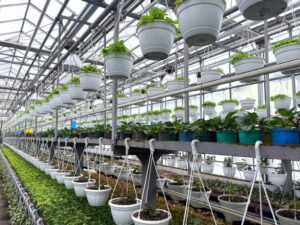
In 2026, Kyiv’s municipal enterprises plan to grow over 4 million annual, biennial, and perennial plants in their greenhouses and hothouses to decorate the city’s parks, squares, and streets, according to Valentin Mondriyevsky, deputy head of the Kyiv City State Administration.
“Even in the difficult conditions of war, Kyiv consistently adheres to its green city development strategy. Its own greenhouse facilities allow the city not only to provide stable landscaping, but also to maintain jobs and professional teams at municipal enterprises. This is an example of a systematic approach to urban environment management and a responsible attitude to the quality of the space in which Kyiv residents live,” Mondriyevsky said.
He said that the total area of greenhouses used by municipal enterprises for the maintenance of green spaces in the city’s districts is over 17,000 square meters. It is here that the painstaking work of growing flowers takes place every day—from sowing seeds to pricking out and preparing plants for planting in open ground.
Municipal enterprises independently grow a wide range of ornamental plants. These include tagetes, salvia, begonia, petunia, ageratum, gazania, verbena, antirhinum, coleus, and others. It is these plants that form the floral diversity of the capital throughout the season.
“Greenhouses and hothouses are a full-fledged production base for the city. Specialists work here who accompany the entire plant cultivation cycle—from seed to planting in urban spaces. This approach allows the city to plan greening systematically and ensure the quality of plants for parks and squares in Kyiv,” said Pavlo Ivanov, Director of the Department of Environmental Protection and Climate Change Adaptation.
Municipal greenhouse farms also perform an educational function. In 2025, educational excursions and training events for students and schoolchildren were held on their territory.
The Department emphasizes that the development of its own greenhouses is an important part of the capital’s environmental policy and an investment in a comfortable and green environment in Kyiv.
In 2025, more than 4.5 million flowers were grown in the greenhouses of the capital’s municipal enterprises, which made it possible to significantly renew and diversify the city’s green areas without additional costs for purchasing plants.

The florist market is entering its peak demand period ahead of Valentine’s Day, but the visual language of gift bouquets is changing noticeably. Instead of “flashy” packaging and standard sets, people are increasingly choosing “quiet luxury” – muted shades, natural textures, and compositions that look less like a mass-produced product and more like a story tailored to the individual.
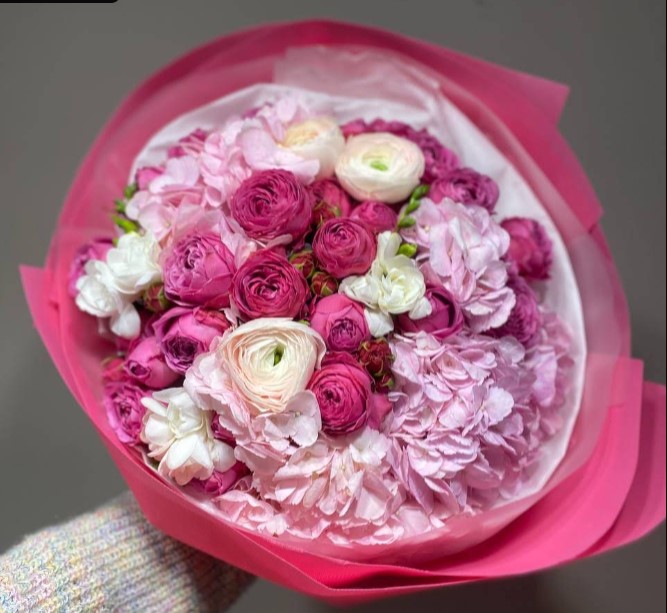
The main trend of the season is soft palettes and freer forms. Professional publications describe a shift away from hyper-saturated “Valentine’s Day” red to combinations with neutrals—blush, mauve, terracotta, sage—as well as sculptural, asymmetrical compositions where movement and “air” between the flowers are important. Roses remain an emotional anchor, but they are more often mixed with ranunculus, tulips, and “characteristic” stems to make the bouquet look modern and less formulaic.
Packaging is changing in parallel. Customers are increasingly choosing matte papers, calm tones (dusty rose, pastel lavender, warm neutrals), and natural textures that “frame” the bouquet rather than distracting from it. This visual shift is also pushing for more sustainable solutions—recyclable materials and responsible supply chain standards.
The third block is logistics and sales channels. According to industry participants, online and telephone orders are growing, as are the share of pick-ups and “last mile” deliveries in the final hours before the holiday. In 2026, when February 14 falls on a Saturday, florists expect particularly heavy weekend traffic, which increases the value of pre-orders and ready-made “pick up and gift” solutions.
In Kyiv, this model is clearly visible in the activity of local salons. For example, LeCharmé operates at two addresses (8 M. Vasilenka St. and 2A M. Donets St.) and delivers throughout Kyiv and the surrounding area.
A separate market trend is the growing popularity of arrangements in baskets and boxes: they are more convenient for delivery, do not require vases, and are perceived as a more “gift-like” format.
Ukrainian delivery services note demand in January-February 2026 for a mix of textures and colors, eco-friendly materials (kraft paper, burlap, wood), and customization “to suit the mood.”
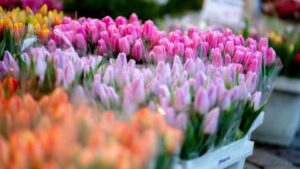
In 2025, Ukraine imported 12.85 thousand tons of cut flowers, which is 8.5% more than in 2024 (11.84 thousand tons), according to the State Customs Service.
According to the published statistics, in monetary terms, the volume of imports last year increased by 14.2% to $64.48 million, compared to $56.46 million a year ago.
The Netherlands remains the undisputed leader in supplies, providing almost three-quarters of the Ukrainian market, or 72.4% of supplies in monetary terms, or $46.68 million. Ecuador (12.8%, or $8.25 million) and Kenya (6.2%, or $4.00 million) also lead in flower supplies to Ukraine. In 2024, this trio remained the same with similar shares of supplies: the Netherlands (71.1%), Ecuador (13.5%), and Kenya (5.8%).
Flower exports from Ukraine in 2025 remained symbolic, amounting to only $184,000 at the end of the year, which is 12.5% less than in 2024 ($210,000). The main buyers of Ukrainian flowers were Moldova (59% or $108,600), Georgia (23% or $42,300), and Lithuania (10% or $18,400). A year ago, the composition of the top three buyers was slightly different: Moldova was also the leader (58% or $121,800), but it was followed by Poland (17% or $35,700) and Lithuania (12% or $25,200).
As reported, in 2021, Ukraine introduced a special three-year duty on imports of cut fresh roses, regardless of the country of origin and export. The duty rate in the first year of its application was 56%, in the second — 44.8%, and in the third — 35.84%.
Based on the results of the duty’s impact provided by the Ministry of Economy, the Interdepartmental Commission on International Trade (ICIT) concluded in 2025 that the application of special measures had a positive effect on the activities of domestic producers, but did not completely eliminate the consequences of the damage caused to them. Recommendations to extend the duty were forwarded to the ministry.



