
The Bulgarian government has proposed significantly tightening the rules for maintaining permanent residency for foreigners, including investors. According to the bill submitted to parliament, permanent residents may be required to be physically present in Bulgaria for at least 183 days during each calendar year.
Bill No. 52-602-01-29, amending the Law on Foreigners of the Republic of Bulgaria, was submitted by the Council of Ministers to the National Assembly on July 28, 2026, according to official data from the Bulgarian parliament.
The bill is currently under review, so the new regulations are not yet in effect.
The main change concerns the distinction between two residency regimes for foreigners.
For holders of EU long-term resident status, it is proposed to maintain the current principle, under which a prolonged continuous absence from the territory of the European Union may serve as grounds for loss of status.
For holders of a Bulgarian permanent residence permit, it is proposed to introduce a significantly stricter national requirement: a foreign national must actually spend more than half the year in Bulgaria.
Thus, if the bill is adopted in its current form, merely holding a Bulgarian permanent residence permit while residing permanently in another country will not be sufficient.
The new rule will affect investors
These changes are of particular significance for foreigners who obtained permanent residence through investment.
Current Bulgarian legislation provides several options for obtaining permanent residence through investment. Specifically, the official government portal lists investments of at least 1 million leva in certain Bulgarian investment funds and a number of other instruments, while a threshold of 2 million leva applies to certain types of securities.
Following Bulgaria’s transition to the euro, the corresponding amounts are converted to the new currency at a fixed exchange rate. The former threshold of 1 million leva corresponds to approximately EUR 511,300, while 2 million leva is equivalent to about EUR 1.02 million.
However, another significant change is taking effect: an investment will no longer automatically allow the holder of permanent residence to live permanently outside Bulgaria.
In the published version of the new requirement, no separate exception is provided for investment residents. This is precisely why the changes could significantly reduce the appeal of the Bulgarian investment program for people who viewed permanent residence primarily as an additional European status rather than as a basis for actually moving to the country.
The new rule potentially applies to a much broader segment than just investors. It may also apply to other foreigners with permanent residence in Bulgaria—including individuals who obtained permanent residence after a long period of residence in the country, certain family members of Bulgarian citizens, and foreigners of Bulgarian origin.
Thus, the proposed changes effectively alter the very concept of permanent residence: the state aims to more closely link the possession of this status to a person’s actual physical presence in the country.
This may prove particularly important for foreigners who hold Bulgarian permanent residence but spend most of the year working or conducting business in other EU countries, the United Kingdom, the United States, CIS countries, or the Middle East.
Investment Thresholds Are Converted from Levs to Euros
The bill also brings the financial requirements of immigration law into line with Bulgaria’s transition to the euro.
Specifically, the previous amounts in levs are replaced by their equivalents in euros.
The threshold of 1 million leva corresponds to approximately EUR 511,000, 2 million leva to about EUR 1.02 million, and 6 million leva to approximately EUR 3.07 million.
This is primarily a technical conversion, so the actual value of the investment requirements does not change significantly as a result of this change.
Permanent Residency Through Investment in Bulgaria Remains in Place; Citizenship-by-Investment Has Been Abolished
It is important to distinguish between the two programs.
Bulgaria previously abandoned the fast-track scheme for direct acquisition of citizenship through investment, which had drawn serious criticism from EU institutions.
However, the investment-based grounds for obtaining a permanent residence permit remain in place. Official government information still lists several types of investments that can serve as grounds for granting a foreigner a permanent residence permit.
It is precisely this program that may now become significantly less “passive”: it will no longer be sufficient for an investor to simply maintain their investment—if the amendments are adopted, they will also have to actually spend a significant portion of the year in Bulgaria.
It is not yet possible to speak of the mandatory 183 days as a rule that has come into effect.
The bill has only just been submitted to parliament and must undergo review by the relevant committees and the parliamentary procedure. The National Assembly currently lists it on its official website as a document submitted by the Council of Ministers, with no information regarding its final adoption.
During the review process, lawmakers may amend the 183-day requirement, add exemptions for certain categories of foreigners, or provide for a transition period for current permanent residents.
Legal experts have specifically pointed out the absence of a clear transition mechanism in the initial draft. Therefore, one of the most important issues to be addressed during parliamentary review will be whether the new requirements will apply to foreigners who obtained permanent residence under the previous rules.

Ukrainian citizens ranked second among the largest groups of foreign residents in Germany as of the end of 2025, trailing only Turkish citizens.
According to data from the German Federal Statistical Office, 1.409 million Ukrainian citizens were living in the country as of the end of 2025. This is an increase from the previous year, when the figure stood at 1.334 million.
Turkish citizens remain the largest foreign group in Germany, numbering 1.520 million people. They are followed by Ukrainians, then Syrian citizens (936,3 thousand), Romanian citizens (903,8 thousand), and Polish citizens (839,7 thousand).
Thus, Ukrainians have become the second-largest foreign community in Germany. This is a direct consequence of Russia’s full-scale war against Ukraine and the mass displacement of Ukrainians to EU countries after 2022.
At the same time, the overall demographic situation in Germany has deteriorated. According to Destatis, the country’s population in 2025 declined for the first time since 2020—to 83.5 million people. Net immigration of 235,000 people was no longer sufficient to offset natural population decline: the number of deaths exceeded the number of births by 352,000.
For Germany, Ukrainian migration remains an important demographic and labor factor. Against the backdrop of an aging population and a labor shortage, Ukrainians have already become one of the key groups of foreigners in the country, and their integration into the labor market, education system, and social welfare system will have long-term significance for the German economy.

Georgia’s residential real estate market continues to grow: in April 2026, apartment sales in Tbilisi and Batumi showed double-digit growth, and foreign buyers remain a key driver of demand, particularly on the Black Sea coast.
According to data from the Recov.ge platform, developed by Colliers Georgia, 3,603 apartment transactions were recorded in Tbilisi in April 2026, a 12.7% increase compared to the same month last year. The market’s total transaction value grew by 28.3% to reach $310 million.
Growth in the capital was recorded in both the primary and secondary markets. The number of transactions in new projects increased by 14.6% year-over-year, including a 10.7% increase in the primary market and a 20.4% increase in the secondary market for new construction. Transactions involving older apartments also rose—by 6.2%.
Prices in Tbilisi also continued to rise. In April, the weighted average price per square meter for new apartments rose by 10.2% in the suburbs, by 2.2% in the wider city center, and by 12.1% in the city center. Overall in Tbilisi, the price of primary market transactions increased by 11.2%, and in the secondary market by 11%.
At the same time, the capital’s market remains predominantly domestic. In April 2026, Georgian citizens continued to dominate among buyers in both older and new developments, while foreign buyers accounted for 10.7%.
In Batumi, the market is more dependent on foreign demand. In April 2026, 1,292 apartments were sold in the city, which is 12.3% more than a year earlier. The market’s total value grew by 27.4% to reach $85 million. For comparison, 1,165 apartments were sold in Batumi in April 2025, and 1,234 in April 2024.
The new-construction segment saw the most active growth. Sales of apartments in new projects increased by 12.3%, while transactions involving existing housing decreased by 5.4%. Growth in the primary market was 13.3%, and in the secondary market for modern projects, 11.6%.
The weighted average price per square meter in new buildings in Batumi rose by 11.3% year-over-year in April, reaching $1,351. Price growth was 15.2% in the primary market and 9.4% in the secondary market.
The main feature of Batumi remains the high share of foreign buyers. In April 2026, foreigners accounted for 47% of transactions involving both older and new apartments, as well as 90% of the total increase in the number of transactions. This means that foreign demand was the primary driver of the market’s acceleration.
According to Galt & Taggart data for the first quarter of 2026, the share of foreigners in the Batumi apartment market was even higher: Georgian citizens purchased 37% of apartments, while foreign buyers accounted for 63% of transactions. Buyers from European countries constituted the largest group, accounting for 18% of all sales. Another 16% of transactions were made by citizens of Ukraine, Russia, and Belarus. Buyers from Israel accounted for 10%, from Turkey—4%, from Arab countries—3%, and from other countries—about 12%.
This structure indicates that Batumi remains an investment market focused on external demand, short-term rentals, and the purchase of resort real estate. In contrast, Tbilisi remains primarily a residential market: according to TBC Capital, about 80% of purchases in the capital are for residential purposes, whereas in Batumi, about 85% of purchases are for investment purposes.
In the longer term, the Georgian market continues to normalize following the surge in 2022, when demand rose sharply due to migration flows. According to TBC Capital, in 2024–2025, demand growth slowed to 5.6–6.0% per year, and in 2026, the company forecasts residential real estate market growth of approximately 4.5%.
In 2025, according to TBC Capital, 78,500 real estate transactions were registered in Georgia, which is 6% more than the previous year. Of these, 49,200 transactions were in the secondary market, and another 29,300 were in the primary market. The average housing price in Tbilisi reached $1,312 per square meter, increasing by 4.1% over the year, while in Batumi it reached $1,395 per square meter, which is 16.5% higher than the previous year’s level.
Georgia remains attractive to foreign buyers due to its relatively low entry barrier, growing tourist traffic, straightforward transaction processes, and high rental yields compared to many European markets. However, rapid growth in supply, particularly in Batumi, and a gradual decline in rental yields may limit further price growth.
Effective March 1, 2026, Georgia also raised the minimum real estate investment threshold for obtaining a temporary residence permit to $150,000. This may shift demand toward more expensive properties and long-term investors, but at the same time reduce interest among some buyers focused on smaller apartments.

In 2025, 9,582 work permits were issued to foreign nationals and stateless persons, and 3,310 were revoked. Thus, 6,272 migrant workers remained in the country, accounting for 0.14% of the 4.5 million workers needed to fill the labor market, a well-informed government source told the Interfax-Ukraine news agency.
The State Employment Service also confirms the small share of foreigners in the domestic labor market. According to the agency’s statistics, prior to the full-scale invasion, employers received approximately 21,000 work permits for foreigners annually.
“After 2022, this figure decreased and has not yet reached pre-war levels. For example, 4,720 permits were issued in 2024, and 7,483 in 2025. This is more than half the number issued before the start of the full-scale war,” the Employment Service’s website states.
The State Migration Service provides slightly different statistics. As of December 31, 2025, there were 47,684 foreigners and stateless persons (temporary residents) registered in Ukraine. Of these, 8,440 temporary residence permits were issued for the first time in 2025.
However, all agencies agree that the share of foreigners in the domestic labor market is negligible. After all, when processing documents, aside from the employer’s consent, numerous issues arise regarding visas, SBU checks, residence permits, and other matters, which is why only a fraction of workers actually come to Ukraine.
Thus, despite labor migration, the labor market is increasingly feeling a shortage of workers.
“That is why it is now necessary to develop a new migration policy, taking as an example the legislation of countries that are successful in this regard, such as Canada, Australia, or Israel. Then there will be no speculation, and the problem of securing a workforce for Ukrainian businesses will be resolved,” the agency’s source emphasized.
Although, in his opinion, it is certainly best to focus on preserving the domestic labor force so that Ukrainians return from the EU rather than leave for it. And only after that, once we understand how many workers are lacking and in which sectors, should we attract foreign workers for specific projects, establishing rules for employer companies and ensuring oversight of them by the State Labor Service.
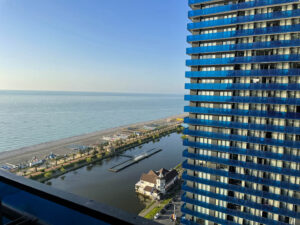
Foreign buyers have become the main driver of growth in Batumi’s residential real estate market: in April 2026, their share of apartment transactions reached 47%, approaching half of the total market. This confirms that Georgia’s largest Black Sea resort is increasingly transforming from a local housing market into an international investment hub.
According to data from the Recov.ge platform, 1,292 apartments were sold in Batumi in April 2026, which is 12.3% more than in April 2025, when 1,165 transactions were recorded. The total market volume for the month grew by 27.4% and reached $85 million.
This growth was accompanied by a noticeable increase in the price per square meter. The weighted average price in new Batumi developments rose by 11.3% year-over-year to $1,351 per square meter. Prices in the primary market rose by 15.2%, and in the secondary market by 9.4%. At the same time, demand is concentrated specifically in new and modern projects: sales in new developments rose by 12.3%, while interest in the existing housing stock declined by 5.4%.
The key driver of growth is foreign capital. Non-residents accounted for 90% of the net increase in the number of transactions in April. Leo Chikava, Head of Research and Data Analysis at Colliers Georgia, notes that the share of foreign buyers has remained stable in the range of 44–47% in recent months, and during certain periods, foreign buyers have already surpassed local buyers in terms of activity.
Batumi differs significantly from Tbilisi in terms of demand structure. In the Georgian capital, domestic buyers remain the main driving force of the market: according to Galt & Taggart, in a January survey of developers, Georgian buyers accounted for about 77% of primary sales in Tbilisi. In Batumi, the situation is reversed: foreign demand is much more significant, and the share of foreign buyers in the surveyed projects reached 52%.
Among the most active foreign buyers in Batumi are citizens of Israel, Russia, and EU countries, as well as buyers from Ukraine, Belarus, and other post-Soviet states. According to Global Property Guide, citing Galt & Taggart, in 2025, buyers from the EU and Israel each accounted for 13% of sales in the surveyed projects in Batumi, while buyers from Ukraine, Russia, and Belarus together accounted for 11%. The exact share of Ukrainians is not disclosed in this report.
In 2025, the Batumi market had already surpassed the $1 billion mark in total value of apartments sold, and the number of transactions reached 17,053, which is 14.7% more than the previous year.
For foreign buyers, Batumi remains attractive due to a combination of a relatively low entry price, its seaside location, a high proportion of new projects, rental potential, and a relatively lenient real estate purchase regime. Against this backdrop, the city competes not only with Tbilisi but also with resort markets in Turkey, Montenegro, Bulgaria, and Cyprus.

Bali authorities are tightening controls on foreigners by stepping up checks on compliance with visa regulations, residency rules, and employment laws on the island. The decision stems from a rise in violations by foreigners and the province’s shift toward a “quality tourism” model, under which authorities aim to attract affluent and law-abiding visitors rather than simply increasing overall tourist numbers.
Among the recorded violations, 2,026 cases led to the immediate revocation of residence permits and forced deportation. Another 1,323 foreign nationals were officially barred from entry and added to Indonesia’s long-term national blacklist. The remaining violators were sent to temporary detention centers or received substantial fines.
Bali’s immigration authorities have also launched a 24-hour hotline through which residents and businesses can report possible violations of immigration rules by foreigners. This includes, in particular, visa overstays, illegal employment, violations of stay conditions, and other activities not permitted under the type of visa.
Authorities are paying particular attention to foreigners who work or conduct commercial activities on tourist visas. The Indonesian Immigration Service has warned that even unpaid advertising or promotional activities may be considered a violation of visa regulations if they are effectively related to work or business promotion. Bloggers, influencers, and content creators have come under increased scrutiny.
Bali authorities are also preparing additional entry rules for foreigners. Starting in 2026, tourists may be screened for financial solvency, length of stay, and stated travel plans. Bali Governor Wayan Koster stated that one element of “quality tourism” could involve verifying tourists’ savings from the previous three months.
Bali remains one of Asia’s most popular tourist destinations, but mass tourism is straining the island’s infrastructure, housing market, transportation, and cultural sites. In recent years, local authorities have increasingly emphasized the need to protect traditions, public order, and the economic interests of local residents.
For foreigners, this means that travel to Bali is becoming more regulated. Tourists need to pay closer attention to their visa validity periods, refrain from working without the appropriate permit, observe local rules of conduct, and be prepared for stricter checks of documents and the purpose of their stay.
Tighter controls are also significant for the real estate and relocation markets. Bali remains a popular destination for remote workers, entrepreneurs, and long-term renters; however, the authorities are sending a clear signal: residency on the island must correspond to visa status, and attempts to use a tourist visa for actual work or business may result in fines, deportation, and a ban on entry.



