
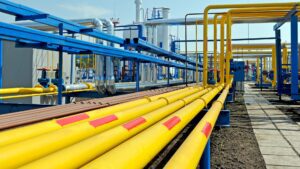
Ukraine may return to the idea of attracting European and American companies to manage its gas transmission system (GTS), Advisor to the Minister of Energy of Ukraine Lana Zerkal has said, expressing this opinion on the air of ICTV TV channel.
“This may be the same idea that was in 2019 for a joint consortium involving European and American companies to use the Ukrainian pipeline,” the ministry’s press service said, citing her.
According to Zerkal, this step will contribute to the lifting of Gazprom’s export monopoly on gas sales, since European consumers will have access to the GTS, deciding which gas supply route is more profitable for them.
“This is a geopolitical problem and it must be resolved at the geopolitical level using mechanisms inherent in geopolitics. Nord Stream 2 has become a stumbling block for the whole of Europe and for transatlantic relations. This is not only a question of Ukraine. This gas pipe has become an issue and a subject of international negotiations at the highest level,” Zerkal said.
She recalled that with the help of Ukraine’s partners in the European Union, it was already possible to amend the EU Third Gas Directive, which provides for its application to Nord Stream 2.
“It is very important that it be applied in full, because it will make it possible to balance market relations if Nord Stream 2 is nevertheless completed, certified and launched,” she said.
According to her, the EU has tools that can secure Ukraine from the use of Nord Stream 2 in full, leaving the Ukrainian GTS without transit.
“But for this we need to work with the European Commission, as well as with other countries that are also not interested in the launch of Nord Stream 2,” Zerkal said.
Romania’s gas transmission system (GTS) operator SNTGN Transgaz has started selling capacity at the point of interstate connection with Ukraine Orlivka/Isaccea-1 on the RBP auction platform since April.
In this regard, the Gas Transmission System Operator of Ukraine (GTSOU) congratulated the Romanian colleagues in its message, expressing hope for the signing of interaction agreements at other points of connection between the countries.
“GTSOU constantly and systematically works with all its colleagues to ensure that such practices become a reality on each border with Ukraine and contribute to the further integration of Ukrainian and neighboring markets. We are glad that Romanian colleagues have now joined Poland and Hungary. This is another step towards easing the use of the Trans-Balkan Gas Corridor. We hope that our Slovak colleagues will support the trend of introducing auctions even before the end of 2021,” Director on Government and International Affairs Olha Bielkova said.
GTSOU said that the distribution of capacities at auctions is a transparent mechanism for the sale of services for the transportation of natural gas, in accordance with the Third EU Energy Package. From October 1, 2020, GTSOU, like all EU countries, distributes capacities to all points of interstate connection exclusively through auctions.
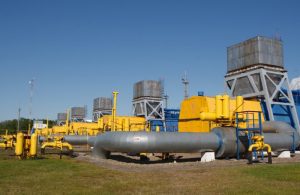
Transit of natural gas through the gas transmission system (GTS) of Ukraine in January-August 2020 amounted to 34.8 billion cubic meters., which is 42% less than in the same period in 2019 (59.6 billion cubic meters).
According to the report of Gas Transmission System Operator of Ukraine LLC (GTSOU), 32.4 billion cubic meters of gas were transported in the western direction (Slovakia – 23.9 billion cubic meters, Hungary – 5.9 billion cubic meters, Poland – 2.6 billion cubic meters), which is 36% less than in January-August-2019, in the trans-Balkan region – 2.3 billion cubic meters (Moldova – 1.87 billion cubic meters, Romania – 0.46 billion cubic meters), which is 73% less than last year in this direction.
Despite a significant drop in transit compared to last year, Gazprom (Russia) fully pays for the transit capacity booked for this year (178 million cubic meters per day), which it used by 80% in January-August.
“For its part, GTSOU fulfills all daily requests and will continue ensuring uninterrupted gas transportation to European countries in the future,” the company said.
Ukrainian President Petro Poroshenko has warned Germany against participation in the Nord Stream 2 gas pipeline project, suggesting, as an alternative, the modernization of a transit gas pipeline passing through Ukrainian territory.
In an interview with German business newspaper Handelsblatt, extracts from which were published by the Ukrainian service of Deutsche Welle, Poroshenko noted that Nord Stream 2 was a political project that is financed by Russia and has no economic justification.
“Nord Stream 2 is a political bribe for loyalty to Russia, imposing an economic and energy blockade on Ukraine, which will hurt us greatly,” he said.
According to him, an alternative solution is the modernization of the existing transit gas pipeline that passes through Ukraine. Poroshenko also said that the development of the gas transportation infrastructure in Ukraine would not require multibillion investments.
On March 27, Nord Stream 2 AG received the permit for the construction and operation of the Nord Stream 2 pipeline system in the German exclusive economic zone (EEZ). The Nord Stream 2 gas pipeline is to pass across the Baltic Sea, connecting Russian suppliers with European consumers at over 1,200 km in length. The pipeline will have capacity for 55 billion cubic meters of gas per year. The project has an estimated cost of almost 10 billion euros. Gazprom’s partners in the project are Engie, OMV, Shell and two German companies BASF and Uniper.
In early April, the Verkhovna Rada urged foreign parliaments, governments and the international business community not to participate in the preparation, financing or lobbying of the construction of the Nord Stream 2 gas pipeline.



