Why not all children can be removed from state custody
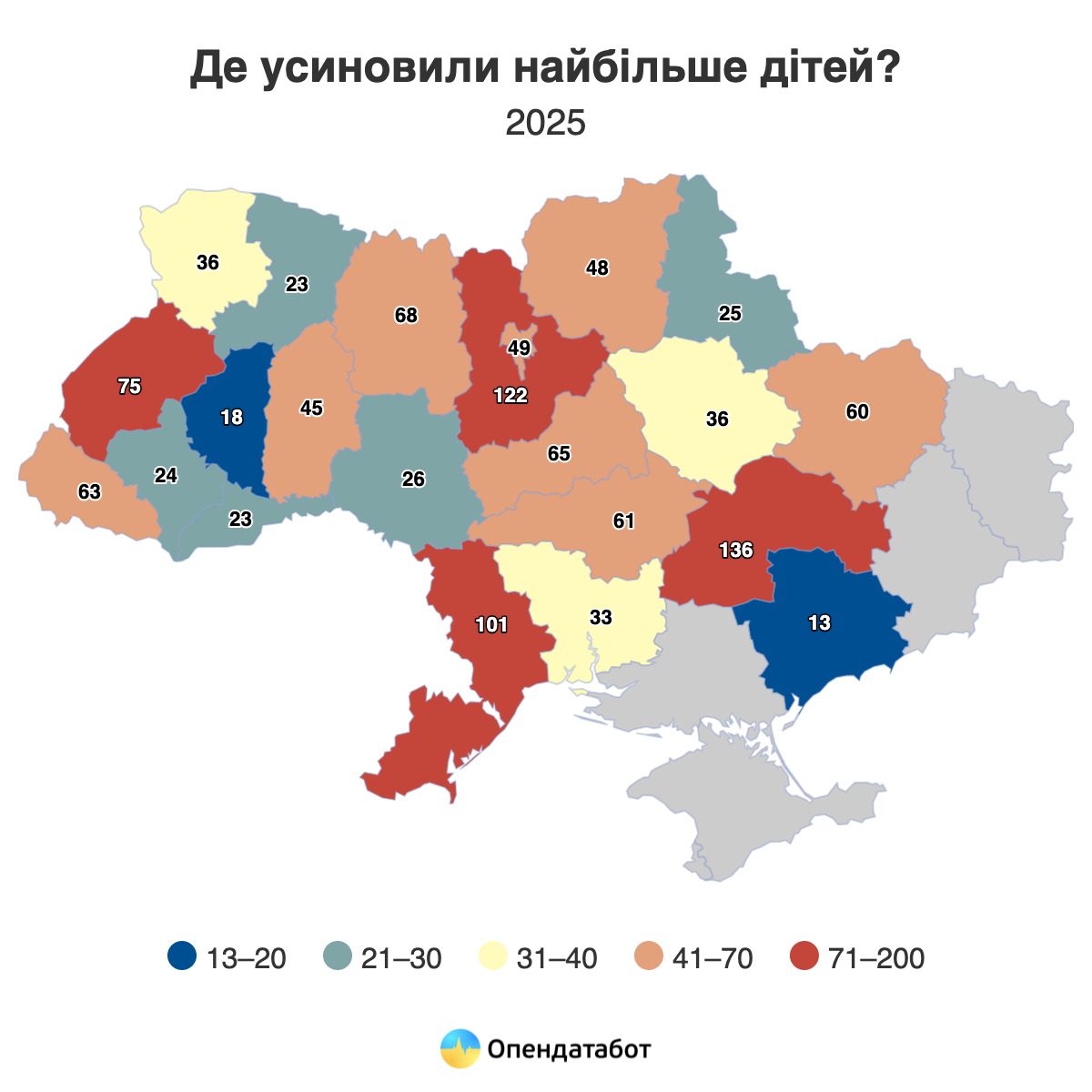
According to the State Service of Ukraine for Children’s Affairs, there were 59,350 orphans and children deprived of parental care in Ukraine as of the end of 2025. This is 4% fewer than in 2024. At the same time, 2,097 prospective adoptive parents are currently registered. On average, there are about 28 children per prospective adoptive parent; however, 1,150 children were placed with new families, and another 6,600 children were placed in foster care last year. The highest number of adoptions and, at the same time, the highest number of children in state care are in the Dnipropetrovsk region.
There were 59,350 orphans and children deprived of parental care in Ukraine as of the end of 2025. This is 4% fewer than in 2024. Overall, the number of such children decreases by an average of 3% each year.
One-third of all these children—20,705—are orphans, meaning those who have lost both parents. The other children are deprived of parental care for various reasons—and by no means all of them can be legally adopted.
“Of the 60,000 children in residential care facilities, only about 5,000 have the status that allows them to be adopted. The rest are so-called social orphans: they have parents or legal guardians, but for various reasons live in institutional facilities. Consequently, they cannot formally be adopted,” notes lawyer and adoptive parent Inna Miroshnychenko
The overall picture is that the number of people wanting to adopt a child is increasing year by year. However, 2025 was an exception: the number of applicants decreased by 13% over the year. In total, 2,097 prospective adoptive parents are currently registered in Ukraine. 77% of them, or 1,619 adoptive parents, are married couples. However, there are still 479 single individuals who wish to take on the responsibility of caring for a child.
Nearly half of all applicants are people between the ages of 40 and 50. Another 41% are under 40, and only 10% are over 50.
The largest number of candidates live in Kyiv (244) and the Kyiv region (224). There are also many adoptive parents in the Lviv and Dnipropetrovsk regions—191 and 182 candidates, respectively.
Despite this, the number of adoptions in 2025 decreased. Last year, 1,150 children found new families. This is 10% fewer than in 2024, when a record number of children were adopted since the start of the full-scale war—1,273 children.
“The adoption procedure itself is fairly clear, understandable, and not overly complicated in formal terms, but it takes a long time. Another major barrier is the territorial system for matching children: an applicant registers in their district and receives information only about children registered there. Previously, this problem was partially solved by the Ministry of Social Policy’s database, where one could view children who had not been placed locally; however, this tool is no longer operational, and as a result, applicants often simply cannot find ‘their’ child,” explains attorney and adoptive parent Inna Miroshnychenko.
The lawyer also notes that a significant portion of the children in the system are not single children but large family groups: three, five, sometimes even more brothers and sisters. They cannot be separated, whereas most prospective adoptive parents are willing to take in one child, at most two. Only a few are willing to take three or four at once.
“Many adoptive parents are looking for a physically healthy child, of whom there are very few in the system. It is important to understand that children end up in residential care facilities not because they have it easy: they may have health or developmental issues caused by difficult conditions in their biological families and in residential care facilities. Also, for most prospective adoptive parents, the child’s age is important—they mostly look for young children of preschool age. However, most of the children in the system who are available for adoption are older children, often teenagers,” comments Inna Miroshnychenko.
Dnipropetrovsk Oblast has led in the number of adoptions for three years in a row—136 children found new families last year. Next are Kyiv Oblast (122 children) and Odesa Oblast (101 children). At the same time, Dnipropetrovsk Oblast has the highest number of orphans and children without parental care—7,397 children.
In addition to adoption, children are also placed in foster care or under guardianship. Thus, 6,627 children found new families in this way in 2025. This is 7% less compared to 2024.
https://opendatabot.ua/analytics/orphans-adoption-2026