
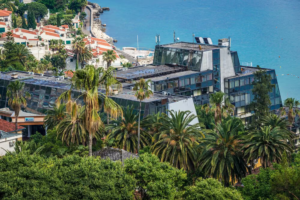
One of the well-known hotels on the Montenegrin coast — Plaza in Herceg Novi — will be put up for public auction on September 14. The property together with the land plot has been valued at €30.742 million, the Serbian business portal Parametar.rs reports.
At the first auction, the hotel cannot be sold for less than 80% of its appraised value, so the minimum price will amount to about €24.6 million. To participate, potential buyers were required to pay a deposit of €3.074 million.
The sale is connected with a years-long dispute surrounding the company Vektra Boka, which managed the property. The proceeds from the sale of the assets are to be used to settle the claims of former employees and other creditors. Among them are the municipality of Herceg Novi and the local Water Supply and Sewerage company. CKB banka also has separate claims against Vektra Boka.
If no buyer is found at the first auction, at the second one the minimum price may fall to 50% of the valuation — approximately €15.37 million.
The package being sold includes land worth €7.01 million and buildings worth €23.73 million. The area of the main hotel property is about 5.44 thousand sq. m.
Source — Parametar.rs

The international hotel management company Ribas Hotels Group (RHG) has joined the nationwide project to promote hotel accessibility, “Space with Opportunities.” WOL.GREEN Polyana has undergone an independent audit, the group’s press service reported.
“Today, accessibility is no longer a competitive advantage that sets a hotel apart from others, but rather a basic requirement for all market players. Amid the war, the number of people with amputations and disabilities is growing, and businesses must ensure equal opportunities for all,” notes Anastasia Ocheretnyuk, PR Lead at Ribas Hotels Group, whose remarks are quoted in the press release.
Inclusivity requirements under Ukraine’s State Building Codes (DBN) are constantly being raised (the latest changes took effect on August 1, 2025; work is currently underway on a new edition—IF-U), and it is not always possible to fully implement these innovations in existing projects. In particular, in the existing hotels of the RHG chain, accessibility has so far been implemented mainly in part—through individual elements such as adapted rooms, ramps, or elevators, the press service explains. Accessibility is being incorporated more comprehensively into new projects that the group is building from the ground up, particularly at “WOL Vinnytsia” and AMA Family Resort, where relevant solutions are planned as early as the design phase.
To assess how truly accessible these solutions are in practice, the Ribas Hotels Group participated in Metro Ukraine’s special project “Space with Opportunities,” carried out in collaboration with the nonprofit organization “Dostupno.UA,” during which 10 free audits of hospitality establishments across Ukraine were conducted. The project’s goal is to help HoReCa businesses create accessible spaces for guests and staff amid the growing number of people with disabilities in Ukraine as a result of the war—a number that, according to rough estimates, could reach 300,000–400,000 people in the post-war period.
The RHG network selected the WOL.GREEN Polyana Hotel for the audit; the company had renovated this unfinished building while the full-scale war was still underway, which allowed it to incorporate some accessibility standards right from the construction phase. The audit confirmed a number of implemented solutions: barrier-free common areas, a reception desk with two service areas, a universal restroom with standard handrails, and an elevator that complies with regulations. At the same time, the experts provided the hotel with recommendations on how to design a guest room adapted for guests with disabilities.
According to Tetyana Morozova, head of the architecture division at TEMO Design, incorporating barrier-free solutions into a project from the very beginning is always less expensive than retrofitting a completed facility. At the same time, inclusivity is not limited to the width of passageways or ramps, but encompasses the guest’s entire journey through the hotel: navigation, lighting, acoustics, and psychological comfort.
Ribas Hotels Group was founded in 2014 in Odesa as an international full-cycle management company and a hotel business ecosystem. It manages the entire process: from site selection, design, and construction to management, franchising, and investment. It is the only hotel group in Ukraine that independently handles all stages of creating and developing hotel projects.
The company’s portfolio includes 56 projects currently in the construction phase, launch phase, or under management, including locations in Ukraine, Poland, Turkey, and Bali. It develops 3-, 4-, and 5-star city and resort hotels under the brands Ribas Hotels, Ribas Rooms, WOL home + hotel, and Mandra Moments. The operator’s total room inventory exceeds 1,000 rooms.
accessibility, AUDIT, HOTEL, inclusivity, RIBAS HOTELS GROUP

The growth potential for the market capitalization of Transcarpathia’s tourism clusters over the next three years could reach 40–50%, and 60% for the Skole District in Lviv Oblast, according to the study “Promised vs. Real” by Ribas Invest and Ribas Hotels Group.
As explained to the “Interfax-Ukraine” news agency, this level of market capitalization is driven by growing tourism demand in regions where competition among professional developers remains minimal.
“The market has learned to look not where everything has already been built, but where infrastructure is just taking shape. The difference in land prices between overheated and new locations is now as much as tenfold—this is the ‘window’ for entry before capital floods in,” explained Artur Lupashko, founder of Ribas Hotels Group.
As part of a comprehensive audit of Ukraine’s hotel and recreational development sector, Ribas Invest has identified clusters of locations where entry costs have not yet peaked, despite rapidly growing demand. These include, in particular, the Sinyak–Pylypets–Podobovets corridor in Zakarpattia, the Skole–Tukhlya corridor in Lviv Oblast, and the Kaniv–Cherkasy corridor along the Dnipro River.
According to the study, the average price per 100 square meters of land in the village of Polyanytsia (Bukovel) is $25,000–45,000, in Pylypets—$3,500–6,000, and in the Skole District—$1,500–3,000. The difference in land prices between these locations reaches 1,000%, while the cost of renting a ready-to-use room differs by only 20–25%.
Researchers also note that by 2026, Zakarpattia will have upgraded rail and road logistics, which will make the region comparable to Ivano-Frankivsk in terms of accessibility—at one-third the cost of assets.
Other promising destinations include the Shatsk–Svitiaz lake region in Volyn, the suburbs of Kyiv, and the Odesa coast, where demand is driven by the desire for safe suburban getaways and energy-independent real estate.
Ribas Hotels Group—founded in 2014 in Odesa—is an international full-cycle hotel management company and a hotel business ecosystem. It integrates the entire process—from site selection, design, and construction to management, franchising, and investment.
Ribas Hotels Group is the only hotel group that independently handles all stages of creating and developing hotel projects.
The company’s portfolio includes 56 projects currently under construction, in the launch phase, or under management, including locations in Ukraine, Poland, Turkey, and Bali. The company develops 3-, 4-, and 5-star city and resort hotels under the brands Ribas Hotels, Ribas Rooms, WOL home + hotel, and Mandra Moments.
The operator’s total room inventory exceeds 1,000 rooms.
HOTEL, INVESTMENT, RIBAS, Skole District, TOURISM, ZAKARPATTIA
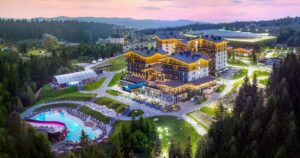
Apartel Skhidnytsya is a 5-star wellness resort in Skhidnytsia featuring 269 rooms of various types and 12 cottages. From the very beginning, the resort was conceived as a year-round destination, so the summer season here boasts extensive amenities and a packed calendar of events.
The Summer Series 2026 kicked off on May 16 with a performance by MONATIK. A series of major concerts and events is scheduled at the resort throughout the summer. One of the highlights will be a performance by Dorofeeva & Positiff, who are reuniting as a duo after a long hiatus. This is a major event for the Ukrainian music scene and a comeback that fans have been waiting for for years. Also on the season’s lineup are Druga Rika, CHEEV, Vitaliy Kozlovskyi, ARKUSH, DZIDZIO, Anna Trincher, Ochi v Ochi, Mila Nitić, YAKTAK, KOLA, and other artists.
One of the main summer venues will be Central Park, a large outdoor space on the grounds of Apartel Skhidnytsya. In winter, it served as an ice rink, and this season it will become an active recreation area with a roller rink, two padel courts, a tennis court, and a multi-purpose field for soccer, basketball, and volleyball.
An outdoor pool with a waterfall has already been prepared for the summer, featuring the renowned Chornomork restaurant, which adds a touch of the Black Sea to the Carpathian getaway. They have also renovated one of Apartel Skhidnytsya’s signature features—the Infinity Pool. This pool offers a panoramic view of the Carpathians, bringing “a piece of the sea to the mountains.”
One of the resort’s strongest offerings is wellness. In 2025, Apartel Skhidnytsya received an award from the World Luxury Hotel Awards. It combines a 2,000 m² spa, a medical Biohacking Center, physical therapy, wellness programs, and personalized bodywork sessions. Guests can come for a few days to unwind or undergo longer restorative treatments to improve sleep, reduce fatigue, and give their bodies time to fully recharge.
This summer, a day camp featuring a program in the format of a large-scale game will be launched for children. Participants will have their own journals, complete challenges, collect badges, and take part in various activities throughout the day. The program will include quests, creative workshops, games with non-toxic paints, water balls, and boats. A special highlight will be evening stargazing through a telescope.
The culinary offerings at Apartel Skhidnytsya complement the resort’s overall experience. There are two restaurants, a lobby bar, and a food court on the premises, and the menu combines European cuisine, local products, and signature dishes so that guests can choose a dining experience that suits their vacation rhythm.
Gastronomic evenings, creative workshops, orchestra performances, and open-air events are also planned for the summer. At Apartel Skhidnytsya, we aim to create a vacation experience where every day has its own atmosphere and a reason to make it brighter and more fulfilling.
“You shouldn’t directly compare the sea and the mountains. These are different vacation scenarios. Our goal is to give guests everything they come for on vacation—and a little more. Pools, sports, a spa, medical rehabilitation, children’s programs, concerts, gastronomy, and service should work together as a single experience. When a person gets all of this in one place, there’s no need to explain why they should come back,” comments Vasyl Krulko, co-owner of the Apartel Resorts hotel chain.
The resort holds the international Green Key eco-certificate, which confirms the resort’s compliance with modern standards of eco-friendly and responsible hospitality. At the same time, Apartel Resorts works with the local community to develop the region as a year-round resort.
Apartel Skhidnytsya Wellness Resort is the kind of destination that is increasingly drawing visitors to Skhidnytsya for a full, enriching vacation—a place to spend time with family, have fun, attend large-scale concerts, and truly recharge.

According to Serbian Economist, Jared Kushner’s company may demand up to EUR50 million in compensation from Serbia for failing to fulfill the terms of the contract regarding the construction of a hotel and residential complex on the site of the former General Staff building in central Belgrade, said Marinka Tepić, vice-chair of the opposition Freedom and Justice Party.
According to her, the contract between the Serbian government and Kushner’s company stipulated obligations on Serbia’s part regarding the preparation of the site for the project, but these were not fulfilled. Tepić claims that because of this, Kushner’s company may seek compensation of EUR50 million.
So far, this is merely a statement by an opposition politician, not a publicly confirmed lawsuit or an official claim by Kushner’s company.
The project involved the site of the former General Staff complex in Belgrade, which was damaged during the NATO bombings in 1999. The complex had long held cultural heritage status, but in 2024, the Serbian government removed its protected status, paving the way for the development project.
According to media reports, the Serbian side agreed to transfer the site to a company linked to Kushner under a long-term 99-year lease. The project called for the construction of a hotel, apartments, and office and commercial spaces in one of Belgrade’s most prominent locations.
The initiative sparked strong opposition from Serbian opposition groups, architects, and activists. For many Belgrade residents, the General Staff building remains not just a ruined structure in the city center, but a symbol of the 1999 NATO bombings and a reminder of Serbia’s modern history. Opponents of the project demanded that the complex retain its memorial and cultural status rather than be turned into commercial real estate.
The situation became more complicated following an investigation into the documents on the basis of which the complex was stripped of its cultural monument status. Serbian prosecutors had previously charged current and former officials in a case involving the possible forgery of documents used to remove the General Staff building’s protected status. Following this, Western media reported that Kushner had abandoned the project amid protests and legal issues surrounding the site.
Jared Kushner is an American entrepreneur, founder of the investment firm Affinity Partners, son-in-law of U.S. President Donald Trump, and former senior advisor to the White House during Trump’s first presidential term.
Serbian President Aleksandar Vučić sharply criticized the project’s collapse and stated that the country had lost a major investment.
According to him, the project involved at least EUR750 million in investments and thousands of jobs. Vučić promised to personally file criminal complaints against those who, in his words, participated in a “campaign” to destroy the project.
For Serbia, a potential claim for compensation marks a new phase in a politically sensitive case. On the one hand, the authorities presented the project as a major investment that could revitalize one of the most prominent locations in central Belgrade. On the other hand, opponents of the project believe that the state should not have transferred a symbolically important site to a private foreign investor for a hotel and commercial development.
The key question now is whether Kushner’s company will file a formal claim against Serbia and on what grounds. No official announcement from Kushner’s company regarding the filing of a lawsuit or a claim for EUR50 million has been published in open sources at this time.
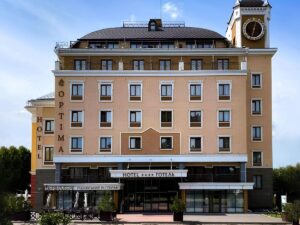
The Optima hotel chain is opening its fourth hotel in Zhytomyr, according to the operator’s press service.
It is specified that the “Zhytomyr by Optima” hotel will begin operations on June 1, 2026. It is located on the fifth through eighth floors of the renovated “Zhytomyr” business center at 6 Pobedy Square. The hotel has 105 rooms.
The four lower floors of the business center are designated for offices, with a total area of 4,000 square meters. In addition to offices ranging from 17 to 36 square meters, the complex includes conference spaces with a total area of over 500 square meters.
The Optima Hotels & Resorts chain comprises more than 60 hotels in Ukraine. Until 2023, the chain operated under the Reikartz Hotels & Resorts brand; since 2020, with the help of Turkish shareholders, it has also opened hotels in Kazakhstan, Georgia, and Uzbekistan. In the summer of 2023, Turkish shareholders acquired the Reikartz brand from the Ukrainian company to develop it in Turkey and Central Asia. In Ukraine, the hotel chain was rebranded in 2023 under the new name Optima Hotels & Resorts.
Optima Hotel Management LLC was established in 2008. According to Opendatabot, the company’s shareholders are Vladimir Kashutin (Lviv, 99.9%) and Andrey Dema (Kyiv, 0.1%). Kashutin is listed as the ultimate beneficiary. However, until 2019, the beneficiaries were listed as Russian citizens Yuri Vasin, Leonid Lavrentiev, and Timur Rodionov.
According to the financial results for 2025, the company’s net loss amounted to 40,097,000 UAH, compared to a net loss of 847,000 UAH in 2024. Meanwhile, revenue grew by 55.45% to 809.36 million UAH.



