
Ukrainian legislation needs a clearer distinction between the elements of crimes related to collaboration, treason, and war crimes, according to Inna Linyova, director of the Human Rights Institute of the Ukrainian Bar Association.
In an interview with Interfax-Ukraine, she noted that the practice of adjudicating cases of collaboration remains ambiguous. According to her, civil society organizations have already documented cases where individuals who, under international humanitarian law, may fall into protected categories were held criminally liable.
This includes, for example, employees of municipal utilities who continued to clean the streets during the occupation, doctors who continued to work in hospitals, or teachers who ensured the basic functioning of local institutions. Under international humanitarian law, such actions may be viewed as maintaining the region’s viability rather than as criminal collaboration with the occupying power.
A different situation, Linyova emphasized, arises in cases where a person passes on information about the location of Ukrainian military forces, directs fire, holds leadership positions in the occupying authorities, or heads a police department or local administration under Russian control. In such cases, there may be grounds for criminal prosecution, but the right to a defense must be ensured here as well.
Separately, Linyova cited the example of employees at the Zaporizhzhia Nuclear Power Plant. According to her, if a person performs technical or professional functions necessary for the safe operation of the nuclear power plant, this in itself is not a crime. But if we are talking about administrative and managerial functions in the interests of the occupying authorities, the assessment may be different.
The expert believes that the problem lies in the imperfection of the legislation: some criminal offenses overlap, and a clear line between treason, collaboration, and war crimes is not always evident.
According to her, the Office of the Prosecutor General is working on drafting a bill intended to systematically bring Ukrainian criminal and criminal procedure legislation into compliance with the Rome Statute.
Such reform is important not only for domestic judicial practice but also for Ukraine’s international reputation. Cases involving war crimes and collaboration are closely monitored by international organizations, and the quality of judicial proceedings can influence the trust of partners, European integration, and future compensation mechanisms.
Ukraine must ensure the right to a defence is rigorously upheld in cases involving war crimes, as breaches of procedural safeguards could lead to complaints being lodged with the European Court of Human Rights and damage the country’s international reputation, according to Inna Linyova, Director of the Human Rights Institute of the Ukrainian Bar Association.
In an interview with the Interfax-Ukraine news agency, she noted that Ukrainian courts are hearing a large number of war crimes cases in absentia, without the accused being present. Such a practice is permissible, but requires the court, the prosecution and the defence lawyers to observe procedures with particular care.
According to Linyova, if a Russian serviceman who has been found guilty in absentia subsequently claims that he was not notified of the case or the trial, and that his lawyer failed to provide a proper defence, he may appeal to the European Court of Human Rights. In such a case, Ukraine risks a ruling that it has violated the right to a fair trial.
She emphasised that the issue of notifying defendants is one of the key concerns. Ukrainian legislation currently does not require the prosecution or the investigating authorities to take all possible steps to locate the defendant. If there is no access to the defendant’s address, it is sufficient to publish information about the trial on the website of the Office of the Prosecutor General and in the newspaper ‘Uryadovy Kurier’.
However, according to Linyova, it is clear that Russian military personnel are unlikely to read such sources. Therefore, the prosecution must additionally use other methods of notification: search for the defendants’ profiles on social media, send messages, and write official letters, including to the Russian Ministry of Defence.
In her view, such actions are necessary not because Ukraine expects a conscientious response from the Russian Federation, but to demonstrate that the Ukrainian system has done everything possible to ensure a fair hearing of the case.
“We cannot expect the Ukrainian judicial system to be fair to Ukrainian citizens and unfair towards Russians. Courts are either fair or unfair,” noted Linyova.
The expert also drew attention to the pressure faced by lawyers representing defendants in such cases. According to her, some lawyers and members of the public mistakenly equate the lawyer with their client, accusing defence lawyers of supporting Russian narratives. However, international standards and professional ethics explicitly prohibit equating a lawyer with their client.
In Linyova’s view, it is extremely important for Ukraine to explain to the public that the fact that an accused Russian serviceman has a defence is not a sign of the state’s weakness, but rather a testament to the strength of the legal system. This is particularly important in the context of future European integration, international legal proceedings and compensation mechanisms.
Around 97–98% of war crimes cases in Ukraine are heard in absentia, that is, without the defendant being present, Inna Linyova, director of the Human Rights Institute of the Ukrainian Bar Association, said in an interview with the Interfax-Ukraine news agency.
According to her, this mainly concerns cases where the accused Russian serviceman is in the Russian Federation or in temporarily occupied territory, and Ukrainian investigative and judicial authorities are conducting proceedings without his physical presence.
Lynova emphasised that trials in absentia are permitted under international standards, but in such proceedings it is particularly important to ensure all guarantees of the right to a defence. Otherwise, Ukraine may face serious legal and reputational risks.
“Such a trial in the absence of the accused is permissible under international standards, but in such cases it is particularly important to ensure that the rights of the accused are protected,” she noted.
According to Linyova, problems with the quality of defence were observed in a number of proceedings: lawyers could be passive, fail to file motions, fail to examine evidence, and effectively limit themselves to a formal presence in the proceedings. In some cases, defence lawyers even used derogatory terms in relation to their clients, which contradicts the very essence of the right to defence.
The Director of the Human Rights Institute of the Ukrainian Bar Association emphasised that effective defence of those accused in war crimes cases is needed not to exonerate criminals, but to protect the interests of Ukraine itself. If the trials comply with international standards, this will strengthen Ukraine’s position as a state governed by the rule of law and reduce the risk of subsequent challenges to the verdicts in international courts.
Since July 2023, the Ukrainian Bar Association has been implementing an initiative to monitor court hearings and analyse court decisions in cases of war crimes. According to Linyova, these trials are the focus of the international community’s attention, as they relate not only to the punishment of the guilty but also to the future compensation system, the restoration of justice and Ukraine’s international reputation.
According to the Office of the Prosecutor General, the number of registered criminal offences classified as war crimes is rising rapidly. By the end of May 2024, there were 129,065 cases; by September 2025, 179,803; and by 16 April 2026, 221,929.
The Ukrainian judicial system is thus facing a massive challenge: it must simultaneously document crimes, ensure the punishment of the guilty and uphold the standards of a fair trial, even in cases that attract significant public attention.
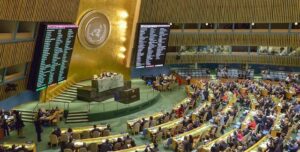
On Thursday, May 12, the UN Human Rights Council will hold its 34th special meeting dedicated to the deterioration of the human rights situation in Ukraine as a result of Russian aggression.
“It is being convened in accordance with the official request filed today by Ukraine and supported so far by 53 states,” the Office of the United Nations High Commissioner for Human Rights (OHCHR) said on its website on Monday.
The Office recalls that the convening of an extraordinary session requires the support of one third of the 47 members of the Council – 16 or more. To date, the following Council Member States have supported this request (16): Finland, France, Gambia, Germany, Japan, Lithuania, Luxembourg, Marshall Islands, Mexico, Montenegro, Netherlands, Poland, Republic of Korea, Ukraine, United Kingdom and United States.
They were also joined by the following Observer States (37): Albania, Andorra, Austria, Belgium, Bosnia and Herzegovina, Bulgaria, Canada, Colombia, Costa Rica, Croatia, Cyprus, Czech Republic, Denmark, Estonia, Georgia, Greece, Guatemala, Hungary, Iceland, Ireland, Italy, Latvia, Liechtenstein, Malta, New Zealand, North Macedonia, Norway, Peru, Portugal, Moldova, Romania, Slovakia, Slovenia, Spain, Sweden, Switzerland and Turkey.
Specific details of the special session and its scenario will be discussed at a public meeting on May 11, UNHCHR clarifies.
The Office recalled that during the 49th regular session of the Human Rights Council on March 3 and 4, 2022, the Council held an emergency discussion on the issue of Russian aggression against Ukraine, after which it decided to establish an independent international commission to investigate all alleged human rights violations in the context of such aggression.



