

The International Atomic Energy Agency has secured agreement from Ukraine and Russia on a local ceasefire to repair the backup power line to the Zaporizhzhya Nuclear Power Plant, IAEA Director General Rafael Grossi has confirmed.
“Technicians from Ukraine’s power grid operator are expected to begin repair work on the 330 kV line, which was damaged and shut down as a result of military operations on January 2, in the coming days. The shutdown left Europe’s largest nuclear power plant dependent on a single functioning 750 kV transmission line,” the statement said.
As noted, the IAEA team left Vienna for the front line to observe the repair work.
“The IAEA continues to work closely with both sides to ensure nuclear safety at the ZNPP and prevent a nuclear accident during the conflict. This temporary ceasefire, the fourth we have agreed on, demonstrates the indispensable role we continue to play,” Grossi said.
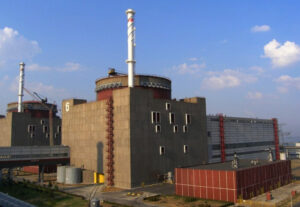
Important repair work has begun on power lines near the Russian-occupied Zaporizhzhia NPP following another local ceasefire brokered by the IAEA, the agency said in a post on social media on Sunday.
“Grossi thanks both sides for agreeing to this new temporary ‘window of silence’ to restore power transmission between the ZNPP and Zaporizhzhia Thermal Power Plant distribution stations, which will help strengthen nuclear safety,” the agency wrote.
It is noted that the IAEA team is monitoring the repair work, which is expected to take several days.
Since the start of the Russian occupation on March 4, 2022, the ZNPP has repeatedly experienced complete and partial blackouts due to the loss of all power lines (it receives electricity from the Ukrainian power grid), with the launch of emergency diesel generators and safety systems, the failure of which could lead to an emergency situation.
According to the IAEA, before the war, the ZNPP had 10 power lines — six at 750 kV and four at 330 kV. The largest nuclear power plant in Europe, which has six 1 GW units, has not been producing electricity since September 11, 2022, following the occupation.
The issue of the ZNPP is one of the problematic ones in the negotiations on the possibility of a peace agreement between Ukraine and Russia, mediated by the US. According to Ukrainian President Volodymyr Zelenskyy, Washington is proposing that the plant in the currently occupied city of Enerhodar in the Zaporizhzhia region be jointly managed by the US, Ukraine, and Russia in a 33%:33%:33% split, while Ukraine is proposing that the plant be operated by a joint venture consisting of 50:50%
IAEA, POWER LINE, REPAIR, truce, ZNPP
U.N. nuclear agency chief Rafael Grossi met Ukrainian energy officials on Tuesday before a planned visit to the Russian-occupied Zaporizhzhia nuclear plant, part of efforts to prevent a wartime nuclear catastrophe.
Grossi, the director of the International Atomic Energy Agency (IAEA), arrived in Ukraine a week after visiting the Kursk nuclear power station in Russia and warning of the danger of a nuclear accident there.
On his latest visit to Ukraine since Russia’s invasion in February 2022, Grossi met Energy Minister German Galushchenko, as well as Petro Kotin, head of state nuclear power company Energoatom, and Oleh Korikov, acting head of Ukraine’s State Nuclear Regulatory Inspectorate.
The IAEA was “fully committed to safety & security of (Ukrainian) nuclear sites, with (a) presence at each,” Grossi wrote on X alongside photos showing him and Ukrainian officials holding talks.
He said they were “exchanging (views) on our support to Ukraine’s NPPs (nuclear power plants) ahead of my ZNPP visit.”
Grossi said on X on Monday that he was on his way to the Zaporizhzhia nuclear power plant (ZNPP) “to continue our assistance & help prevent a nuclear accident.”
Ukrainian President Volodymyr Zelenskiy said he would meet Grossi after the IAEA chief visits the country’s nuclear plants.
The ZNPP in southeastern Ukraine, Europe’s largest nuclear power plant, fell to Russian troops soon after Moscow’s full-scale invasion and is not operating now.
Both sides have frequently accused each other of shelling the plant. Moscow and Kyiv both deny the accusations.
Zelenskiy and Dutch Prime Minister Dick Schoof on Monday visited the city of Zaporizhzhia, which lies across the Dnipro River to the northeast of the plant.
Zelenskiy also said that at this stage of the war, it is not possible for Ukraine to take back control of the plant.
“It is safer for Ukraine to control the Zaporizhzhia plant, but so far, from the point of view of the battlefield, I do not see such possibilities, and those that probably exist, they are dangerous,” Zelenskiy said.
Russian news agencies reported on Monday that a high-voltage power supply line at the plant had automatically disconnected, but the plant’s needs are supplied by another line. There was no reason given for the automatic disconnection.
Ukraine said Russian attacks had damaged one of the two external overhead lines connecting the plant to the Ukrainian power grid on Monday. Russia did not immediately comment on this assertion.
Russia says the Kursk nuclear plant visited by Grossi last week has been repeatedly attacked by Ukrainian forces that are just 40 km (25 miles) away since Ukraine carved out a slice of Russian territory in a cross-border attack this month.
Grossi said after visiting the Kursk nuclear plant that it was extremely fragile because it had no protective dome and that the “danger or possibility of a nuclear accident has emerged near here.”
Ukraine’s foreign ministry on Thursday denounced what it said were Russian efforts to “accuse Ukraine of alleged provocations against nuclear safety”.
It said Russia had intensified a “disinformation campaign to distract attention from its own criminal acts at the Zaporizhzhia nuclear power plant.”
In a statement, it described such accusations as “cynical” following attacks on energy infrastructure that forced Ukraine to disconnect several nuclear power units from the grid last week.
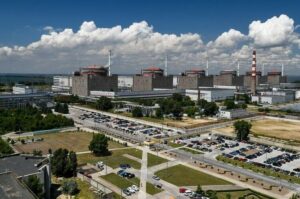
IAEA experts are closely monitoring the situation at the Zaporizhzhia nuclear power plant (ZNPP) in connection with allegations of a sabotage threat, but during recent inspections no signs of mines were found there, Rafael Grossi, the agency’s director general, said Wednesday.
“I was in contact with experts from the permanent mission to the ZNPP today, just a few hours ago. We are aware of the allegations and statements from both sides. (…) We have not detected any signs of mines during recent inspections, but we remain extremely wary,” Grossi said at a briefing in Japan, commenting on reports of a sabotage threat at the ZNPP.
He added that “we cannot relax now,” and promised to report regularly on the situation at the plant.
According to Grossi, the IAEA has requested access to a number of other locations at the ZNPP. “IAEA experts have asked for additional access. This is needed to make sure there are no mines or explosives at the site,” the IAEA quoted the director general as saying.
“In particular, access is required to the roof over reactors 3 and 4, to the engine room and to some components of the nuclear power plant cooling system,” he added.

Ukrainian President Vladimir Zelensky and International Atomic Energy Agency (IAEA) Director General Rafael Grossi at a meeting in Kiev discussed specific steps to avoid safety risks at the Zaporizhzhia NPP, the president’s press service said.
“Ukrainian President Vladimir Zelensky held a meeting with International Atomic Energy Agency (IAEA) Director General Rafael Grossi, who is visiting our state in fulfillment of the agreements reached during a telephone conversation between the head of state and the head of the IAEA on June 6,” the Ukrainian presidential press service said in a statement Tuesday.
Reportedly, the head of state stressed that as a result of Russia’s purposeful undermining of the Kakhovska HPP dam, which is the largest ecocide crime of modern times, the risks to the safety of the Zaporizhzhia nuclear power plant have significantly increased. Therefore, a quick and decisive reaction of the international community to this audacious terrorist act is urgently needed.
Zelenski positively assessed the presence of the agency’s inspectors at the Zaporizhzhia NPP illegally occupied by Russia and welcomed Raphael Grossi’s intention to personally visit the plant to assess the situation on site.
The head of state once again stressed that the only way to prevent a nuclear incident at the Zaporizhzhia NPP is its complete demilitarization, de-occupation and restoration of control over the plant by Ukraine.
According to the president’s press service, during the meeting the sides discussed specific steps that need to be taken to minimize risks and prevent incidents at the Zaporizhzhya NPP, as well as ways of cooperation with the IAEA to this end.
Zelenskiy supported Rafael Grossi’s proposal to send a group of IAEA experts to Ukraine to assess the consequences of the explosion at the Kakhovska HPP and to prepare proposals on specific directions of assistance in overcoming them. He noted that this mission would be fully assisted by the Ukrainian institutions involved.

Rafael Grossi, director general of the International Atomic Energy Agency (IAEA), said that he had left for Ukraine to meet with President Volodymyr Zelensky.
“On his way to Ukraine to meet with President Zelensky and to present a program to help clean up the disastrous Kakhovka reservoir spill,” he wrote on his Twitter account Monday.
According to the report, Grossi intends to assess the situation at the Zaporizhzhia NPP and conduct a rotation of the IAEA mission with a reinforced composition.
As reported, after the Russians blew up the dam of the Kakhovska hydroelectric power plant and spilled the Kakhovska reservoir, Grossi announced the launch of a program of assistance to Ukraine. He noted that by using nuclear techniques, the IAEA will determine the impact of the flooding on drinking water, human health, soil and water management, as well as assess the integrity of critical infrastructure.



