
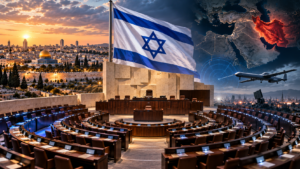
Israel’s parliamentary election on October 27, 2026, ended without a clear majority for either of the main political blocs. Prime Minister Benjamin Netanyahu’s Likud party retained first place, but his right-wing religious bloc lost its majority in the Knesset. This sets the stage for difficult coalition negotiations and could affect Israeli policy toward Iran, the Palestinian territories and Ukraine, reports the Experts Club information and analytical center.
According to the results released by Israel’s Central Elections Committee on October 30, Likud secured 27 of the 120 parliamentary seats. Yashar, led by former Israel Defense Forces Chief of Staff Gadi Eisenkot, won 21 seats, while former Prime Minister Naftali Bennett’s B’Yachad alliance received 12. Arab political parties collectively secured a record 19 seats.
Netanyahu’s right-wing religious bloc controls 53 seats, compared with 48 for the opposition. Forming a government requires the support of at least 61 lawmakers. Voter turnout reached 77.9%, with more than 5.7 million people casting ballots. The results are scheduled to be submitted to President Isaac Herzog on November 4, while the new Knesset is expected to be sworn in on November 10.
Experts Club analysts identify three main political scenarios. Under the first, Netanyahu could form a new coalition with support from some opposition lawmakers or negotiate a national unity government. The second involves an opposition government headed by Eisenkot, potentially relying on external parliamentary support from Arab parties. The third is a prolonged political deadlock that could lead to another election in 2027.
Regardless of the coalition negotiations, a fundamental reversal of Israel’s security policy appears unlikely in the near term. Both Netanyahu and Eisenkot regard Iran’s military capabilities as a strategic threat. Their differences concern primarily the methods used to confront Tehran, coordination with the United States and the role of diplomatic initiatives.
A centrist government could nevertheless create additional opportunities for negotiations concerning the Gaza Strip, humanitarian arrangements and relations with Arab countries. By contrast, the continuation of a right-wing coalition would increase the likelihood of maintaining a hardline approach toward the Palestinian territories.
The election outcome is particularly significant against the backdrop of the war launched by Israel and the United States against Iran in late February 2026. Despite diplomatic contacts and mediation efforts by Qatar, no comprehensive settlement has been reached. Further escalation threatens shipping through the Strait of Hormuz, international energy markets and the stability of Persian Gulf countries.
For Ukraine, the election creates potential opportunities to expand cooperation with Israel on countering Iranian-made Shahed drones, intelligence sharing and the development of air defense technologies. However, even a change of government would not guarantee an immediate revision of Israel’s cautious policy toward Russia or the supply of Israeli air defense systems to Ukraine.
Another risk is growing competition among Ukraine, Israel and Middle Eastern countries for interceptor missiles and other defense resources. Kyiv’s preferred outcome would therefore be regional de-escalation accompanied by stronger bilateral technological cooperation.
The election results indicate that Israel is entering a period of political uncertainty. The composition of the next governing coalition will influence not only the country’s domestic stability but also its approach to regional conflicts and relations with international partners.



