
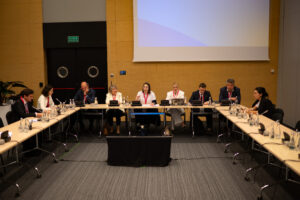
The funds directed toward the recovery of Ukrainian business must simultaneously perform a second function — preparing companies to work in the EU single market, participants said during a discussion held as part of the Ukraine Recovery Conference in Gdańsk.
The key issue of the panel was whether current instruments for supporting Ukrainian business sufficiently combine short-term recovery with long-term preparation for European integration. Participants discussed how to ensure that every euro of recovery not only helps companies survive the consequences of the war, but also brings them closer to the standards, rules and practices of the EU single market.
The discussion focused on the results of regional business dialogues conducted by the Office of the Deputy Prime Minister and the Ukraine2EU program. Over six months, more than 600 companies from six sectors of the economy joined the dialogues. One of the main conclusions was that the companies best prepared for the EU market often achieved this not thanks to separate recovery programs, but due to the requirements of European buyers.
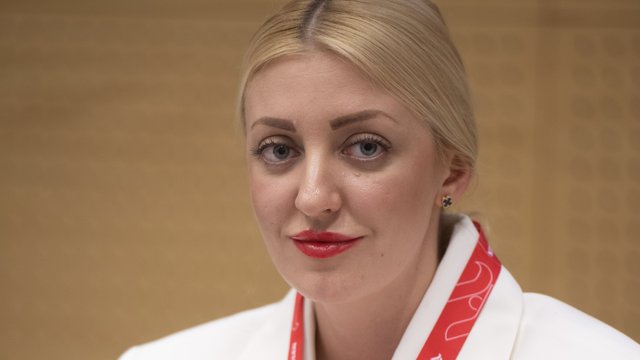
“For business, European integration is not an abstract political process, but a very practical set of requirements: European standards, certification, proper corporate governance, transparent financial reporting, compliance with regulatory requirements and the ability to be a reliable partner for European buyers and investors. Our regional dialogues with business showed that the biggest gap today lies not in attitudes toward European integration — Ukrainian business predominantly supports this course — but in insufficient understanding of specific requirements, future changes and practical tools that will help prepare for integration into the EU single market. That is why our task is to make this process as understandable, practical and accessible as possible for Ukrainian entrepreneurs,” said Viktoriia Lobun, adviser to the Deputy Prime Minister for European and Euro-Atlantic Integration of Ukraine.
According to Ukraine2EU program manager Mante Makauskaite, regional dialogues are only one element of broader work to prepare the Ukrainian economy for EU membership.
“Preparing business for EU accession cannot be reduced only to informing companies about the rules. Companies need practical tools: consultations, sectoral road maps, support in implementing standards, access to partnerships and an understanding of how the single market works. It is precisely this comprehensive preparation that allows the economy not only to adapt to EU requirements, but also to use accession as an opportunity for growth,” Makauskaite said.
Participants in the discussion emphasized that for some Ukrainian enterprises, it was the buyer from Germany, Poland or another EU country who became the main incentive for introducing standards, improving the quality of reporting, auditing, internal procedures and compliance. At the same time, this creates a risk that companies without direct access to buyers in the EU remain outside the process of practical preparation for the European market.
Gabriel Blanc, head of the European Commission’s Ukraine Investment Framework, noted that existing instruments for supporting Ukraine already take into account the connection between recovery and European integration, but their effect must be even more targeted for business.
“The Ukraine Facility, Ukraine Investment Framework and instruments of international financial institutions already create a foundation for recovery to be linked to Ukraine’s future EU membership. But our task is to make this link as practical as possible for companies. Support must help not only restore assets, but also improve the managerial, financial and regulatory readiness of business to operate in the single market,” Blanc stressed.
The issue of access to financing was discussed separately. For banks and financial institutions, what matters is not only the political context of Ukraine’s future accession to the EU, but also the existence of a bankable, understandable and transparent project. High-quality accounting, clean financial data, reliable audit and corporate governance were considered elements that simultaneously make a company more attractive for investment and closer to the requirements of the EU single market.
“A bank does not finance the calendar of a country’s accession to the EU, but a specific project that can be assessed, structured and supported. Transparent financial data, high-quality reporting, a clear business model, audit and the company’s ability to meet its obligations are important to us. But these very things are also part of the homework that business must do for integration into the single market,” said Karol Tofil, director for international partnerships at the Polish state development bank.
According to him, preparation for the single market and preparation for attracting financing are often one and the same process.
“When a company brings order to its reporting, management, data and compliance, it simultaneously becomes more understandable to the bank and stronger as a potential participant in European supply chains. These are not two separate tracks, but one logic of increasing trust in business,” Tofil added.
Participants in the discussion noted that the most vulnerable group remains regional small and medium-sized enterprises, medium-scale producers and companies focused mainly on the domestic market. It is they who may feel the future approximation to EU rules most strongly, but at the same time they have the least access to cheaper financing, advisory support, buyers from the EU and programs for preparing for standards.
Kateryna Havrys, director for strategic development of international markets, regulatory policy and government relations at Epicentr K LLC, noted that for large business, the issues of recovery, investment and preparation for the EU market are already connected at a practical level.
“For a company that works in retail, the agricultural sector, manufacturing and energy, European standards are not theory, but daily operational work. Recovery requires capital, but capital itself does not solve the problem if the company does not have access to equipment, technologies, specialists, certification and long-term planning. Business needs instruments that simultaneously help rebuild and become competitive in the EU,” Havrys said.
According to her, from the point of view of companies, support must be more comprehensive.
“Business lacks not only access to money. Often it lacks the right type of financing, guarantees, advisory support, assistance with project preparation and an understanding of exactly how to turn an investment into compliance with EU standards. This is what needs to be changed in support instruments,” the representative of Epicentr K emphasized.
Another challenge named was that some Ukrainian owners are already investing in production directly in EU countries, where financing is cheaper and the rules of the single market are already in force. This process is a form of integration of Ukrainian capital into the European space, but at the same time it raises the question of how to reduce the risk gap between investments in Ukraine and in EU countries.
In this context, participants discussed the role of guarantees, risk-sharing mechanisms, blended financing and advisory support. The point was that a Ukrainian project must become no less bankable and understandable for financial institutions than a similar project in Poland or Lithuania.
Lesia Kuzmenko, associate director and deputy head of the EBRD in Ukraine, stressed that business support must begin even before the moment when a project becomes fully bankable.
“The most difficult task is to help a company go from a potentially interesting idea to a project that can be financed. This requires not only loans, but also guarantees, risk sharing, advisory support, work on corporate governance, financial reporting, standards and business resilience. In many cases, precisely such preparation simultaneously makes a company attractive for investment and closer to the EU market,” Kuzmenko said.
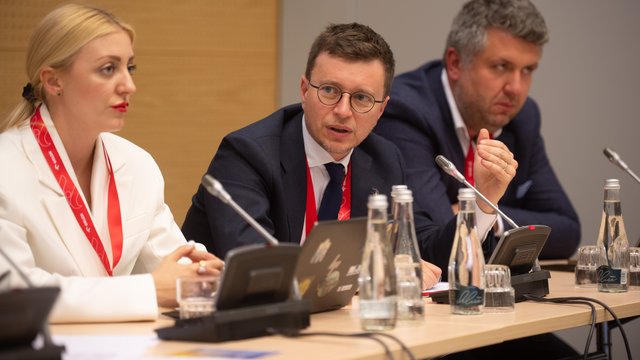
A separate part of the discussion was devoted to the EBRD as one of the largest investors in Ukraine’s real economy. According to data presented during the panel, as of June 1, 2026, the total amount of EBRD financing for Ukraine stood at EUR 23.74 billion in 696 projects. It was also noted that for the second year in a row, more than 90% of EBRD projects and 57% of its investments were in the private sector.
Participants of the panel also considered Ukraine’s integration into the EU not only as a matter of assistance to Ukraine, but also as an element of strengthening European competitiveness. Ukrainian companies that comply with EU standards can become part of production chains, agricultural and industrial potential, biomass, logistics corridors and the skilled labor market needed for an enlarged single market.
The Polish direction of cooperation was considered as one example of practical integration. During the discussion, it was noted that more than 3,600 companies with Polish capital operate in Ukraine, while almost 27,000 companies with Ukrainian capital operate in Poland. They constitute the largest group of foreign companies in Poland — almost 28% of all foreign enterprises.
Maciej Legutko, director of the international cooperation department at the Employers of Poland association, noted that Ukrainian-Polish production ties already have a significant scale, but moving to a new level requires removing barriers in standards, financing and risk perception.
“Polish business sees Ukraine not only as a market, but also as a partner for joint value-added chains. But for a Ukrainian supplier to enter a Polish or broader European production chain as an equal partner, it must confirm standards, stability, quality of management and the ability to fulfill contractual obligations. Poland’s experience before joining the EU shows that precisely this preparation opens business access to scaling,” Legutko said.
At the same time, standards, financing, the risk profile of Ukrainian projects and the ability of companies to confirm their compliance with customer requirements remain barriers to the full entry of Ukrainian suppliers into Polish and broader European production chains.
Darius Skusevičius, ambassador-at-large for the coordination of Ukraine’s recovery and reconstruction at the Ministry of Foreign Affairs of Lithuania, stressed that support for Ukrainian business is an investment in Europe’s future economic architecture.
“For Lithuania, the logic of early engagement is very simple: Ukraine is already part of European economic security, even if the membership process is still ongoing. By investing in preparing Ukrainian companies for EU standards, we are investing not in charity, but in the future competitiveness, resilience and strategic autonomy of Europe,” Skusevičius said.
As part of the discussion, Lithuania’s bilateral business partnership program was announced, which is intended to become an example of a practical approach to preparing Ukrainian companies. Its logic lies in partnership with a company from the EU, which finances not only a specific operation, but also the preparation of business for the standards and requirements of the single market.
“Partnership with a company from the EU should help Ukrainian business not just sell a product, but also learn to work according to the rules of the market it is entering. This is a model in which the standard is embedded from the very beginning, and preparation becomes part of the investment,” Skusevičius added.
Participants in the discussion concluded that the recovery of Ukrainian business must be linked to investment readiness, access to financing, EU standards and inclusion in European value-added chains. Recovery without preparation for the single market may help companies survive the crisis, but does not guarantee their competitiveness after Ukraine joins the EU.
Ukraine Recovery Conference is an international conference on Ukraine’s recovery that brings together governments, international financial institutions, business, local self-government bodies and civil society to mobilize support for reconstruction, investment and Ukraine’s economic resilience. URC 2026 took place on June 25–26 in Gdańsk under the joint chairmanship of Poland and Ukraine. The forum focused on supporting Ukraine’s reconstruction, attracting investment for Ukrainian business, as well as on the sectors most affected by Russian aggression, in particular energy, critical infrastructure and logistics.
BLANC, EU, HAVRYS, MAKAUSKAITE, SKUSEVIČIUS, UKRAINE, UKRAINE RECOVERY CONFERENCE, urc, КУЗЬМЕНКО, ЛЕГУТКО, ЛОБУНЬ, ТОФІЛЬ



