
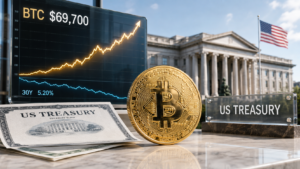
Bitcoin (BTC) saw its price surge sharply on Wednesday evening, rising to $69,700, gaining around $4,000 in a short space of time and reaching its highest level in roughly two months, according to the Fixygen website.
After reaching its intraday high, the leading cryptocurrency corrected to around $68,500–$68,700 but remained up about 6% over 24 hours. The intraday low was around $64,100.
The sharp move began after the US Department of the Treasury announced that it would at least double the volume of buyback operations involving long-term US government bonds, to $4 billion or more per transaction.
Following the news, the yield on 30-year US Treasuries fell by around 8 basis points to 5.20%, with a similar decline observed in 10-year securities. At the same time, the US dollar began to weaken, while demand for risk and safe-haven assets increased.
Initially, following the Treasury’s announcement, bitcoin rose to around $64,900, then broke above $65,000, after which the rally sharply accelerated. At its peak, the price reached $69,700.
The surge triggered large-scale liquidations of short positions in the cryptocurrency market. According to CoinGlass data cited by CoinDesk, approximately $1.3 billion worth of cryptocurrency derivatives positions were liquidated in just one hour, between 14:50 and 15:50 UTC, with more than half of the total involving bitcoin trading pairs. Ethereum liquidations amounted to around $430 million.
The gains spread across virtually the entire major cryptocurrency market. Ethereum rose by around 9%, XRP by more than 6%, and Solana by around 6%.
BTC’s technical movement provided an additional factor. Before the current surge, analysts had noted the formation of an “inverse head and shoulders” pattern on the daily chart. According to technical analyst Aksel Kibar, a sustained breakout above the area around $66,600 could open the way for a move toward $76,000.
At the same time, the rapid pace of the current rally increases the likelihood of short-term volatility: a significant part of the move was amplified by the forced closure of short positions, and after reaching $69,700, bitcoin had already retreated by more than $1,000.
Bitcoin is the world’s largest cryptocurrency by market capitalization. Its supply is algorithmically limited to 21 million coins, with around 20 million BTC currently in circulation. Cryptocurrency prices are characterized by heightened volatility and can change significantly within a short period.

Sales of new passenger cars in July of this year fell by 10.5% compared to the same month in 2025—to 5,754 thousand units, according to a report by “Ukravtoprom” on its Telegram channel.
According to the association, the most popular brand remains Japan’s Toyota, which increased its sales by 20% to 985 units.
Skoda took second place with 693 units (+24%), while VW came in third with 444 units (-10%).
The top ten most popular brands also included Renault with 345 units (-47%); BMW with 308 units (+17%); Hyundai with 298 units (=); Mazda—259 units (+66%); BYD—229 units (-69%); Suzuki—194 units (+39%); and Audi—156 units (-38%).
The Toyota RAV-4 crossover was the month’s best-seller.
According to Ukravtoprom, a total of about 38,800 new passenger cars were sold in the country from January through July, which is 1% less than a year ago.
According to Ukravtoprom, the new passenger car market in 2025 grew by 17% compared to 2024, reaching 81,300 units.
According to Fixygen, the cryptocurrency market ended the week of July 27–August 1 mostly lower amid the U.S. Federal Reserve’s cautious stance, volatile inflows into exchange-traded funds, and weak earnings reports from Coinbase, the largest U.S. crypto exchange.
As of August 1, Bitcoin was trading at around $63,000, down from approximately $65,300 at the start of the week. Thus, the leading cryptocurrency lost about 3.6%.
Ethereum rose to nearly $1,950 at the start of the week but then also came under pressure. Most of the major altcoins were unable to sustain a steady upward trend, as investors preferred to reduce their positions in riskier assets. Solana largely remained within the $70–76 range throughout the week.
The main macroeconomic event of the week was the U.S. Federal Reserve meeting on July 28–29. The Fed kept the target range for the federal funds rate at 3.5–3.75%. At the same time, the regulator noted that inflation remains above the 2% target, particularly due to rising energy prices and other consequences of the conflict in the Middle East. An additional hawkish signal came from the fact that three members of the Federal Open Market Committee voted to raise rates by 0.25 percentage points.
For cryptocurrencies, this means that expensive dollar liquidity will persist. With high interest rates, investors receive attractive yields on government bonds and money market instruments, which limits the inflow of capital into Bitcoin and altcoins.
The market had been hoping for at least some softer rhetoric from the Fed, so the lack of a signal regarding an imminent rate cut was one of the reasons for Bitcoin’s decline in the second half of the week.
U.S. spot Bitcoin ETFs ended the week with a combined net outflow of about $61.5 million. On Monday and Tuesday, investors withdrew $11.6 million and $49.7 million, respectively. On Wednesday, the funds recorded an inflow of $32.1 million, and on Thursday, $233.1 million. However, on Friday, $265.4 million was withdrawn again. This pattern indicates that there is no sustained institutional demand yet. Positive inflows last for one or two days, after which they are followed by comparable or even larger outflows.
Friday’s outflow from BlackRock’s IBIT fund was particularly notable at $122.7 million. $54.8 million was withdrawn from Fidelity’s FBTC, and $52.6 million from Grayscale’s GBTC.
Until Bitcoin ETFs return to a steady inflow of funds, a price recovery above the nearest resistance levels will be difficult.
Coinbase’s financial results put additional pressure on the market. The largest public crypto exchange in the U.S. reported its third consecutive quarterly loss. Following the release of the report, Coinbase’s stock price fell, and analysts noted challenging conditions for cryptocurrency trading and a lack of clarity regarding the timeline for a recovery in trading volumes.
Declining activity among retail investors is one of the main risks for the market. Despite Coinbase’s share of cryptocurrency trading rising to 10.3%, overall market volumes remain weak.
At the same time, the company continues to reduce its reliance on spot trading fees and is expanding its business in stablecoins, derivatives, digital asset custody, and blockchain infrastructure. However, this is more of a long-term positive factor and does not yet offset the decline in speculative activity.
One of the week’s trends was investors’ continued tendency to focus on the largest and most liquid digital assets. When macroeconomic risks intensify, capital typically flows out of smaller tokens faster than out of Bitcoin. As a result, altcoins may decline even if the price of Bitcoin remains relatively stable.
Ethereum maintains fundamental support thanks to the network’s use in decentralized finance, asset tokenization, and infrastructure projects. However, for a sustainable recovery, it needs a rebound in demand across the entire crypto market and stabilization of Bitcoin.
Solana and other highly volatile assets may experience short-term spikes, but without an increase in liquidity, such movements are likely to remain unsustainable.
The base case scenario for early August remains Bitcoin’s consolidation within the $60,000–$66,000 range. The nearest support zone is the $62,000–$63,000 range. However, $60,000 remains the key psychological and technical threshold. A resurgence of geopolitical tensions or continued outflows from ETFs could lead to a retest of this level.
A sustained move below $60,000 would increase the likelihood of a decline toward the $55,000–58,000 range. For this scenario to play out, a combination of several negative factors would be required: a further strengthening of the dollar, rising U.S. Treasury yields, significant outflows from ETFs, and a deterioration in stock markets.
For Bitcoin to resume its upward trend, it must return above the $64,700–$66,000 range. In this case, the next targets could be $68,000 and $70,000.
A positive scenario is possible provided there is a return of steady capital inflows into Bitcoin ETFs, a reduction in geopolitical risks, and the release of weak U.S. economic data, which would reinforce expectations of future Fed policy easing.
If the market stabilizes, Ethereum may attempt to climb back above $1,900. However, should Bitcoin fall to $60,000, pressure on Ethereum and most altcoins will intensify.
Thus, in early August, the market will most likely remain volatile and dependent primarily on inflows into U.S. ETFs, U.S. macroeconomic data, and the situation in the Middle East. There is no clear signal yet that the correction has ended, but Bitcoin holding the $60,000 level will support the possibility of a further recovery.
Bitcoin is the largest cryptocurrency by market capitalization, created in 2009. Ethereum is the second-largest digital currency and serves as the underlying asset for the Ethereum smart contract network.

Ukrainian car market of new passenger cars decreased by 61.5% compared to the prewar year 2021 – down to about 40 thousand units, informs AUTO-Consulting.
“But the main thing is that the Ukrainian car market survived, it exists even during the war. Thanks for that to the Armed Forces of Ukraine,” – the website of information-analytical group reports.
At the same time, AUTO-Consulting states that the results of last year for the car market were the worst since 2000.
“For example, in 2015, when there was also a significant drop due to military action, the market reached 46.5 thousand cars and showed a 50% decrease,” – noted in the message.
On its Facebook page AUTO-Consulting also cites preliminary results of sales of new passenger cars in December – sold 4,009 cars, which is almost 23% more than in November-2022. Toyota remained the leader with 27.4% market share, Skoda came second in November (10.3%), while Suzuki (7.9%) moved up to third place from eighth. Renault, which was in second place in November 2022, moved down to fifth place (5.7% of the market).
According to the group, the market of new light commercial vehicles (LCV) in 2022 decreased by 69% – to 4 thousand units, and, as the analysts note, the total volume of 44 thousand sold cars and light commercial vehicles was the lowest since 1997-1998, when the market of new passenger cars was about 30 thousand units.
At the same time, the company noted that this year the leading operators of Ukrainian car market expect positive dynamics.
As reported, in 2021, sales of new cars, according to Auto-Consulting increased by 20% in 2021 – to 103.65 thousand units.

The Verkhovna Rada intends to regulate the sphere of handling genetically modified organisms (GMOs) and improve the system of assessing their risks as to their possible impact on human health and the environment.
The relevant draft law No. 5839 “On state regulation of genetically engineered activities and state control over the handling of GMOs and genetically modified products to ensure food security” was approved as a basis at the parliamentary session on Wednesday by 247 MPs (with the required 226 votes), a member of the Golos faction Yaroslav Zheleznyak said in a Telegram feed.
According to the explanatory note to the document, its adoption will allow to delineate the powers of public authorities to eliminate duplication of functions in the field of handling GMOs, to improve the system of risk assessment of GMOs on the possible impact on human health and the environment.
In addition, the document will implement European mechanisms for state registration of GMOs in Ukraine, improve the requirements for labeling of GMO products and establish the rules of their traceability as well as strengthen the state control in the field of GMO handling and establish liability for violation of the legislation in this area.
Thus, the adoption of the draft law will allow achieving systemic compatibility of Ukrainian legislation with the EU legislation in the field of GMO handling, which is envisaged by Ukraine’s obligations under the Association Agreement.
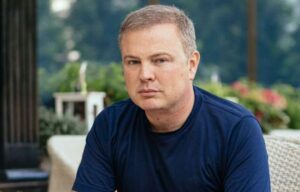
An exclusive interview with Dmytro Nikiforov, the owner of AT Market (Kyiv), which bottles Carpathian high-mountain water under the Voda UA brand, about the situation in the industry and the business environment that has developed after the invasion of Ukraine by Russia.
– Let’s first speak about the indicators, pre-war and post-war market shares, sales volumes.
– Our market share in percentage is insignificant. Today, I will estimate it at up to 1.5%. But at the same time, with such a market share, we are the 11th or 12th producer in the country in terms of quantities consumed out of more than 150 legal water producers. This place in the market indicates how this market is monopolized, that it is not a market-based one, and that there is no such imbalance in any country in the world.
— This is not caused by administrative difficulties in obtaining license to develop water sources, right?
– No, only with the difficulties of marketing. There is one gigantic company in Ukraine that has “concreted” its place in the market by market-based and non-market methods, which makes it very difficult to gain a market share. With only 1.5% of the market, we are barely in the top 10 manufacturers, so you can see how the situation is with the 140 other manufacturers that are not in the top 10. However, everyone survives somehow. At the same time, we occupy the second place in the HoReCa market. That is, there is a huge distance between the first and second place, but we managed to gain a foothold within the country in second place in this segment. This is, as it were, a great success. Unfortunately, we are unlikely to replace the leader, but we intend to expand. The second place among almost 160 manufacturers is a good indicator that the product is in demand, and it is a matter of technique to develop it and we are pretty much working for this.
– Do you expect the nationalization of companies from the industry with Russian owners after the military invasion of Ukraine by Russia?
– It’s hard for me to predict, because there are actually a huge number of them, and as far as I know, nothing has been nationalized. It is unknown how these processes are going to take place, since companies with Russian capital, owning assets in Russia and operating in Ukraine, this is not normal in today’s conditions. It is clear that this situation will somehow change, but I do not know how it will change.
– What kind of contacts with the Russian Federation did you have before the war?
– If you google “drinking water Voda UA buy Moscow,” then there are many links where it was sold or its shelf stocks are being sold. Russia was not a priority market for us, because they did not have a very loyal attitude towards Ukrainian manufacturers and Ukrainian brands. There were shipments there, but I would not call them large. For us, the loss of this market means absolutely nothing, so we painlessly said goodbye to them.
– And from the point of view of Russian water imports, how will the market be freed up if its trademarks are removed?
– I do not know of any Russian water that would be sold here, except for water for healing Essentuki, which has not been seen here for a long time.
– Do you deal with data on the dynamics of sales after the start of the war?
– I must state the decline in sales during the war period, despite the fact that our brand exposure at points of sale has increased significantly, since we were one of the first to manage the logistics of water from western Ukraine to regions of the country that were unsafe at that time. But, in the domestic market itself, we have a decline in sales, even in the case with the same period last year.
– How are you going to compensate for this decline?
– The central area of focus we are currently working on is export supplies to the EU, since our major production facilities are located 150 km from the nearest border. We believe that the Western consumer should be aware of the existence of Ukrainian products and will have an incentive to buy them not only because of their quality, but also in solidarity with Ukraine and to help Ukrainian businesses.
On this occasion, we launched the “Support Ukraine, buy Ukrainian” project, and we are trying to reach out, first of all, to Eastern European large distributors in retail chains.
– How successful is everything going on?
– We have just started, the project is only two weeks old and so far we have only two responses. Well, that’s already encouraging.
– It is clear that you mainly have Eastern Europe in the export geography. What other regions do you work with?
– We had Kuwait for the export deliveries, but due to the ongoing events, this business was suspended, because it is not yet possible to develop logistics by sea. We primarily consider border countries with cheap logistics, as well as the UK, where, in our opinion, pro-Ukrainian sentiment is the strongest in Europe.
– How do you assess the current situation on the border, what kind of “bottleneck” has formed there?
– The biggest challenge is always to sell the product and find a market. We can handle the rest of the problems.
– How does the large share of bottled water impact logistics at its relatively low cost?
– The cost of water always has about 50% of transport costs. This is the specifics of the industry, since the product itself is inexpensive, but from the point of view of transportation, nothing can be worse than water in glass: you have volume and weight at the same time. For example, the cost factor of logistics in vodka will be about 10%, but in water it can be more than 50%. But the fact is that all water manufacturers in the world are in such conditions.
Yes, by supplying products to Poland, for example, we will still be more competitive than Vittel or Evian, or some other well-known European brands. It will take longer for them to reach Poland, and their cost factor of logistics will be even higher. Of course, they take by brand awareness, but the market conditions are the same for everyone – everyone transport water by trucks. Therefore, from this point of view, all manufacturers are on an equal footing, and we do not pay any increased premiums for logistics from Ukraine to Europe. There are no problems here, there are a lot of trucks, the market price and we do not pay inflated tariffs compared to other manufacturers.
– Many companies complained that after the start of the war, truck drivers of draft age were not allowed to go abroad, which forced them to stop exporting. Have you experienced this?
– No, we didn’t, because we don’t have exports to Europe today.
– How do you think the state could improve the situation with import-export?
– There are three key points here. We all understand that money today means much less than before the war: if you do not sow wheat, then you will not bake bread either. Now, thank God, access to money in Ukraine is quite simple. Now, the main thing is to preserve, restore and develop own production facilities.
The first is that not a single bank will give you a loan to restore destroyed factories and enterprises, because there is no collateral, it is destroyed. Therefore, the state needs to give targeted bank loans for the restoration of destroyed facilities and enterprises.
Secondly, the state is obliged to support business with money, namely working capital, because with the introduction of martial law, all debt obligations within the business were frozen, and therefore there is a huge problem with payments. That is, trading enterprises did not pay all their suppliers on absolutely legal grounds, thus the enterprises were left without profit, and many of them are shutting down. They are completely self-sufficient and have not suffered from shelling, but due to a lack of working capital, they simply halt. Therefore, the state should immediately open programs to finance working capital and secure bank loans.
Yes, some non-returns are possible, but these are all really trifles, these steps should be taken immediately.
And the third is the encouragement of exports. It is clear that products such as chicken or wheat do not need government support, the state must support the export of products, the share of which in deliveries abroad was nil or insignificant before the war. We need to introduce a new SKU to our export portfolio.
This support can be as compensation of 10% of the value shown in the export declaration. Then we can somehow compete with the Europeans and expand the range of export products. This is important because the domestic market has shrunk and for many, exports are their only salvation today. The state should think very hard about how to support the export of those products, the share of which was insignificant or it was absent abroad.
– Since the beginning of the war, most of the Ukrainian business supports the Armed Forces and the population. Will the additional “humanitarian” burden on it greatly affect its economic activity?
– Of course, the Ukrainian business itself will not be able to cope with this task. That is, it provides assistance in some issues, but it cannot globally settle this problem, because there is no such a resource. Business itself needs support, so it helps to the best of its ability. I do not think that today the share of business support of the general needs of the Armed Forces and those who are in need is high. Of course, business is doing what it can, but its efforts, even roughly, are not enough to solve the problems of supporting the Armed Forces and vulnerable groups of society.
– Who have you already helped, what has been done since the beginning of the war?
– Since the beginning of the war, we were among the first to arrange logistics and delivery of water to Vinnytsia and Kyiv regions, when Russian invaders were still standing near Kyiv. We have opened our warehouses for all those in need. We were given applications, according to which we shipped water for the Armed Forces of Ukraine, volunteer organizations, hospitals, bomb shelters and, in general, for everyone in need. That is, we gave away products worth about UAH 4.5 million. We shipped water from warehouses in Vinnytsia and Kyiv. We shipped not only water, but also tea, also our own brand.
– How else can your company provide assistance, as in the case of a broken water supply in Mykolaiv, for example?
– In this case, specifically our company cannot render the help, because it is unrealistic to compensate the water supply system interrupted in the city of Mykolaiv with bottles. Tap water cannot be compensated by the manufacturer of bottled water. The problem is solved by filling tanks in a nearby city and sending them there. We can compensate for the lack of drinking water in shelters, hospitals, cities and villages, but we cannot compensate for broken water pipes.
– Do you expect that the well-being of the population will decline and everyone will switch to cheaper alternatives, even to consumption of tap water?
– Yes, we are expecting this, especially because we work in the medium plus segment. Our water, a priori, cannot be cheap. This is Carpathian water. Ipso facto it will be more expensive than all the others, due to the logistics and the difficulty of obtaining it. We work in the medium plus segment, and it will take a large tumble. I predict that some of our fans and consumers will switch to cheaper bottled water, and consumers of cheap bottled water will most likely switch to filtered water in large part. It’s unavoidable. The contraction and reduction of the market will happen, because, as we understand without overstating the obvious, the well-being and purchasing power of people is declining, and the consumer will save as much as possible on all consumer goods.
– What is your “planning horizon”, for what period do you make calculations in the work: weeks, months or a season?
– We do not live according to the principle “the day has passed and thank God.” We are actively preparing to meet the summer season, we are trying to expand as much as possible in retail outlets within the country. We are negotiating cooperation with the largest distributors and are trying to use the tool and the possibility of exporting as much as possible, so we focus on such a medium-term perspective until the end of the year. We believe that the situation will not worsen, and perhaps it will improve. Therefore, we feel quite sovereign: we are engaged in planning and expanding as much as possible.
– Can you share the details of the biggest recent deals?
– In principle, we do not have such large transactions. We are present in almost all national retail chains. We are simply expanding our presence in these chains. That is, if there are 350 stores, and before the war we were present only in 50, then our task now is to expand at least two or three times. We are engaged in a purely routine, I cannot give any transaction as an example.
– What has changed at your plant since the beginning of the war?
– The plant is located in the Carpathian “nowheresville,” therefore, almost nothing has changed there. Yes, some workers were drafted into the Armed Forces of Ukraine to join territorial defense units, but, in principle, the plant has been working absolutely stably all this time, and martial law did not impose any special difficulties on its operation.
– Voda UA attended major government events last year. How did you manage to take this place, and will the current popularity of Ukrainian politicians abroad help support the export of your brand?
– We did not make any efforts to get on the tables of government bodies. There is no administrative resource for a water manufacturer to somehow enter there, it somehow happened by itself. That is, the Verkhovna Rada was the first client from government agencies, for which we made a special label with the symbols of the parliament. After that, all major government agencies began to purchase our water. Moreover, not only directly from us, but also from distributors. I think that this is largely due to naming, when you understand 100% which country’s water you are drinking.
All of these bodies have conducted independent water testing, according to which our water meets the highest quality standards, and in many ways it is significantly ahead of well-known world brands. As far as I know, we are the only ones in the country who produce mountain spring water. Water is extracted mainly from underground wells, while we extract from high-altitude water intakes at an altitude of 1,400 meters above sea level. Therefore, thanks to branding and unprecedented water quality, we are present at many official events and economic forums in government structures.
We consider it incorrect to use the popularity of our politicians abroad for advertising purposes. Therefore, we never post photos of the president, prime minister or MPs with our water or against the background of our water even in social networks. We consider this wrong and do not consider this way of brand development.
– The Cabinet of Ministers has recently simplified the import of products with a label not in Ukrainian. Do you allow for the possibility of simplifying the label, changing containers from glass to plastic, or other forced changes in the appearance of your products?
– In addition to Voda UA, we have brands that are simpler, which we bottle in standard containers. As for Voda UA, 90% of the success lies in the design and packaging. Our glass bottle is even more like a vase that foreigners take with them as a souvenir from our country. That is, this is a business card, and it is thanks to it that we became the second in HoReCa. By simplifying the bottle, we will lose this sense of exclusivity and something completely distinct in the national identity. Therefore, for us, any simplification of the brand will inevitably be associated with a decrease in sales, and if there is a shortage of containers, labels or packaging, we will be forced to suspend the bottling of Voda UA until the situation is resolved and focus on the Karpatska Dzherelna Vysokohirna brand, which we bottle in standard containers. In principle, it is no different from Voda UA, but it costs less from the point of view of the brand, since its bottling is much simpler. Therefore, Voda UA will be bottled exclusively in its intended containers or will not be bottled at all.
– What is the situation with glass and plastic containers in the industry?
– To date, we do not experience problems with components. Yes, we had to change suppliers, because not everyone remained in service. We have new suppliers of labels, molds, and so on, but in fact, we have all of this, or all of this can be ordered in neighboring countries. The problem may be exclusively in glass bottles, because we can only make them at a factory where we have molds. It is impossible to transfer activities to another factory. Ordering new ones is very expensive and takes a long time, so we are tied to the Vetropack plant in Hostomel as for glass. Thank God, it did not suffer much from the Russian occupiers. Production there will be launched after mine clearance. Also, as far as I know, the stock of bottles they produced for us was not affected. I think that within a month we will be able to receive the shipment, so in our particular case there are no problems with the container.
– Now there is an opportunity for businesses to switch to the general taxation system at 2%. Have you taken advantage of this opportunity?
– My financial consultants and accounting department said that we remain on the same positions: 2% of turnover in today’s realities is not profitable for us.
– What initiatives would you recommend to the state in the field of taxation in your industry and for business in general?
– Apart from loans, business does not need to be supported, as well as there is no need to lower taxes. It is necessary to immediately beat this “hydra,” which is called the registration of tax invoices. This is the tool, thanks to which the thievish tax officials and MPs covering them wash out the turnover in the amount of VAT from the business. The state must immediately stop the practice of registering tax invoices, which does not exist anywhere in the world. This is the main problem of our entire tax system today.
Business suffers from this registration of tax invoices, all these criteria for classifying enterprises as risky should be removed immediately. They are simply killing business by washing away the working capital and this should be stopped immediately.
There is no need to lower taxes, they are feasible. In the net, VAT should be abolished in principle, and introduce understandable and clear turnover tax and sales tax, non-refundable. Because any refundable tax like VAT is a so-called square tax and creates corruption risks, but such people are getting benefits from this money flow that it is impossible to get this issue rolling.
Therefore, the abolition of VAT and income tax with their replacement for an exit capital tax is what the state should do for business. Without this, the business will not be cured, no matter how it is stuffed with loans. All funding is broken down into something that simply cannot work in the existing paradigm.



