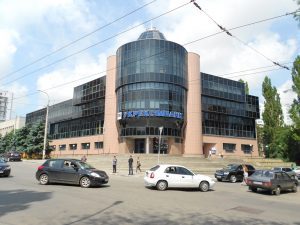
State-owned Ukreximbank (Kyiv) is considering a scenario to repurchase its eurobonds from the market with their replacement with cheaper and longer-term resources, chairman of the financial institution Yevhen Metsger has said.
“As one of the working scenarios, the repurchase of our eurobonds from the market is considered, the rate at which is about 10% in dollars, and replacing them with cheaper and longer-term resources from the International Monetary Fund, he said.
In addition, Metsger said that the bank is holding a dialogue on additional capitalization with the Finance Ministry as a representative of the owner and with the National Bank of Ukraine (NBU).
“Formally, the management will first discuss the situation and forecast of activities with the supervisory board, then ask it to apply for additional capitalization to the government. For the entire cycle, we assume that it will take us time until the end of the second quarter,” he said.
The chairman of the board of Ukreximbank said that the bank needs additional capital to enable it to develop.
He said that without additional capital, the bank will also not be able to provide the necessary support during a pandemic to a number of clients and key sectors of the economy.
“To rely on itself, make a profit, then invest it in net worth is a long way to go, given that the bank’s financial results for 2019 do not allow to reinvest profits in capital. Our former management declared over UAH 600 million of income. However, in reality, I am afraid that we will get a much more modest figure,” the banker said.
According to him, the bank now has quite negative dynamics in operating income, resulting in, there is no way to quickly accumulate financial results to cover one-time effects, and it will take time for the new management team to reproduce the working business model and reverse the trend.
https://ucap.io/

According to the pessimistic forecasts, the market for pet food may fall to 20% by the end of 2020, CEO of Kormotech Rostyslav Vovk said. “The experience of previous crises shows that according to the pessimistic scenario, the market for finished food in Ukraine can go down to 20%,” he told Interfax-Ukraine.
According to Vovk, in the field of animal care, the crisis becomes considerable in one and a half or two years after its beginning. He said that over the past five years, the food market for cats and dogs has grown by 15% annually. The market volume amounted to 122,000 tonnes in 2019.
“This year it will not grow in full size, but it will not go down significantly either, as feed is a product that is difficult to quickly replace (with another feed or food from the table). At the same time, we are predicting, based on the results of previous crises, that demand for keeping expensive pedigreed dogs and cats will decrease slightly. This means that kennels will become less involved in breeding and this will certainly lead to a decrease in feed consumption,” the CEO of Kormotech said.
According to him, the population will have significantly less money by the autumn, and if product prices begin to rise, pet owners can not only buy less, but also look for a cheaper alternative.
“Customers who generally preferred products of the economy segment are more likely to start buying less, adding water to dry and cereal to a wet diet,” Vovk said.
The CEO of Kormotech said that the demand for the company’s products grew by 30% in the second half of March, and as of the second week of April began to return to normal range.
“We assume that the owners of the animals made feed stocks in the same way as other products. In small retail outlets, usually located near residential buildings, sales grew by 30% (the share of this sales channel for our products was 15%), online stores by 45% (the share of this channel is 5%). Pet stores are key point of sale, showed an increase of 32% (the share of this channel is 55%),” Vovk said.
Kormotech exports products to about 20 countries, including France, Estonia, the Netherlands, Slovenia, and Poland. The facilities of the company include two plants for the manufacture of dry and wet pet food. The company produces products for cats and dogs under its own brands Optimeal, Club 4 Paws (Meow! and Woof! trademarks) and in private label.
The ultimate beneficiaries of Kormotech are Olena and Rostyslav Vovk.
The Singapore Food Agency (SFA) has decided that Ukrainian producers of thermally processed products from poultry, pork and eggs will be able to obtain permits for exporting products to the Singapore market, the Foreign Ministry of Ukraine said.
“Any crises also bring new opportunities. The access of Ukrainian goods to the Singapore market will help our entrepreneurs increase exports, despite the coronavirus [COVID-19] crisis,” the Foreign Ministry’s press service said, citing Foreign Minister Dmytro Kuleba on Friday.
The Foreign Minister said that global markets and chains of goods supply are currently being transformed due to a pandemic, and Ukraine is able to use the changes to its advantage, first of all, revealing the hidden potential of exports to Asian markets.
Detailed explanations of the terms of export to Singapore can be obtained from the State Service of Ukraine on Food Safety and Consumer Protection.
The Foreign Ministry said that Ukrainian exporters who use the new opportunities should fill the form of the Ukrainian exporter from the Embassy of Ukraine in the Republic of Singapore (it concerns only the export of Ukrainian goods to the markets of ASEAN countries: Brunei, Vietnam, Indonesia, Cambodia, Laos, Malaysia, Myanmar, the Philippines, Singapore, Thailand) at the link: https://goo.gl/forms/wL5iAZEOk82bfv3n2.

Umanpyvo (Uman beer) LLC (Uman, Cherkasy region), the local producer of beer and soft drinks, will begin exporting its products to Belarus, and the first batch of 21.5 tonnes of products will be delivered in April.
“The first 21.5 tonnes of products will be delivered in April. We are constantly expanding the geography of exports. However, we only cooperate with partners who do not require changes in the recipe and increase expiry date of our products, as this contradicts the principles of Umanpyvo,” the company reported in a press release, citing the company’s CEO Ihor Kysil.
According to the company, Umanpyvo is trying to find new partners, negotiate, adapt packaging to the requirements of legislation of specific countries, and obtain all the necessary certificates during the quarantine period because of coronavirus (COVID-19) pandemic.
Now the company is negotiating with potential new partners from Kazakhstan, Latvia, Lithuania, Estonia, Georgia, Armenia, Germany, the United States, Canada, and also plans to expand its participation in the markets of Poland and Israel.
Umanpyvo representatives said that the company began to enter foreign markets in 2018. During this time, point deliveries were provided to ten countries, as well as regular export to Poland and Israel.
Umanpyvo (Uman beer) is a Ukrainian local producer of beer, cider and soft drinks with a closed production cycle.
Uman Brewery was founded in 1878.

Ovostar Union, a leading egg and egg products manufacturer in Ukraine, supplied 466,000 eggs or 40 tonnes to Israel in April, which is 0.003% of its monthly production volume, the company’s press service has told Interfax-Ukraine.
“Israel is a country with high requirements for safety and quality of food, and we are proud that our products passed the control of the Israeli veterinary service, and we have the opportunity to supply eggs to this market. Israel is currently experiencing a shortage of this product, and, in addition to Ukraine, buys eggs in other European countries. On April 1, 2020, the Israeli Veterinary Service allowed producers of table eggs from Ukraine to export them to the country,” the company said.
Ovostar Union said that the company has been consistently implementing its export development strategy since 2015. Ovostar products are delivered to 55 countries, including to the markets of the EU, the Middle East, Southeast Asia and Africa. The export volume in 2019 amounted to an average of 43 million units per month, in 2018 – 48 million units per month.
Ovostar, citing the State Statistics Service, reported that the production of industrial eggs in Ukraine is growing annually, and in January-February 2020, egg production by specialized enterprises increased 8.6% compared to the same period in 2019.
“At the same time, the volume of the domestic market, taking into account the significant share of eggs collected by households, remains almost unchanged. The egg is one of the key export goods of the agricultural sector of Ukraine. With an average monthly production of 780 million pieces by poultry farms in general, 190 million eggs are exported, making our country one of the key players in the global egg industry,” the company said.
Speaking about the company’s work during the coronavirus disease (COVID-19) pandemic in Ukraine, Ovostar said that since the introduction of quarantine restrictions, the company, despite the additional costs of ensuring sanitary standards at enterprises, exchange rate fluctuations and rising cost of feed, has not changed selling prices for packaged products delivered to retail chains.