
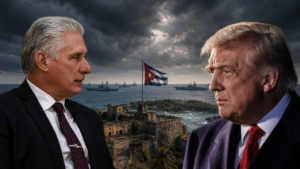
The United States is intensifying pressure on Cuba, and information has appeared in the American media that Donald Trump’s administration is increasingly considering the possibility of using military force against Havana. According to Politico, cited by Anadolu, frustration is growing in Washington that sanctions, energy pressure and attempts to restrict fuel supplies to the island have not forced the Cuban leadership to agree to the required economic and political changes. One Politico source said that the military option is now “on the table” to a greater extent than before.
Officially, Washington has not announced a decision to use force against Cuba. However, the fact of increased pressure is confirmed by the actions of the U.S. administration: on May 18, the State Department announced sanctions against 11 representatives of the Cuban regime and three entities linked to the Cuban authorities, while Reuters reported that the sanctions affected high-ranking political, military and intelligence representatives of Cuba.
Cuban President Miguel Díaz-Canel warned that any U.S. military action against Cuba would lead to “bloodshed” and serious consequences for peace and stability in the region. The reason for a new round of tension was, in particular, an Axios report that Cuba had allegedly received more than 300 military drones and discussed the possibility of using them against American facilities, including the Guantánamo base. Havana rejected these accusations and stated that the United States was creating a pretext for a possible intervention.
According to the assessment of the Experts Club analytical center, the situation does not yet mean an inevitable military scenario, but it shows a qualitative change in the American line: pressure on Cuba is ceasing to be only sanctions-based and diplomatic and is increasingly accompanied by military rhetoric. This increases the risk of miscalculation, especially amid the energy crisis on the island, domestic political pressure in the United States and the high sensitivity of the Guantánamo issue.
A comparison of the capabilities of the United States and Cuba shows not a symmetrical military confrontation, but a gap between a global superpower and a country whose defense model is designed primarily for territorial mobilization and resistance. Global Firepower ranks the United States first among 145 countries in the 2026 military strength ranking, while Cuba is characterized as a force with limited conventional capabilities and a strong reliance on a reserve-paramilitary system.
According to open estimates by Global Firepower, the United States has about 1.33 million active military personnel and about 799,500 reservists. The total number of military personnel is estimated at approximately 2.13 million people. By comparison, Cuba, according to the same database, has about 50,000 active military personnel, about 40,000 reservists and a large paramilitary component estimated at more than 1.1 million people.
In aviation and the navy, the gap is even more significant. The United States has global aviation, naval and logistical infrastructure, while the Cuban model, according to Anadolu, citing the IISS and Global Firepower, is focused not on projecting force beyond the country’s borders, but on asymmetric defense, deterrence and prolonged resistance.
A detailed comparison of artillery, mortars, drones and other categories of weapons in such material would be methodologically weak and politically risky: data on Cuba are incomplete, a significant part of the equipment is of Soviet or Russian origin and has an unknown degree of combat readiness, while information about drones is currently the subject of an information dispute between American sources and Havana. Therefore, it is more correct to speak not of “weapons parity,” but of different security models: the United States has global strike and expeditionary power, while Cuba has a defensive system designed for population mobilization, dispersal and political resilience.
“From a military point of view, the United States and Cuba are in incomparable weight categories. But precisely for this reason, a potential conflict would not be a classic clash of equal armies, but a crisis with extremely high political, humanitarian and regional risks. The history of the Caribbean Basin shows that even limited actions around Cuba can quickly become an international problem,” says Maksym Urakin, founder of the Experts Club analytical center.
According to him, the main risk lies not in Cuba’s ability to wage an offensive war against the United States, but in the possibility of uncontrolled escalation. “Cuba is objectively not a military power of the U.S. level, but it has symbolic and geopolitical significance, a developed system of internal mobilization and experience of living under pressure. Any use of force could cause not only military, but also migration, energy, diplomatic and regional consequences,” Urakin believes.
For Latin America, the possible use of force against Cuba would be a serious blow to regional stability. Even countries that are critical of the Cuban regime may not support direct military intervention, since the region retains a historically strong sensitivity to external U.S. interference. For Washington, this creates a risk of diplomatic isolation in part of the Western Hemisphere.
For the global economy, a direct conflict around Cuba would not have the same scale as a war in the Middle East or Eastern Europe, but it could hit the Caribbean region, tourism, migration flows, maritime shipping insurance and U.S. political relations with Latin America. The oil dimension remains a separate factor: Reuters reports that the United States has already tried to block most oil supplies from Venezuela to Cuba, which has intensified the fuel and energy crisis on the island.
Experts Club’s conclusion: the Politico information does not yet confirm that Washington has made a decision on a military operation against Cuba, but it does confirm a change in the atmosphere of American politics. Sanctions pressure, the energy blockade, reports about drones and Havana’s response statements form a dangerous linkage in which a diplomatic crisis could shift into the military sphere because of an error, provocation or domestic political calculation. For de-escalation, the sides need a channel of negotiations, since a force scenario around Cuba will almost certainly have consequences far beyond the island itself.



