
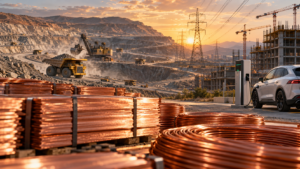
The global copper industry will need approximately $332 billion in new investment in mining projects by 2050 to prevent a large-scale shortage of the metal, which could reach 20 million tonnes per year, or 44% of projected demand. This is stated in the Transition Metals Outlook 2026 study by analytical company BloombergNEF (BNEF), published on October 20, 2026.
According to the forecast, the global copper market could face a deficit as early as 2028, as the expansion of mining capacity lags behind consumption growth. The main drivers of increasing demand will be the electrification of transport, modernization of power grids, industrial development, and infrastructure construction.
BNEF analysts expect global copper consumption to increase by 61% by 2050 compared with 2026, reaching almost 46 million tonnes.
At the same time, demand for copper associated with the electrification of the economy will grow by 89%, to 23.3 million tonnes. Thus, these areas will account for more than half of global metal consumption.
Electric transportation will become the fastest-growing segment. Copper use in electric cars, electric trucks, buses, and related infrastructure will increase by 244%, reaching 11.4 million tonnes by the middle of the century.
Copper is essential for the production of electric motors, inverters, batteries, high-voltage wiring, and charging stations. In addition, the metal is widely used in construction, industrial equipment, electrical grids, and consumer electronics.
According to BloombergNEF estimates, existing global copper ore reserves are sufficient to meet long-term needs, but the problem lies in the insufficient pace of developing new deposits and expanding existing operations.
The average period from the start of project development to the commissioning of a new copper mine is approximately 17 years. As a result, even with the necessary $332 billion in investment, the metal shortage could persist until at least 2043.
Additional challenges arise from declining copper grades in mined ore, rising production costs, and insufficient funding for geological exploration in previous years.
Without new capital investment, global copper supply could decline by 14.5%, from 30 million tonnes in 2026 to 25.7 million tonnes in 2050. The development of copper scrap recycling will partially offset the decline in primary production but will not be able to completely eliminate the projected shortage.
Chile, according to BloombergNEF’s forecast, will retain its status as the largest producer of primary copper. However, production in the country could decline from 5.8 million tonnes in 2026 to 4.8 million tonnes in 2050.
Despite the decline in absolute production volumes, Chile’s share of global primary copper production could increase from 24% to 28%, as reductions in other countries will be more significant.
Analysts warn that a prolonged copper shortage could lead to higher global prices and increased costs for energy equipment, electric transportation, and infrastructure projects. In certain segments, manufacturers may be forced to make greater use of alternative materials.
Martin Tengler, head of metals and mining research at BloombergNEF, noted that the situation regarding the supply of raw materials to the global economy has changed significantly compared with previous forecasts.
According to him, the development of new production capacity and improvements in battery technologies have reduced the risks of shortages of most energy transition metals. However, the main challenge is becoming ensuring the availability of the necessary materials in specific regions and at the required times.
At the same time, copper remains the main exception to the overall trend of improving forecasts.
According to Transition Metals Outlook 2026, nine of the ten metals and materials studied could potentially have sufficient production capacity by 2050, provided investment continues and depleted reserves are replaced.
In particular, global lithium consumption is expected to nearly triple, from 1.6 million to 4.8 million tonnes of lithium carbonate equivalent, while demand for graphite will more than double, from 3.3 million to 6.9 million tonnes.
At the same time, the increasing adoption of lithium iron phosphate batteries is reducing the expected need for nickel and cobalt compared with previous forecasts.
China continues to dominate the processing of energy transition metals. According to BloombergNEF, for eight of the ten materials studied, more than half of global processing capacity is concentrated in a single country, and for seven of these materials, that country is China.
The Experts Club analytical center has produced a video overview of the world’s largest copper-producing countries and a comparison of copper production from 1971 to 2025.
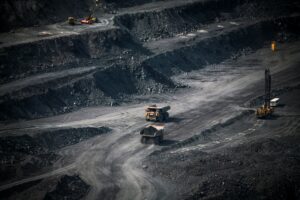
PJSC “Ingulets Mining and Processing Plant” (Ingulets Mining and Processing Plant, Kryvyi Rih, Dnipropetrovsk Oblast), which is part of the Metinvest Group and is currently temporarily idle, allocated 3.4 million UAH in January–June of this year to preventive measures and programs aimed at improving safety, occupational health, and the work environment.
According to information on the implementation of the collective bargaining agreement for the first half of 2026, despite martial law and the temporary suspension of the production cycle, the main priorities of the joint efforts between management and the labor union remain the people—their safety, employment, timely payment of wages, and the preservation of social guarantees.
At the same time, it is noted that 19 planned comprehensive measures have been implemented. As a result, working conditions have been improved for 217 employees, and sanitary and living conditions have been improved for 48 employees. Over 1.7 million hryvnias were allocated to provide employees with personal protective equipment and work clothing.
Under martial law, certain provisions of the collective bargaining agreement are being partially implemented due to the lack of organizational and technical conditions necessary for the plant’s full-scale operations. However, specific obligations were fulfilled for those employees involved in maintaining the plant’s essential functions and ensuring the rapid resumption of the production cycle. Specifically, in the first half of 2026, the average monthly salary exceeded 17,000 UAH—a 30.4% increase compared to the first half of 2025.
As reported by Oleksandr Myronenko, Chief Operating Officer (COO) of the Metinvest Group, the Ingulets Mining and Processing Plant has been shut down since 2024—production there is uneconomical due to high electricity prices. The facility has been properly mothballed, and production can be resumed if market conditions are favorable.
Ingulets GOK specializes in the extraction and processing of ferruginous quartzites from the Ingulets deposit, located in the southern part of the Kryvyi Rih iron ore basin. It produces iron ore concentrate. The company’s production capacity is 14 million metric tons of iron ore concentrate per year.
Ingulets Iron Ore Mine is part of the Metinvest Group, whose major shareholders are PJSC “System Capital Management” (SCM, Donetsk, 71.24%) and the “Smart-Holding” group of companies (23.76%). The management company of the Metinvest Group is Metinvest Holding LLC.



