
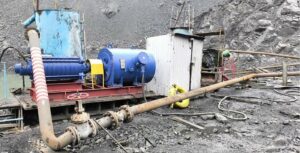
The Northern Mining and Processing Plant (Northern GZK, Kryvyi Rih, Dnipropetrovsk Oblast), part of the Metinvest Group, has invested 3.5 million UAH in the modernization of pumping equipment, which is expected to pay for itself within a year.
According to the company, as part of its 2025 investment program, a new pump unit was installed at Northern GOK’s Pershotravnevy open-pit mine. Its operation over the past nine months has already yielded significant economic benefits through energy savings.
It is noted that in open-pit iron ore mining operations, pumping equipment is used to remove groundwater from the bottom of the quarry, which prevents flooding, strengthens the slope walls, and ensures safe mining operations. A pumping station is located at the lowest point of the Pershotravnevy Quarry, and its equipment performs these functions.
Last year, due to operational needs to deepen the quarry to a lower level, it became necessary to replace the pumping equipment with a more powerful system. At that time, the station was operating a CNS 300-560 pump. According to its technical specifications, its capacity was 300 cubic meters of water per hour, and it could deliver water to a head of 560 meters, with subsequent transportation to the technical water supply and slurry management facility.
To increase the technical capabilities of the pumping equipment for dewatering the lower ore-bearing horizons, an investment project was approved to purchase a new, more powerful pump. Last fall, the NSSH 315-630 unit was put into operation.
The new pump’s productivity is higher due to its increased flow capacity—up to 315 cubic meters of water per hour—and it is capable of pumping water to the upper horizons at a head of up to 630 m. At the same time, the new equipment’s energy consumption is equal to that of the previous unit. Both units are equipped with 800 kW motors.
“Last year, the company invested 3.5 million UAH in the modernization of the pumping equipment at the Pershotravnevy Quarry. Current energy-saving estimates show that over a full year of operation of the NSSH 315-630 pump, we will achieve an economic benefit that will fully recoup the investment and continue to generate a profit for the plant,” explained Maksym Danilov, head of the Pershotravnevy Quarry at Pivnich GZK.
Pivnichny GZK is part of the Metinvest Group, whose main shareholders are PJSC “System Capital Management” (SCM, Donetsk) (71.24%) and the “Smart-Holding” group of companies (23.76%). The management company of the Metinvest Group is Metinvest Holding LLC.
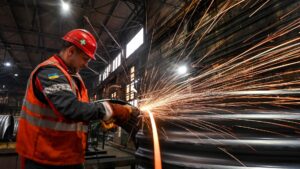
The Zaporizhzhia Metallurgical Plant “Zaporizhstal” is carrying out systematic work to maintain and modernize its crane system and lifting equipment
According to the company’s press release, the reliable operation of this equipment is a key component of ensuring the continuity of production processes, employee safety, and the creation of comfortable working conditions.
It is noted that the plant operates 230 lifting mechanisms and 447 cranes. All equipment undergoes regular maintenance, repairs, and modernization with the implementation of modern solutions in the field of occupational health and safety.
“Today, the company is carrying out comprehensive work to maintain the crane fleet in good working order—from regular technical audits and timely detection of malfunctions to staff training and the implementation of modern safety standards. This approach ensures uninterrupted production operations and creates safer working conditions for our employees,” noted Kirill Gavrilyuk, Director of Occupational Health and Industrial Safety at Zaporizhstal.
It is also reported that in 2025, the company carried out a series of major overhauls of crane equipment with a total cost of over 13.6 million UAH. In particular, a major overhaul of the ore-handling gantry crane was carried out in the blast furnace shop. As part of the work, the crane and trolley travel mechanisms, as well as the grab lifting and closing mechanisms, were updated; the trolley rails were replaced; and the steel structures, electrical equipment, and safety devices were repaired.
In the slab mill section of the hot rolling shop, major repairs were performed on two grab cranes. The work involved repairing the main steel structures, the main hoisting mechanisms, control systems, electric motors, and electrical equipment.
In addition, the company allocated approximately UAH 170 million to maintain the equipment in good working order and perform routine repairs on the crane equipment.
In 2026, Zaporizhstal continues the systematic modernization of its crane fleet. Since the beginning of the year, 14 new industrial air conditioners have been installed on overhead and crane systems in the hot rolling shop, cold rolling shop, blast furnace shop, and open-hearth shop. To improve working conditions for crane operators, the company also purchased and installed modern anti-vibration seats, which help reduce the impact of vibration and prevent the development of occupational diseases.
In total, nearly 90 million UAH is allocated for maintenance and repairs of crane facilities in 2026.
Among the largest projects of the year is the overhaul of one of the gantry cranes in the hot rolling shop, with an investment of over 7 million UAH. The project involves a comprehensive upgrade of mechanical and electrical equipment, modernization of control systems, replacement of cables and wiring, and the completion of a full range of commissioning works.
In all structural units of the plant, material-handling cranes are equipped with audible alarms to warn employees of moving machinery. In the hot rolling shop, four cranes have additionally been fitted with a visual lighting system for the areas where loading and unloading operations take place. In the railway transport department, two cranes are equipped with an automated signaling system that prevents the mechanisms from starting without a warning signal. The combination of audible signals and visual indicators helps employees better navigate the crane operating area and significantly reduces production risks during loading and unloading operations.
Zaporizhstal is one of Ukraine’s largest industrial enterprises, whose products are in high demand among consumers both in the domestic market and in many countries around the world.
Zaporizhstal is a joint venture of the Metinvest Group, whose main shareholders are PJSC System Capital Management (71.24%) and Smart Steel Limited (23.76%). Metinvest Holding LLC is the management company of the Metinvest Group.
crane fleet, METINVEST, MODERNIZATION, occupational safety, ZAPORIZHSTAL
The agricultural holding “TAS Agro” plans to invest approximately $15 million over the next three years in modernizing dairy farms to bring them into compliance with EU standards, the company’s CEO Oleg Zapletnyuk said in an interview with Delo.ua.
The CEO of the agricultural holding clarified that TAS Agro is concentrating its livestock operations in the Vinnytsia region, where it is completely rebuilding a farm, increasing the number of stalls, and implementing loose housing for livestock.
“The total investment amount is approximately $15 million over the next three years. We are investing in this step by step. This primarily concerns cows. Our goal is to transform outdated livestock farming into a highly productive sector, increase its efficiency, improve livestock housing conditions, and enhance the quality of meat and dairy products,” Zapletnyuk said.
The company’s CEO noted that the strategic plan calls for expanding the land bank from the current 80,000 hectares to 100,000 hectares by the end of 2026.
“Strategically, we plan to increase our land bank to 100,000 hectares. We are currently considering certain assets; if we manage to finalize the purchase by the end of the year, that will bring us to about 100,000 hectares. The next step is to increase it to 120,000 hectares, but that is by 2028,” he said.
Assessing the financial results, the company’s CEO noted that TAS Agro’s net profit for 2025 is expected to be in the range of $20–22 million.
“In 2025, the company’s net profit was in the range of $20–22 million, but we have not yet sold part of our production. As of today, we have effectively sold the wheat, but we have not yet updated the key financial indicators. Estimated at $20–22 million, this is actually 10% more than we had budgeted,” he emphasized.
Zapletnyuk attributed the decline in profitability compared to 2024 (over $25 million) to drought in some of the regions where the company operates and the drop in global prices for agricultural products.
Last year, the holding exported approximately 270,000 tons of agricultural products, with exports accounting for about 60% of total production. The primary destination was the EU, which received 49% of all shipments. Additionally, 25% of exports went to North African countries, 19% to Asia, and 4% of the products were sold in Middle Eastern markets. At the same time, sunflower seeds, as well as a significant portion of soybeans and rapeseed, are processed domestically at partner plants for the subsequent sale of finished products.
The TAS Agro agricultural holding was established in 2014. It cultivates approximately 80,000 hectares across six regions of Ukraine. Its specialization is crop production and dairy farming (cattle herd—5,500 head). Its grain storage capacity is 250,000 tons. Serhiy Tihipko is the founder of the “TAS” group and the beneficiary of the agricultural holding.
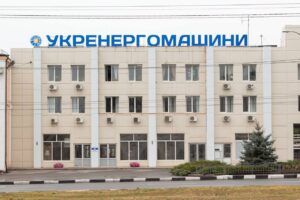
In 2026, JSC “Ukrenergomashiny” plans to invest approximately 60 million UAH in production development, specifically for the purchase of new equipment, major repairs and modernization of existing equipment, and the provision of technological equipment for workplaces.
“The total planned capital investment for 2026 amounts to UAH 60 million. Funding will be provided from the company’s own funds,” according to the company’s 2025 financial report published in the disclosure system of the National Securities and Stock Market Commission.
In particular, it is planned to allocate UAH 33.5 million in investments to improve the technical level of mechanical assembly, metallurgical, and welding operations, installation work, and equipment modernization; UAH 12.4 million toward the development of auxiliary production and laboratory facilities, office equipment, and tools, and UAH 14 million toward design, research, development, and technological work.
As reported, in 2025, Ukrenergomashiny increased its net revenue by nearly 33% compared to 2024—to 1.06 billion UAH—and its net profit by 3.5 times, to 3.07 million UAH.
According to the report, exports accounted for 70.7% (nearly UAH 770 million), including shipments to Kazakhstan, India, Armenia, Bulgaria, and Hungary.
Last year, in particular, a steam turbine was delivered for the Aksu TPP and power equipment for the Ekibastuz Thermal Power Plant (Kazakhstan), a set of power equipment for the Kozloduy NPP (Bulgaria) and the Armenian NPP, and sets of power (turbine) equipment for the Bandel TPP (India).
Domestic customers were supplied with equipment for the Khmelnytskyi, Rivne, and South Ukraine NPPs, as well as the Dobrotvor, Trypillya, Zmiiv, Kryvyi Rih, Burshtyn, and Darnytsia TPPs, and the Kremenchuk HPP.
Motor equipment was supplied, in particular, to Tatra-Yug LLC (83 traction electric motors), the Kryukiv Electric Locomotive Plant (18 induction generators), and Ukrzaliznytsia (41 induction generators).
JSC “Ukrenergomashiny” (formerly JSC ‘Turboatom’ and “Elektrovazhmash”) is Ukraine’s sole manufacturer of turbine equipment for hydroelectric, thermal, and nuclear power plants. It also manufactures, in particular, electric motors for rail and urban transport (the “Elektrovazhmash” product line).
As of early 2026, the company employed 2,169 people.
At the same time, the report notes that, in accordance with orders from the CEO, under martial law conditions—taking into account the state of production, its supply of material and energy resources, and with the aim of rationally utilizing working hours and financial resources—a part-time work schedule has been established for the company’s employees.
“Employees of JSC ‘Ukrenergomashiny’ work according to schedules based on the company’s needs,” the document states.

The Ma’Rizhany industrial hemp processing plant (Zhytomyr Oblast) has begun a new operating season following a technical hiatus during which the company modernized its production lines, the company announced on Facebook.
“We have installed new equipment to make hemp straw processing even more efficient. This will allow us to expand the volume and range of our products—natural raw materials for construction, textiles, agriculture, and many other sectors,” the company said.
The Ma’Rizhany Industrial Park was added to the Industrial Parks Register in August 2024. In May 2025, the Ma’Rizhany Hemp Company began operations here; it is currently Ukraine’s largest facility for the primary processing of industrial hemp. The plant’s initial capacity was 14,000 tons of long fiber per year.
Earlier, Dmytro Kysilevsky, deputy chairman of the Verkhovna Rada Committee on Economic Development, noted that if hemp cultivation in the region expands to 4,000 hectares, the park plans to double its processing capacity to 20,000 tons of raw material annually.

The agricultural holding company Continental Farmers Group (CFG) has allocated $23.9 million to upgrade and modernize its fleet of machinery, the company’s press service reported.
“Continental is consistently implementing its investment plans, maintaining a focus on the systematic renewal, standardization, and modernization of its fleet. This approach enhances operational efficiency, cost predictability, and the technological resilience of the business,” emphasized Georg von Nolken, CEO of the agricultural holding.
According to the report, the agricultural holding’s fleet was expanded with 17 tractors of various power ratings, nine self-propelled sprayers, seven seeders, four cultivators, as well as trailer and warehouse equipment. In addition, the company purchased two grain harvesters and one potato harvester.
“Continental” has also expanded its logistics division and purchased 14 new tractor-trailers with semi-trailer dump trucks and five cargo trucks. The agricultural holding explained that this is another step toward creating a closed-loop logistics cycle “from field to elevator,” which will reduce dependence on external carriers.
All new equipment is integrated into the precision farming system. The units support automatic section control, operation based on task maps, and remote monitoring, which allows for the optimization of seed, fertilizer, and fuel costs.
Continental clarified that the purchased machines are already being used in the 2026 spring planting campaign.
The Mriya agricultural holding and CFG, united under the name “Continental Farmers Group,” have been operating as a single business since November 2018, when Mriya signed an agreement with the international investor Salic UK regarding the sale of assets.
Salic was founded in 2012. Its sole shareholder is the Saudi Arabian Public Investment Fund, which invests in agricultural and livestock production.



