

Low and moderate alcohol consumption may correlate differently with mortality risk depending on the type of beverage: in a large observational study, moderate wine consumption was associated with a lower risk of death from cardiovascular disease, whereas even low consumption of beer, cider, or spirits was associated with a higher risk. These findings will be presented at the American College of Cardiology (ACC) Annual Scientific Session in New Orleans on March 28.
The study included 340,924 adult participants in the UK Biobank from 2006 to 2022. The authors analyzed alcohol consumption habits and subsequent mortality rates, dividing participants into groups based on their intake of pure alcohol. As a reference, the researchers noted that a standard 12-ounce can of beer, a 5-ounce glass of wine, and a 1.5-ounce serving of spirits contain approximately 14 grams of pure alcohol.
According to the results, compared to those who never drank or drank only occasionally, people with high alcohol consumption had a 24% higher risk of death from any cause, a 36% higher risk of death from cancer, and a 14% higher risk of death from heart disease. Among light and moderate drinkers, differences by beverage type were more pronounced: consumption of spirits, beer, or cider was associated with a statistically significant higher risk of death, whereas a similar level of wine consumption was associated with a lower risk.
Specifically regarding cardiovascular mortality, the researchers found that among moderate wine drinkers, the risk of death from cardiovascular disease was 21% lower than among those who did not drink or drank only occasionally. At the same time, even low consumption of spirits, beer, or cider was associated with a 9% increase in the risk of death from cardiovascular causes compared to the group of never or occasional drinkers.
The authors believe that the differences may be related not only to the beverage itself but also to the manner of consumption. Wine is more often consumed with meals and by people with a higher-quality diet and generally healthier lifestyles, whereas beer, cider, and spirits are more often consumed outside of meals and are associated with a lower-quality diet and other risk factors. The researchers also mention the possible role of polyphenols and antioxidants found, in particular, in red wine.
At the same time, the authors emphasize that this is an observational study and therefore shows correlations rather than proving a causal relationship. Alcohol consumption was assessed based on participants’ self-reports at the start of the study and did not reflect possible changes in habits over time. Additionally, UK Biobank participants are, on average, healthier than the general population, which may limit the generalizability of the findings to the entire population.
Thus, the presented data support the general conclusion of recent years that lower alcohol consumption is generally better for health, but within the low-to-moderate drinking group, risks may vary depending on the type of beverage and accompanying lifestyle. The authors believe that high-quality randomized trials will be needed in the future to better understand the differences between beverages.

In the first half of 2024, 87,655 children were born in Ukraine, which is 9% less than in the same period last year, according to the Ministry of Justice. At the same time, 250,972 deaths were recorded. The largest number of babies and deaths in Ukraine were in Dnipropetrovs’k and Kyiv regions.
The birth rate decreased by 1.5 times this year compared to the period before the full-scale invasion: 87,655 children compared to 132,595 in 2021.
The highest number of newborns was registered in Kyiv – 9,695 children, 7,923 in Lviv region, and 6,962 in Dnipro region. The number of babies born in the frontline regions is consistently low: in Kherson (221) and Donetsk (702). In the Luhansk region, no babies were registered in the last six months.
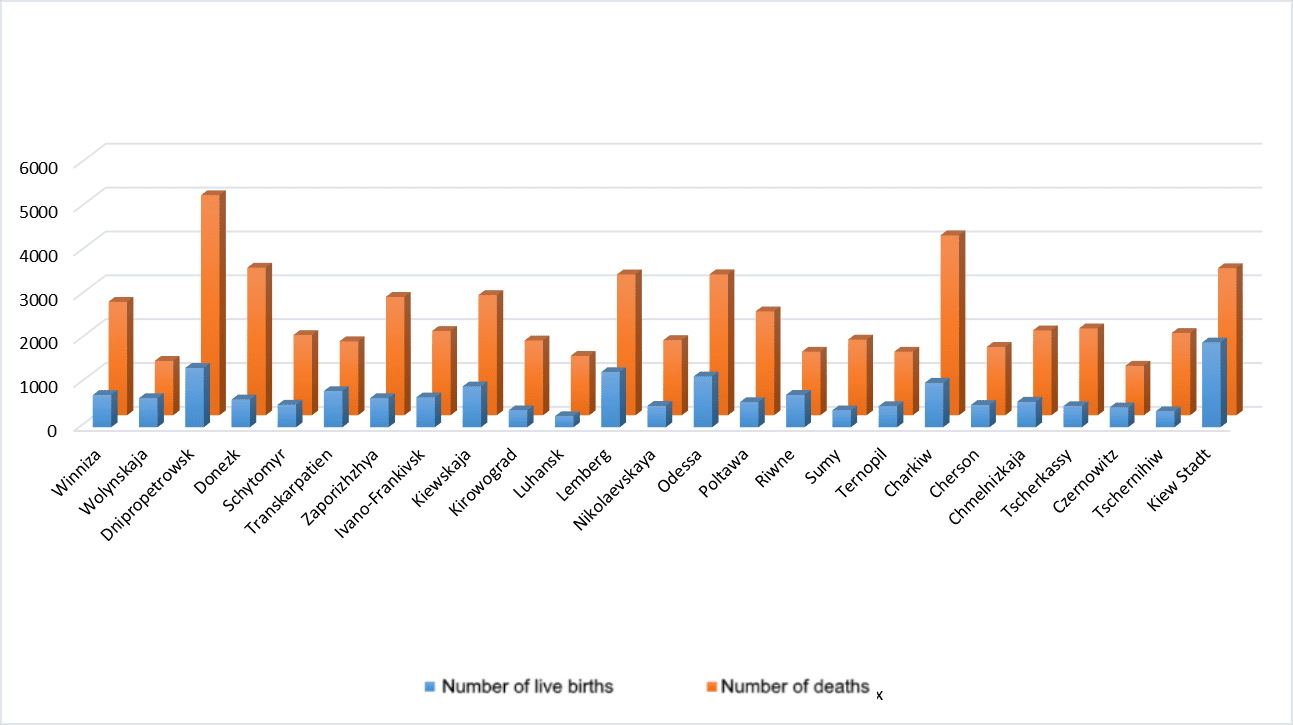
Currently, there are three deaths for every newborn citizen. This ratio is one of the key indicators of the demographic crisis. For comparison, in the pre-civil war period, there were two deaths per child in 2018-2020.
250,972 people died in Ukraine in the first six months of 2024. This is 1.4 times less than in the same period in 2021, when 349,041 deaths were recorded. However, it is worth noting that 2021 was the peak year for deaths due to the COVID-19 pandemic.
The lowest number of deaths occurred in the frontline Kherson (2334) and Donetsk (5753) regions and in Chernivtsi (5422). Anti-record numbers were set in Dnipropetrovs’k region (26,374), Kharkiv region (17,999), and Kyiv (17,449).
https://opendatabot.ua/analytics/birth-death-2024-6
Ratio of fertility and mortality by region in Jan 2022
SSC of Ukraine
Ratio of fertility and mortality by region in Jan 2022
SSC of Ukraine
Ratio of fertility and mortality by region in Jan 2022
SSC of Ukraine
Ratio of fertility and mortality by region in 2021

SSC of Ukraine



