
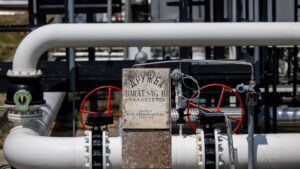
On Wednesday, after 12:00 p.m., Ukraine resumed oil transit via the Druzhba pipeline, according to a source close to the Ukrainian government who spoke to the online portal “Energoreforma.”
“At 12:35 p.m., oil transit was launched. Pumping has begun,” said the source speaking to “Energoreforma.”
He has not yet specified the volume of the transit.
As reported with reference to Slovak Economy Minister Denisa Saková, the resumption of supplies via the Druzhba pipeline to that country is expected on Thursday morning.
Hungary and Slovakia have not received Russian oil via the Druzhba pipeline since January 27 of this year due to damage to the pipeline caused by Russian shelling. Earlier, Hungarian Prime Minister Viktor Orbán stated that he would not lift his veto on the €90 billion EU loan for Ukraine until oil supplies are restored.
Péter Magyar, leader of the Tisza Party, which won the elections in Hungary, called on Ukrainian President Volodymyr Zelenskyy to ensure the Druzhba pipeline is restored as soon as possible.
The day before, the Kremlin stated that Russia is technically ready to resume transit through the Druzhba pipeline to Hungary.
Hungarian MOL announced on Wednesday, April 22, that the state-owned JSC “Ukrtransnafta,” responsible for operating the Ukrainian section of the Druzhba pipeline, had officially notified it of the completion of repair work on the Druzhba pipeline, as well as the termination of the force majeure circumstances that had been in effect since January 27, 2026.
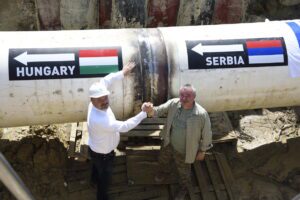
Serbian company Srbijagas and Hungary’s FGSZ have finished building the linear section of a gas pipeline connector between the two countries through which Hungary will be able to receive Russian gas transported through a Black Sea pipeline instead of through Ukraine.
Serbia’s national TV channel reported the welding of the “golden” joint of the pipeline on the border between the two countries.
Gas supplies along the new route are supposed to start on October 1, the beginning of the new gas year.
The TurkStream pipeline, which carries Russian gas across the Black Sea to Turkey and onward to Southern Europe, went into operation in January 2020. Turkey, Bulgaria, Greece, Macedonia and Romania were the first to receive gas through the pipeline. Serbia, as well as Bosnia and Herzegovina began receiving gas along the new route at the start of 2021. In future, TurkStream gas is also supposed to reach Austria through Hungary.
The first phase of the connector between Serbia and Hungary, with capacity of 6 billion cubic meters per year, involved building a 15-km linear pipeline section.
The expansion of the connector to 8.5 bcm per year has been postponed from October 2022 to October 2023. Hungarian gas companies and officials lost time in the middle of 2020 due to concerns that they might be hit by U.S. sanctions.
The U.S. State Department issued a new clarification on section 232 of the Countering America’s Adversaries Through Sanctions Act (CAATSA) on July 15, 2020, stating that sanctions could be imposed against investors in Russian export energy pipeline projects. The new clarification extended the possibility of imposing sanctions against persons investing, or providing goods and services, directly and that significantly facilitate the construction of the Nord Stream 2 gas pipeline and the second string of the TurkStream pipeline.
Hungary imported 8.637 bcm of Russian gas in 2020.

The decision of the National Security and Defense Council (NSDC) of Ukraine to return to state ownership of a part of the main oil product pipeline Samara-Western Direction will lead to a halt in supplies along it, but will not cause a deficit and a significant increase in prices for diesel fuel, A-95 Consulting Group said.
“We see no prerequisites for resource tension in the market. In the past three years, the loading of the oil product pipeline has decreased, the main reason was the introduction in the summer of 2019 of a special duty of 3.75% [now 4%] on pipeline supplies of Russian diesel fuel. As a result, if in 2018 imports through Prykarpatzakhidtrans amounted to 1.98 million tonnes [30.5%], then in 2019 it was 1.23 million tonnes [17.76%], and in 2020 – some 635,000 tonnes [8.57%],” the group said in a statement.
According to A-95 Group Director Serhiy Kuyun, the Ukrainian market is diversified to the maximum, and it will not be difficult to replace the 50,000 tonnes of pipeline supplies per month.
“This will happen both due to reorientation of pipeline volumes for shipment by railway, and due to reserves of domestic oil refining and imports by sea,” he said.
Kuyun, in particular, assumes that at least 20,000-30,000 tonnes can additionally be delivered to Ukraine from the Belarusian terminal in Gomel, where Russian diesel fuel is transshipped form the pipeline Samara-Western Direction to the railway transport. Also, from March, an increase in imports of Russian diesel fuel by railway across the eastern border is expected. A large margin of capacity for transshipping from the sea remains at the Ukrainian ports: they are used by less than 30%. We can also count on a slight increase in supplies from Belarus.
“The greatest potential has Ukrainian oil refineries, which are loaded with raw materials by less than 30%. The main reason is the disproportion in excise taxes on motor fuels. It stimulates the consumption of diesel fuel and liquefied gas, which Ukraine is forced to import by 70-80%. A solution to this problem could give an incentive to increase oil refining and, as a result, reduce import dependence on all fuel types,” Kuyun said.
A-95 Consulting Group does not exclude an insignificant (within 1-1.5%) increase in wholesale prices for diesel fuel in the central and western regions, where pipeline diesel fuel was mainly distributed.
As reported, Prykarpatzakhidtrans operates a section of the Samara-Western Direction oil product pipeline with a length of about 1,100 km, intended for pumping diesel fuel from Russia and Belarus, both for the internal needs of Ukraine and for transit to Europe, in particular, to Hungary. The design capacity of the pipeline is 3.5 million tonnes per year.
The Ukrainian section of the Samara-Western Direction oil product pipeline belongs to Prykarpatzakhidtrans LLC (Rivne). Until 2016, the company was a structural subdivision of Russia’s Transneft subsidiary Transnefteprodukt. In February 2016, Transneft sold Prykarpatzakhidtrans to the Swiss International Trading Partners AG. In March 2019, the Antimonopoly Committee of Ukraine (AMCU) allowed the unitary enterprise Oil Bitumen Plant, owned by the large private Belarusian oil trader Interservice, to acquire control over Prykarpatzakhidtrans.
At present, Prykarpatzakhidtrans with a charter capital of UAH 105.563 million belongs to the Oil Bitumen Plant (51%), International Trading Partners (48%) and Anatoliy Shefer (1%).
The pipeline was built during the Soviet era and after the proclamation of Ukraine’s independence was to become the property of the state on the basis of succession, as a main pipeline. At the same time, Russian Transnefteprodukt did not transfer this pipeline to the ownership of Ukraine. In 2011, the Economic Court of Rivne region recognized the Ukraines’s ownership of a part of the pipeline passing through the territory of Ukraine, and the Economic Court of Appeal and Supreme Economic Court in 2014-2015 upheld this decision.
However, in 2015, the Economic Court of Rivne region canceled the decision due to allegedly newly discovered circumstances. Later, in 2017, the same court ruled that the ownership of a part of the oil product pipeline belonged to Prykarpatzakhidtrans LLC. It was based on the conclusion of the forensic engineering and technical expertise of the experts of the Ukrainian Research and Design Institute of Nitrogen Industry and Organic Synthesis Products that this pipeline was not a main pipeline. The NABU considers such a conclusion to be deliberately false, therefore, together with the SBU in February 2021, it announced suspicions to the experts.
President of Ukraine Volodymyr Zelensky, by decree of February 19, 2021, put into effect the NSDC decision on taking measures to protect the property interests of the state, which, among other things, instructed the Cabinet of Ministers to determine the central executive body responsible for the preservation and operation of a part of the oil product pipeline passing through the territory of Ukraine.
According to NSDC Secretary Oleksiy Danilov, “an instruction has been given to all relevant bodies: to return the property of the Ukrainian people in a legal way and to find out why the state property ended up in private hands.”
DESTABILIZE, OIL PRODUCT, PIPELINE, PRYKARPATZAKHIDTRANS, UKRAINIAN MARKET



