
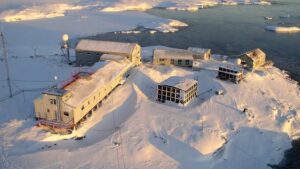
Thanks to Ukraine’s participation in the POLARIN project under the Horizon Europe program, two new international research projects are launching at the “Akademik Vernadsky” station and on the icebreaker “Noosphere,” according to the National Antarctic Scientific Center (NASC).
“At the ‘Vernadsky’ station, researchers will study the aerosol-mediated dispersal of microbial communities in polar regions as part of the MICROAIRPOLAR project. The second project—TRICUSO-FLOATS—is dedicated to monitoring carbon in the Southern Ocean; for this project, six argon buoys equipped with a range of sensors will be deployed from aboard the icebreaker ‘Noosphere,’” the NANC stated in a press release on Tuesday.
Specifically, as part of the MICROAIRPOLAR project, which is being carried out by scientists from the Autonomous University of Madrid (Spain) and Northumbria University (United Kingdom), special MicroAirCollector equipment will be installed at three stations in the Arctic and three in Antarctica to collect samples of microorganisms from the air. Scientists will conduct genetic analysis to determine exactly what the wind carries into the polar regions and will track the trajectories of air masses and the movement of bacteria in the Arctic and Antarctic, as well as between them.
As part of the second project—TRICUSO-FLOATS, carried out by scientists from the National Oceanography Center (United Kingdom), the Norwegian Research Center, and Sorbonne University (France)—carbon monitoring will be conducted in the Southern Ocean. To this end, six argon buoys equipped with a range of sensors will be deployed from the Noosphere to measure total alkalinity and dissolved inorganic carbon content, which will help quantify how much carbon the Southern Ocean absorbs.
Both studies will begin during the next Antarctic season, which starts in late 2026.
The NASC also notes that POLARIN brings together 64 polar research infrastructures belonging to organizations from around the world. MICROAIRPOLAR and TRICUSO-FLOATS are the first winning projects to gain access to the “Vernadsky” and “Noosphere” stations as part of POLARIN.
“For Ukraine, such initiatives represent an opportunity to participate in cutting-edge scientific research and to be an active member of the global polar community,” the NASC concludes.
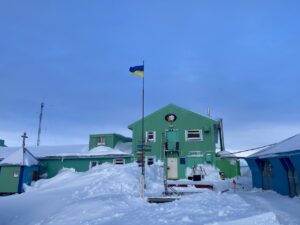
The National Antarctic Science Center (NASC) has started participating in the Polarin research project of the European Union’s Horizon Europe program, the Ministry of Education and Science reports.
“Today, on March 1, 2024, the Polarin project of the EU’s Horizon Europe program has officially started, with the participation of the National Antarctic Science Center (NASC) and 49 other organizations from around the world. These are institutions that provide polar research from the EU, Chile, Canada, the USA, the UK, and other countries. The project is coordinated by the Alfred Wegener Institute, Germany,” the press service of the Ministry of Education said.
It is noted that Polarin involves the unification of 64 research infrastructures in the Arctic and Antarctic and the provision of free access to them (both direct and remote) to all participants.
“In this way, it is planned to support interdisciplinary research in both polar regions to address global issues, including climate change. After all, these regions are especially important for the Earth’s climate and are the first to respond to changes,” the statement said.
The agency said that the created network covers all related areas of research – from marine and terrestrial to atmospheric, and will include research stations, ships, observatories, repositories and databases.
Ukraine is represented in the project by two infrastructures: the Antarctic station Akademik Vernadsky and the Noosphere icebreaker.
“This will allow us to attract additional international funds to the Antarctic program, and Ukrainian scientists to use the polar facilities of other countries and participate in important scientific initiatives,” the press service quoted the director of the National Academy of Sciences Yevhen Dykyi as saying.
Ukraine will join Polarin in 2024-2025, and the project will last for 5 years. The project budget is 14.6 million euros, of which more than half a million euros are earmarked for Ukraine.



