
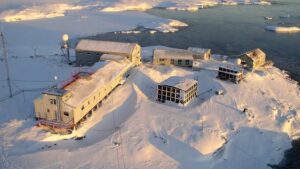
Thanks to Ukraine’s participation in the POLARIN project under the Horizon Europe program, two new international research projects are launching at the “Akademik Vernadsky” station and on the icebreaker “Noosphere,” according to the National Antarctic Scientific Center (NASC).
“At the ‘Vernadsky’ station, researchers will study the aerosol-mediated dispersal of microbial communities in polar regions as part of the MICROAIRPOLAR project. The second project—TRICUSO-FLOATS—is dedicated to monitoring carbon in the Southern Ocean; for this project, six argon buoys equipped with a range of sensors will be deployed from aboard the icebreaker ‘Noosphere,’” the NANC stated in a press release on Tuesday.
Specifically, as part of the MICROAIRPOLAR project, which is being carried out by scientists from the Autonomous University of Madrid (Spain) and Northumbria University (United Kingdom), special MicroAirCollector equipment will be installed at three stations in the Arctic and three in Antarctica to collect samples of microorganisms from the air. Scientists will conduct genetic analysis to determine exactly what the wind carries into the polar regions and will track the trajectories of air masses and the movement of bacteria in the Arctic and Antarctic, as well as between them.
As part of the second project—TRICUSO-FLOATS, carried out by scientists from the National Oceanography Center (United Kingdom), the Norwegian Research Center, and Sorbonne University (France)—carbon monitoring will be conducted in the Southern Ocean. To this end, six argon buoys equipped with a range of sensors will be deployed from the Noosphere to measure total alkalinity and dissolved inorganic carbon content, which will help quantify how much carbon the Southern Ocean absorbs.
Both studies will begin during the next Antarctic season, which starts in late 2026.
The NASC also notes that POLARIN brings together 64 polar research infrastructures belonging to organizations from around the world. MICROAIRPOLAR and TRICUSO-FLOATS are the first winning projects to gain access to the “Vernadsky” and “Noosphere” stations as part of POLARIN.
“For Ukraine, such initiatives represent an opportunity to participate in cutting-edge scientific research and to be an active member of the global polar community,” the NASC concludes.

The National Antarctic Scientific Center (NASC) and the Mexican Antarctic Research Agency (AMEA) signed a memorandum on scientific cooperation in Antarctica in Mexico City on Monday, August 11. signed a memorandum on scientific cooperation in Antarctica in Mexico City, which provides for joint Ukrainian-Mexican research aboard the icebreaker Noosfera and at the Akademik Vernadsky station, according to the NANC.
NASU President Yevhen Dykyi noted that it is strategically important to study the Antarctic ecosystem in the context of climate change and to involve more countries in this effort.
“Antarctica is a unique global laboratory where scientists from any country can work together across national borders on global science and study processes that affect not only Antarctica but the entire planet… It is a great honor and pleasure for us to become a bridge to Antarctica for those countries that are just beginning their journey there, and we look forward to welcoming our Mexican colleagues to the Vernadsky station and aboard the Noosfera,” he said.
AMEA President Patricia Valdespino emphasized that cooperation with Ukraine is a “happy opportunity” for Mexico.
“It is a happy occasion that the National Autonomous University of Mexico (UNAM), in particular the Institute of Marine Sciences and Limnology (ICMyL), the National School of Earth Sciences, and tomorrow the Faculty of Natural Sciences, are involved in the launch of this project, its successful implementation, and the exchange of information with Mexicans. We are committed to actively participating in decisions that improve our relationship with the planet through science, technology, and sustainable development,” she said.
It is noted that, in addition to scientific interest, “Antarctic diplomacy” is of great importance for Ukraine, as it is becoming an increasingly important instrument of “soft power” and strengthening our country’s position in the Global South, in particular through the expansion of bilateral cooperation with Latin American countries.
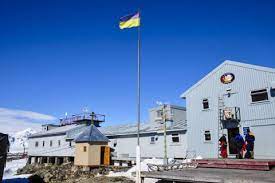
The 29th Ukrainian Antarctic expedition has arrived at the Akademik Vernadsky station, the changeover of annual teams has started, the Ministry of Education and Science of Ukraine reports.
“On the “Akademik Vernadsky” began the reshift of annual expeditions. On the night of March 20-21 (Ukrainian time) our ship “Noosphere” delivered to the station the 29th Ukrainian Antarctic expedition, which should replace colleagues from 28 UAE”, – stated in the message of the press service of the Ministry.
It is noted that in the coming days will continue to unload the icebreaker, in particular polar explorers should transfer to the shore 50 tons of cargo and 140 tons of fuel needed for the next year of wintering.
Also, scientists and specialists of the 28th UAE will hand over cases to the team of the 29th expedition.



