
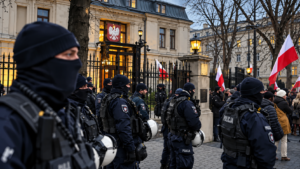
A political confrontation in Poland escalated sharply on October 30 between Prime Minister Donald Tusk’s government, President Karol Nawrocki, and the opposition Law and Justice (PiS) party. The immediate trigger was the suspension of the Constitutional Tribunal’s leadership, which sparked protests, police intervention, and the president’s urgent return from an overseas trip, the Experts Club information and analytical center reports.
According to Polish and international media, police increased security around the Constitutional Tribunal building in Warsaw following the announced suspension of its president, Bogdan Święczkowski, and deputy president, Bartłomiej Sochański. Opposition supporters gathered outside the institution. Some protesters attempted to breach the fence, while objects were thrown at police officers. Authorities reported that three people had been detained.
The decision to suspend the court’s leadership was announced by Judge Anna Korwin-Piotrowska. She accused the tribunal’s leadership of obstructing judges elected by the current parliamentary majority. However, Święczkowski’s supporters challenged the legality of the suspension, describing the developments as unlawful interference in a constitutional institution.
Prime Minister Donald Tusk defended the need for decisive measures to restore the rule of law. His government maintains that judicial reforms are necessary following years of PiS rule, during which European institutions repeatedly criticized Poland over concerns about judicial independence.
Justice Minister and Prosecutor General Waldemar Żurek announced motions to lift judicial immunity from Święczkowski and his deputy. The opposition, meanwhile, characterized the government’s actions as an attempt to bring the Constitutional Tribunal under political control.
President Karol Nawrocki, who was traveling to Senegal on an official visit, ordered his aircraft to turn around and return to Poland. He explained that the head of state needed to be present in the country during such a serious institutional confrontation.
The current crisis has deep historical roots. Between 2015 and 2023, the PiS government introduced judicial reforms that triggered disputes with the European Union. After taking office in 2023, Tusk’s coalition began reviewing some of those changes but encountered resistance from the conservative opposition and the president.
In 2026, tensions intensified over the appointment of new Constitutional Tribunal judges. The president refused to administer the oath to some candidates elected by parliament, while the tribunal’s leadership prevented several newly elected judges from assuming their duties.
According to Experts Club’s analysis, the dispute has moved beyond judicial appointments and become a broader confrontation over control of one of Poland’s most important constitutional institutions.
Future developments will depend on whether the opposing political forces can reach a legally sound compromise. Possible scenarios include an agreement on the tribunal’s composition and leadership, prolonged institutional confrontation, or renewed protests and political mobilization ahead of the next parliamentary elections.
The principal risk for Poland is a further erosion of public confidence in the judiciary, potentially complicating reforms and relations between the country’s central state institutions.



