
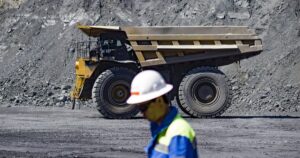
Ferrexpo plc, a mining company with its main assets in Ukraine, has announced the resumption of pellet production at Poltava Mining and Processing Plant (PGZK, Gorishni Plavni, Poltava region) after a temporary suspension of operations on January 20 due to a power outage caused by shelling of Ukraine’s energy infrastructure.
“Following the temporary suspension of operations announced on January 20, 2026, improvements in the availability and prices of domestic and imported electricity have enabled the resumption of production at PGZK. Currently, one pellet production line is in operation. The group uses its own fleet of railcars to export products to customers in Eastern and Central Europe,” the company said in a statement on Monday.
Commenting on the resumption of production, interim CEO Lucio Genovese noted that with the onset of spring, the group was able to resume operations, produce and export high-quality iron ore products.
“Following the intense attacks on Ukraine’s power generation and transmission infrastructure, we are grateful for the hard work across the country that has enabled the rapid completion of repairs. I am also grateful to my colleagues who have worked tirelessly to restore one of the pelletizing lines. This once again demonstrates our ability to be flexible and agile in very challenging conditions,” said the CEO.
In addition, Ferrexpo plc also provided updated corporate information regarding its Swiss subsidiary Ferrexpo AG (FAG).
According to this information, in the course of its normal business, FAG has a number of banking relationships, including with MBaer Merchant Bank AG (MBaer), which recently had its license revoked and was ordered into liquidation by the Swiss Financial Market Supervisory Authority (FINMA).
It is specified that MBaer was used by the group to make commercial payments outside Ukraine. FAG has approximately $3 million in MBaer, and this amount is part of the group’s net cash resources of approximately $30 million as of February 27, 2026. According to a public statement by MBaer’s liquidators, sufficient assets are available to fully satisfy all customers and creditors, so FAG currently expects a full return of its deposit in MBaer, although the timing of when this will be possible is currently unknown.
However, it is noted that the revocation of MBaer’s license does not affect FAG’s or the group’s relationship with its other banking partners and is not expected to have a material impact on the group’s operating subsidiaries in Ukraine. Despite the liquidation of MBaer, the company has made certain payments outside Ukraine, although its ability to do so is limited.
“Management is actively exploring alternative banking options so that FAG can continue to make commercial payments on behalf of the group, but these negotiations are complicated and have historically been complicated by issues related to one of the beneficiaries of The Minco Trust, which owns Fevamotinico S.a.r.l. If the group is unable to arrange alternative banking arrangements outside Ukraine, there is a risk of significant negative consequences for it,” the statement concludes.
As reported, Ferrexpo suspended production and sent some of its employees on leave due to a power supply failure at its enterprises as a result of shelling of Ukraine’s energy infrastructure on January 20.
Ferrexpo owns 100% of Yeryistovsky GZK LLC, 99.9% of Bilanovsky GZK LLC, and 100% of Poltavsky GZK PJSC.
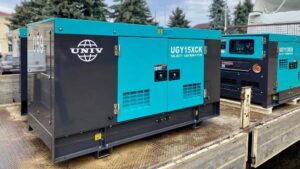
A shipment of 76 emergency generators from EU strategic reserves arrived in Kyiv on Tuesday to restore power supply to Ukrainian settlements.
According to an Interfax-Ukraine correspondent, this is immediate assistance from the EU for urgent needs and is part of the EU’s ongoing support for Ukraine’s energy security.
During a conversation with journalists, European Union Ambassador to Ukraine Katarina Mathernova noted that she was pleased to have the opportunity to “demonstrate the concrete assistance that the European Union is providing to Ukraine.”
“This is only a small part of the equipment that we are transferring to Ukraine. Another part is still at customs,” she said.
The ambassador explained that this is part of 447 generators previously announced by the European Commission due to extremely low temperatures in Ukraine in January. The total cost of these generators is EUR 3.7 million.
In general, more than 10,000 generators have already been transferred through the European Union’s Civil Protection Mechanism since the start of Russia’s full-scale invasion of Ukraine.
In total, as Maternova noted, the EU has already provided EUR 190 billion in aid since the start of the full-scale invasion.
In December 2025, Ukraine significantly increased its electricity imports – by 54% compared to the previous month, to 639.5 thousand MWh, which was the highest figure since July 2024, the DIXI Group analytical center reported on its website on Wednesday, citing data from Energy Map.
“The increase in imports occurred against the backdrop of a deterioration in the power grid due to massive attacks by the Russian Federation on energy infrastructure and seasonal growth in consumption,” the center said.
During December, Russia carried out four massive attacks, targeting electricity generation, transmission, and distribution facilities. In particular, the attacks on December 6 and 23 led to a forced reduction in the generation of nuclear power plants, which provide more than half of Ukraine’s total electricity production. An additional factor contributing to the increased load on the power system was a significant drop in air temperature throughout the country, which led to an increase in energy consumption.
According to Energy Map, the increase in supply volumes was usually recorded the day after or two days after the shelling, during a period of reduced available generation and growing power shortages. Thus, after the attack on December 6, imports increased to 21.3 thousand MWh on December 7 (+18%) and to 32.6 thousand MWh on December 8 (+81%). A similar trend was observed after other massive strikes that took place on December 13, 23, and 27.
In December, Hungary accounted for the largest share of imports – 41%. Slovakia accounted for 21%, Romania and Poland for 18% each, and Moldova for 2%.
In December, the maximum transmission capacity of inter-state crossings for electricity imports increased from 2.1 GW to 2.3 GW. On average, the available transmission capacity was used at 37.4% during the month.
“Thus, December 2025 was the third consecutive month that Ukraine ended as a net importer of electricity,” DIXI Group emphasized.
On the other hand, Ukraine did not export electricity in December. The last time zero export volumes were recorded was in August 2024.
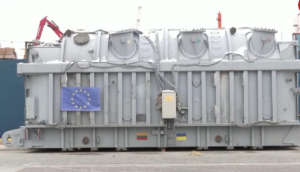
Lithuanian state-owned AB Energijos skirstymo operatorius, which operates the country’s distribution networks, will transfer another batch of equipment to Ukraine for the needs of the energy sector.
“Under the donation agreement, Ukraine will receive more than 200 power transformers of various capacities (…) The humanitarian aid is expected to arrive before the start of the heating season,” the Ukrainian Ministry of Energy said on Wednesday.
The equipment will be transported through the humanitarian aid and civil protection mechanism, which is funded and coordinated by the European Commission (ECHO).
“The transformers are critically needed for the rapid restoration of distribution networks damaged by Russian attacks, as well as to ensure a stable power supply to consumers in wartime,” said Energy Minister Svitlana Grinchuk, whose words are quoted in the statement.
The ministry explained that in order to respond quickly to enemy strikes and carry out operational repairs, it is necessary to have sufficient reserves of backup equipment. To this end, the Ministry of Energy has initiated the creation of a National Strategic Reserve of Power Transformers, which is being formed with the help of international partners, among others.
Since the start of the full-scale invasion by the Russian Federation, Ukraine has received 324 humanitarian shipments of energy equipment from Lithuania, with a total weight of 5,247 tons.
JSC Energy Company of Ukraine (ECU) is increasing electricity imports from the EU to compensate for losses in the Ukrainian power grid due to hostile attacks. Starting from mid-March, the daily volume of imports by the state-owned trader has increased by an average of 2 times.
The company continues to import electricity from Slovakia and Romania, and in March it also started supplying electricity from Hungary. Today, the company is the second largest importer of electricity in Ukraine.
“Over the past two years, Ukraine, together with the EU, has significantly increased its technical and organizational capabilities for electricity imports, which now plays a crucial role in the stable energy supply of consumers,” said Vitaliy Butenko, CEO of the Energy Company of Ukraine. “Given the continuing massive attacks on energy facilities, the Government of Ukraine continues to actively cooperate with European partners to obtain additional import opportunities.
Reference
Energy Company of Ukraine (ECU) is a national energy trading company that offers comprehensive solutions for the purchase, sale and management of energy resources. The company was established in 2022 without attracting or transferring state assets or property. Revenues are generated by high-tech trading products and instruments.
The company is one of the TOP-5 traders in Ukraine in terms of electricity sales, a leader in cross-border energy trading, and a TOP-2 trader of green electricity.
The company established the first state-owned balancing group of electricity market participants, which is now the second largest in Ukraine. The company’s customers generate 10% of Ukraine’s GDP. The company is 100% owned by the state.
Generation distribution in power system of Ukraine in 2022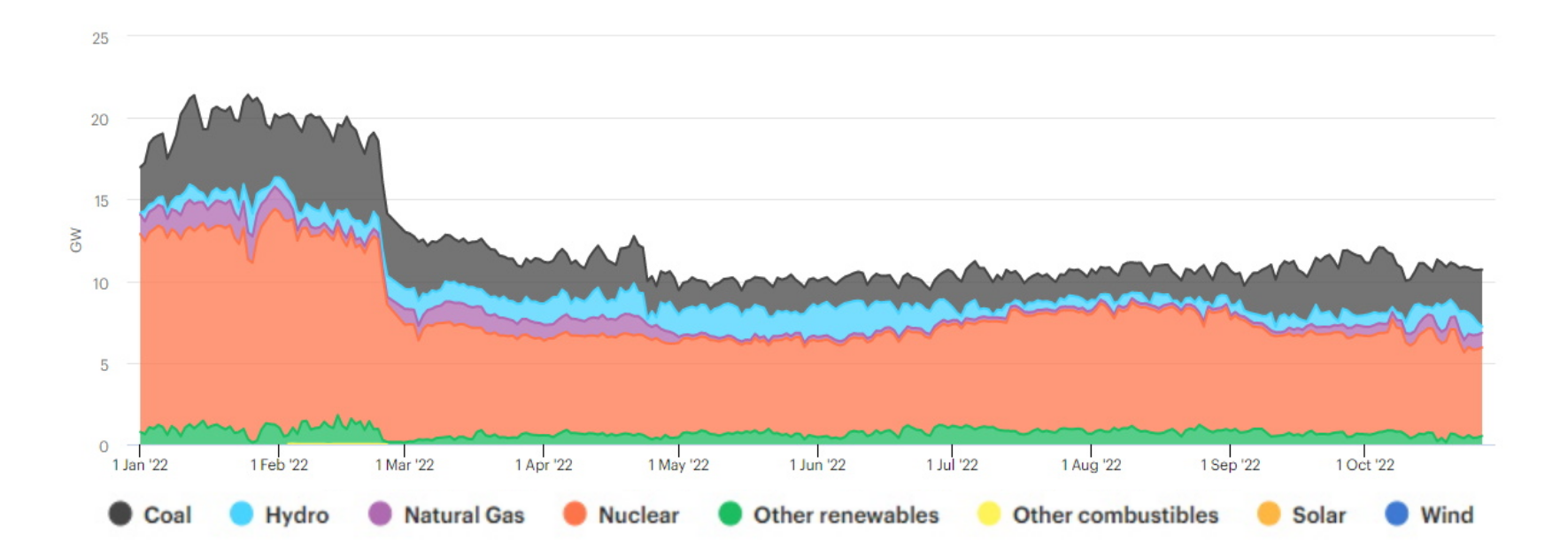
Source: Open4Business.com.ua and experts.news



