

Bucharest. At the forum “Rebuilding Ukraine: Security, Opportunities, Investments,” during a panel discussion, experts from the business and financial sectors stated that only a limited number of Romanian companies are currently ready to participate in large-scale projects to rebuild Ukraine, while access to financial instruments and risk-sharing mechanisms remains a key prerequisite for their more active involvement.
The panel was moderated by Cristina Chiriac, president of the National Confederation of Women Entrepreneurs of Romania (CONAF). The discussion was attended by Teodora Preotias, Director of European Funds Administration at the Romanian Bank for Investment and Development, Mihai Daraban, President of the Romanian Chamber of Commerce and Industry, and Viorel Manole, Executive Director of the Romanian Defense Industry Association PATROMIL.
The participants noted that the market for projects to rebuild Ukraine is currently largely structured by international financial institutions, which have high requirements for corporate governance, compliance, and risk management. According to them, a significant number of Romanian companies do not have sufficient operational capacity to act as main contractors and are forced to limit themselves to the role of subcontractors in supply chains.
“Participation in large projects requires access to credit lines, guarantees, and risk-sharing mechanisms, which are mostly administered by international financial institutions. Without this, many of our companies simply cannot enter into such contracts directly,” Preotasa noted during the discussion.
Experts emphasized the need to create an official Romanian-Ukrainian information platform that would consolidate data on available tenders, donor requirements, and opportunities for business participation. They also called for the development of a national strategy to support companies operating or planning to operate in the Ukrainian market in conditions of heightened political and security risks, including state guarantees and investment insurance instruments.
A separate discussion focused on the possibility of locating part of strategic production capacities in Romania or other safe neighboring countries to ensure continuity of production and logistics. According to Manole, such an approach could strengthen the contribution of national industry to the reconstruction of Ukraine while minimizing security risks for investors. He had previously publicly noted the potential of locating Ukrainian defense production in Romania as an element of bilateral cooperation.
Following the discussion, the participants concluded that Romanian companies have significant potential in Ukraine’s reconstruction projects, but its implementation depends on the coordination of state institutions, the availability of financial instruments, and close cooperation with international partners and financial organizations.
The forum “Rebuilding Ukraine: Security, Opportunities, Investments” is being held on December 11-12 in Bucharest under the auspices of the Romanian Ministry of Foreign Affairs and the Ukrainian Ministry of Foreign Affairs and is organized by the New Strategy Center. According to the organizers, more than 30 panel discussions and parallel sessions are planned over two days with the participation of representatives of governments, international organizations, the private sector, financial institutions, and experts from Europe, North America, and Asia. The topics of the panels cover security and defense, infrastructure, financing and investment, green energy, digitalization, human capital, and cross-border cooperation.
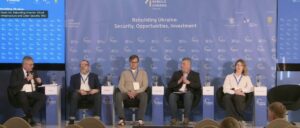
At the Rebuilding Ukraine: Security, Opportunities, Investments forum in Bucharest, participants in a panel discussion on the role of the private sector in Ukraine’s reconstruction emphasized that attracting private capital is critical for the implementation of large-scale projects, but its participation is impossible without effective mechanisms for financing, insurance, and reducing investment risks.
The panel “Private Sector – A Key Actor in the Reconstruction of Ukraine. Financing and Insurance Instruments” was moderated by Victor Srayer, managing partner of Otto Broker (Romania). The discussion was joined by Volodymyr Tsabal, secretary of the Verkhovna Rada Committee on Budget, and Susan E. Walton, senior advisor on new markets – global risks and sustainability (USA) Susan E. Walton, CEO of BCR – Romanian Commercial Bank Sergiu Manea, Director of Legal and External Relations at Vodafone Romania Alexandra Olaru, and JBIC Regional Head for EMEA, Resident Executive Officer of the Japan Bank for International Cooperation Takayuki Sato.
Participants noted that the private sector, both Ukrainian and foreign, faces a double challenge. Ukrainian companies have limited access to debt financing due to high interest rates, war risks, and domestic capital market constraints. Foreign investors, in turn, are forced to take into account political and military risks, as well as regulatory peculiarities of working in Ukraine.
The main solutions identified were the use of blended financing instruments, the involvement of international financial organizations to cover part of the risks, and the creation of a guaranteed framework by the state and partners that makes projects “bankable” for commercial structures. “For private capital to enter the reconstruction process, investors need to clearly see which risks are assumed by the state and international financial institutions, and which are assumed by themselves. Without this, projects either do not start or remain at the conceptual level,” Manea noted.
Special attention was paid to the role of political and military risk insurance, as well as the importance of transparent information and local partner networks. According to the speakers, successful project implementation requires strategic coordination between government agencies, donors, and private businesses, particularly in terms of selecting priority projects, structuring agreements, and monitoring their implementation.
The panel participants also emphasized that reconstruction is impossible without reliable digital and energy infrastructure. The experience of neighboring countries that have undergone large-scale infrastructure programs can be used to implement practical solutions in Ukraine. “Private capital, combined with government support and good governance, can significantly accelerate post-war recovery. The state’s task is to create predictable rules of the game and an institutional environment that will make this possible,” Walton concluded.
Following the discussion, participants concluded that the private sector has significant potential in rebuilding Ukraine, but that realizing this potential depends on the availability of financial instruments, effective insurance protection mechanisms, and coordinated action between public and private actors.
The forum “Rebuilding Ukraine: Security, Opportunities, Investments” is being held on December 11-12 in Bucharest under the auspices of the Romanian Ministry of Foreign Affairs and the Ukrainian Ministry of Foreign Affairs and is organized by the New Strategy Center. According to the organizers, more than 30 panel discussions and parallel sessions are planned over two days with the participation of representatives of governments, international organizations, the private sector, financial institutions, and experts from Europe, North America, and Asia. The topics of the panels cover security and defense, infrastructure, financing and investment, green energy, digitalization, human capital, and cross-border cooperation.
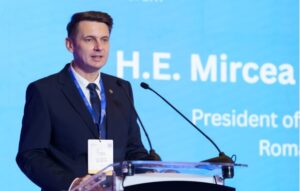
On Thursday, December 11, the international forum “Rebuilding Ukraine: Security, Opportunities, Investments” began in Bucharest on Thursday, December 11. At the opening, Ionel Nitu, president of the New Strategy Center think tank, and Mircea Abrudianu, president of the Romanian Senate, emphasized Romania’s readiness to play a key role in the post-war reconstruction of Ukraine and to become the main logistics hub for this process.
According to Nitu, the forum aims to create a permanent platform for dialogue focused specifically on the practical aspects of Ukraine’s reconstruction, involving representatives of central government, business, international financial institutions, and local administrations in border regions. As a neighboring country, he emphasized, Romania has a direct understanding of local needs and challenges, which creates additional opportunities for joint investment and cooperation projects in the fields of infrastructure, logistics, and energy.
“As Ukraine’s neighbor, Romania has a practical understanding of what reconstruction means in the context of ongoing aggression. Our goal is to bring the government, business, and local authorities to the table and move the discussion to the level of concrete decisions and contracts,” Nitu said, opening the first panel of the forum.
The head of the New Strategy Center drew attention to the concept of a “strategic transport triangle” involving Romania, Ukraine, and the Republic of Moldova, which should be based on the port infrastructure of the Black Sea and the Danube, as well as on the rail and road corridors that are already the focus of the European Commission’s efforts to expand the region’s transport capacity. He also stressed the need for a multidimensional approach to reconstruction, combining economic, social, humanitarian, and security dimensions, as well as the need for “direct, honest, and results-oriented dialogue” between all participants in the process.
The first panel of the forum, “The Importance of Romania for the Reconstruction of Ukraine,” was opened by the keynote speaker, Mircea Abrudianu, President of the Romanian Senate. He confirmed the political position of official Bucharest on supporting Ukraine in countering Russian aggression and stressed that Romania’s participation in reconstruction is not only an economic priority but also a “political and security imperative for the whole of Europe.”
Abrujan noted the strategic importance of Romania’s geographical location for reconstruction logistics: through the port of Constanta, the Danube ports, and the development of railway and road infrastructure, the country aims to become a central hub for cargo flows related to infrastructure, energy, and industrial projects in Ukraine. “Romania has all the prerequisites to become a logistics center for reconstruction — from ports on the Danube and Black Sea to transport corridors connecting the EU with the Ukrainian economy,” he said during his speech.
Separately, the Senate President emphasized the need for deep reforms in Ukraine in parallel with reconstruction projects, primarily in the areas of energy, infrastructure, public administration, and digitalization. In his opinion, investments in reconstruction should also be seen as a tool for Ukraine’s European integration, taking into account the negotiations on EU accession. “If we are talking about long-term investments, we need a just and lasting peace, and until it is achieved, a predictable security environment, which is ensured, in particular, by military support for Ukraine from its allies,” Abrudyan stressed.
He also recalled that the issues of “just peace” and security guarantees for Ukraine had already been discussed during his recent meeting with Verkhovna Rada Speaker Ruslan Stefanchuk in Stockholm, where the parties agreed on joint approaches to future peace negotiations.
The forum “Rebuilding Ukraine: Security, Opportunities, Investments” is being held on December 11-12 in Bucharest under the auspices of the Romanian Ministry of Foreign Affairs and the Ukrainian Ministry of Foreign Affairs and is organized by the New Strategy Center. According to the organizers, more than 30 panel discussions and parallel sessions are planned over two days with the participation of representatives of governments, international organizations, the private sector, financial institutions, and experts from Europe, North America, and Asia. The topics of the panels cover security and defense, infrastructure, financing and investment, green energy, digitalization, human capital, and cross-border cooperation.
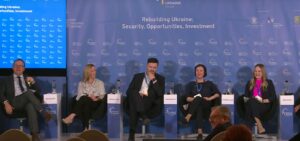
Participants in the panel discussion “Challenges of the Ukrainian Labor Market. Mobilizing Human Capital for Sustainable Reconstruction” at the forum on Ukraine’s reconstruction in Bucharest concluded that the country needs a two-pronged policy for sustainable economic recovery: creating conditions for the return of those who wish to do so, while simultaneously supporting the active diaspora as a resource for investment and knowledge transfer.
The panel was moderated by Adam Eberhart, Deputy Director of the Center for East European Studies at the University of Warsaw (SEW UW). The discussion was joined by Svitlana Kovalchuk, Executive Director of the Yalta European Strategy (YES) Bogdan Zavadetchik, President of the Charitable Foundation “Resources and Public Initiatives” in the Chernivtsi region Olena Tanasychuk, representative of the Ukrainian diaspora in the UK at Ealing Community & Voluntary Service (ECVS) Ania Abdulah, and Osamu Hattori, Head of the Japan International Cooperation Agency (JICA) office in Ukraine.
According to surveys cited by participants, most Ukrainian refugees would only consider returning if there were reliable guarantees of security and a stable economic situation. At the same time, statistics show that after two to three years abroad, the likelihood of returning decreases sharply due to deeper integration of people into their host countries, particularly through employment, children’s education, and access to social services. “The longer people stay abroad, the more their lives shift—and the harder it is to convince them to start from scratch at home,” Ebergart noted.
Separately, experts noted that the potential opening of borders could trigger a new wave of emigration, particularly among men of conscription age, who are currently restricted from leaving due to mobilization rules. Against this backdrop, participants emphasized the need for policies that, on the one hand, create the conditions for return—through security, jobs, housing, and access to services—and, on the other hand, support a strong and organized diaspora.
The discussion concluded that the Ukrainian diaspora can remain an important resource for the country’s development even without physical return, through investment, professional networks, educational and expert projects. “The question is not only how many people will return, but also how many of them, wherever they live, will remain actors in Ukraine’s development,” Kovalchuk concluded. Participants agreed that a coordinated human capital policy should be one of the key elements of Ukraine’s post-war reconstruction strategy.
The forum “Rebuilding Ukraine: Security, Opportunities, Investments” is being held on December 11-12 in Bucharest under the auspices of the Romanian Ministry of Foreign Affairs and the Ukrainian Ministry of Foreign Affairs and is organized by the New Strategy Center. According to the organizers, more than 30 panel discussions and parallel sessions are planned over two days with the participation of representatives of governments, international organizations, the private sector, financial institutions, and experts from Europe, North America, and Asia. The topics of the panels cover security and defense, infrastructure, financing and investment, green energy, digitalization, human capital, and cross-border cooperation.



