

The Estonian Ministry of Foreign Affairs announced the allocation of EUR340,000 to help Ukrainians living near the front lines cope with damage to energy infrastructure caused by Russia’s ongoing attacks.
As the Ministry of Foreign Affairs emphasized, Estonia’s aid will help families heat their homes and prepare their livestock for winter, improve the thermal insulation of shelters for internally displaced persons, and purchase mobile emergency response centers for Ukrainian rescue workers. The aid will be delivered through the Ministry of Foreign Affairs’ long-standing humanitarian partners: the non-governmental organization Mondo, the Estonian Refugee Council, and the Estonian Rescue Association.
“Putin still hopes that attacks, cold, and darkness will break the Ukrainians’ resistance. We will not let that happen. As a result of Russia’s ongoing aggression, Ukrainians are facing yet another harsh wartime winter. With the onset of cold weather, people across the country will have to contend with power and heating outages and worry about how to keep their homes warm,” emphasized Foreign Minister Margus Tsahkna.
“The situation is particularly difficult near the front lines, where the need for assistance is greatest due to the fighting. As Estonians, we know very well what a cold winter means. That is why we are directing our aid first and foremost to where it is needed most—to families trying to cope in their own homes, to people forced to flee their homes because of the war, and to rescue workers who come to the aid of others even in the most difficult circumstances,” added Tsahkna.
Estonia is providing the non-governmental organization Mondo with 160,000 euros to help shelters for internally displaced persons near the front lines in the Sumy, Dnipropetrovsk, and Kharkiv regions prepare for winter. Thirteen shelters will be supplied with heating equipment and materials, and two of them will also undergo repairs and improvements to their thermal insulation. Thanks to Estonia’s support, approximately 860 internally displaced persons—primarily the elderly, people with disabilities, women, and children—will have warm housing this winter.
The Estonian Refugee Council will receive EUR160,000 to support families living near the front lines in the Kharkiv, Dnipropetrovsk, and Zaporizhzhia regions. The funding will help families heat their homes and cover the costs of maintaining livestock throughout the winter, as livestock farming is an important source of livelihood for many. The project is co-financed by the European Commission’s Directorate-General for Civil Protection and Humanitarian Aid (DG ECHO).
The Estonian Rescue Association will receive EUR 20,000 to purchase equipment for two mobile emergency aid stations for rescuers from the State Emergency Service of Ukraine (SES). The mobile emergency aid stations will provide people in crisis zones with a place where they can warm up, access electricity, and, if necessary, receive psychological support.
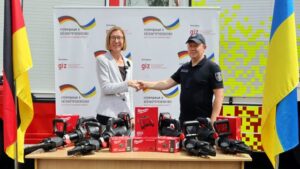
The State Emergency Service (SES) received 10 sets of equipment for emergency rescue operations from Germany, the SES reported on Tuesday.
“The equipment allows SES specialists to more quickly free people from under rubble and cut through metal structures and vehicles. This equipment will significantly enhance the capabilities of our units and help save many more lives,” said Volodymyr Demchuk, Deputy Head of the SES of Ukraine.
The equipment was purchased by the German government through the Deutsche Gesellschaft für Internationale Zusammenarbeit (GIZ).
“This is an example of effective cooperation and a testament to the genuine partnership and friendship between Germany and Ukraine,” emphasized Katrin Buchholz, Chargé d’Affaires ad interim of Germany.
The equipment was provided as part of the project “Support for State and Municipal Emergency Management in Ukraine,” which is being implemented on behalf of the German Federal Ministry for Economic Cooperation and Development and is part of the transition-period development assistance program.
This is not the first time the State Emergency Service has received assistance under this project, through which Ukrainian rescuers have been provided with modern technology and specialized equipment and have undergone training.
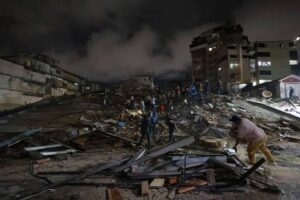
At least 164 people were killed and 971 were injured as a result of two powerful earthquakes in Venezuela that occurred on the evening of June 24, according to international news agencies, including the Associated Press, CNN, and Reuters, citing the country’s acting president, Delcy Rodríguez.
“At least 164 people were killed and 971 were injured after two powerful earthquakes shook Venezuela,” Acting President Delcy Rodríguez said on Thursday, adding that rescue teams are rushing to the hardest-hit areas to free people trapped under the rubble,” the AP reported on its website on Thursday.
The 7.2- and 7.5-magnitude earthquakes, which struck on Wednesday evening, were among the strongest to hit Venezuela in over a century and were felt throughout the region. The country’s main airport sustained damage and was closed, and buildings were evacuated even in such remote areas as the Brazilian Amazon, located approximately 1,700 km from Venezuela’s capital, Caracas.
According to Rodríguez, authorities are deploying rescue teams from other parts of the country to La Guaira state, located on the coast north of Caracas. That state has been hit the hardest.
The acting president noted that they are trying to make the most of daylight hours to speed up rescue efforts for people believed to be trapped under the rubble. “Dozens of buildings have collapsed there… and we are now conducting intensive rescue operations to save lives,” said Rodríguez.
After 6:00 p.m. on June 24, two powerful earthquakes with magnitudes of 7.2 and 7.5 struck Venezuela in quick succession. Many buildings were reported to have collapsed.



