
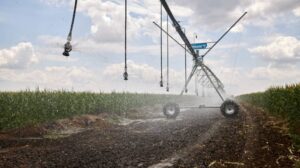
In 2025, the State Fisheries Agency’s water management organizations provided farmers with a full range of services for supplying water for irrigation in the Zaporizhzhia, Kirovohrad, Mykolaiv, and Odesa regions, with the total area of irrigated land exceeding 40,500 hectares, according to its press service on Telegram.
It is specified that to achieve this result, the pumping stations of state irrigation systems supplied 130.8 million cubic meters of water and used about 51.5 million kWh of electricity.
According to the State Fisheries Agency, the largest irrigation areas in 2025 were serviced by the Kiliya Interdistrict Water Management Administration (MUVG), where 78.5 million cubic meters of water were supplied to nearly 10,000 hectares of agricultural land, The Dniester MWH supplied 24.3 million cubic meters of water to irrigate 8,600 hectares of fields, and the Izmail WMD irrigated 8,300 hectares of fields, the agency specifies.
Various irrigation methods were used for maximum efficiency: sprinklers, drip irrigation, and flooding. Thanks to this, in addition to traditional cereals and legumes, vegetables, and fruits, farmers grew the “white gold” of the south—cotton, which began to be cultivated in Ukraine last year, the agency said.
Employees of the State Fisheries Agency’s water management departments have already begun preparing water management and reclamation facilities for the winter period and the 2026 irrigation season.

The Food and Agriculture Organization of the United Nations (FAO) has transferred modern technical equipment to the Institute of Fisheries, Marine Ecology and Oceanography (IRGEMO), according to the press service of the State Fisheries Agency.
“The development and systematic updating of the material and technical base of scientific institutions is a key condition for high-quality research in the field of fisheries. Modern equipment expands the possibilities for field and laboratory monitoring of aquatic biological resources, increases the accuracy of data collection and analysis, and ensures their practical use in management decision-making. This forms the basis for effective and long-term state policy in the field of conservation and rational use of aquatic ecosystems,” emphasized Deputy Minister of Economy, Environment, and Agriculture Taras Vysotsky, whose words are quoted in the report.
During the meeting, the head of the State Fisheries Agency, Ihor Klymenok, presented the features of the reform of the fisheries sector, the status of joint projects, and outlined areas for further cooperation.
The list of technical equipment transferred to the scientific institution for conducting ichthyological research and assessing aquatic biological resources includes two vehicles needed for scientific teams to conduct field work, two boats with a trailer for their transportation, six microscopes, sets of water analyzers for hydrological, hydrochemical, and ecological research, and a portable echo sounder with multi-frequency sensors, a control station, and software.
“Assistance from international partners is critical to strengthening the scientific capacity of the industry in the current environment,” said the head of the State Fisheries Agency, thanking the FAO for its systematic support of Ukraine’s fisheries sector.



