
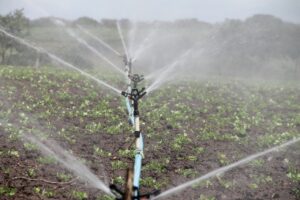
The Program of Activities of the Cabinet of Ministers of Ukraine calls for increasing the area under actual irrigation in Ukraine to 200,000 hectares by 2027, according to the program.
To this end, in 2027, the government plans to introduce long-term planning for the development of hydraulic land reclamation and to establish operators for state-owned irrigation and drainage systems.
The program also calls for the integration of data from the State Water Cadastre and other natural resource cadastres into the State Land Cadastre based on up-to-date geospatial data from the national geospatial data infrastructure in 2027.
A specific objective for 2026 is to ensure the continuity of agricultural production harvesting and transportation under martial law to preserve the harvest and minimize losses.
In addition, the government plans to provide open access to the Public Cadastral Map in 2027, taking into account the security situation, and to introduce long-term planning for Ukraine’s rural development.
According to the Accounting Chamber, there are 253 state-owned irrigation systems in the territory controlled by Ukraine, with a total designed area of 791,800 hectares; however, in 2024–2025, actual irrigation covered less than 15% of this area. At the same time, according to the State Agency for Land Reclamation, Fisheries, and Food Programs, as of early August 2026, water supply contracts had been signed for the irrigation of nearly 76,600 hectares of farmland, and more than 66,000 hectares had already been irrigated.
As previously reported, on August 17, the Cabinet of Ministers of Ukraine approved the Government Action Program. Verkhovna Rada Chairman Ruslan Stefanchuk stated that parliament will review the Program in the near future in accordance with established procedures.
agricultural sector, GOVERNMENT, irrigation, land reclamation, land registry

In 2025, the Cabinet of Ministers allocated UAH 34 million to support 10 agricultural enterprises operating on reclaimed land in the Dnipropetrovsk, Zhytomyr, Kyiv, Kirovohrad, Odesa, Sumy, and Cherkasy regions, according to a statement by the press service of the Ministry of Economy, Environment, and Agriculture on its Telegram channel.
The ministry specified that the program has ensured the irrigation of 2,500 hectares of agricultural land and expressed confidence that this will increase the sustainability of agricultural production in the face of climate risks and military challenges.
“Investments in land reclamation are investments in the development of agricultural production. Thanks to state mechanisms, farmers can restore irrigation infrastructure, use land more efficiently, and plan production cycles even in difficult conditions,” said Deputy Minister of Economy, Environment, and Agriculture Iryna Ovcharenko, whose words are quoted in the report.
The Ministry of Economy reminded that state support provides for compensation for the costs of reconstruction and/or construction of land reclamation systems. The maximum amount of payments is UAH 26,500 per 1 hectare of land where hydraulic reclamation is carried out.
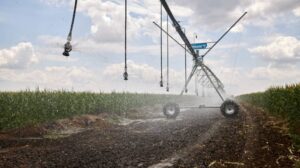
In 2025, the State Fisheries Agency’s water management organizations provided farmers with a full range of services for supplying water for irrigation in the Zaporizhzhia, Kirovohrad, Mykolaiv, and Odesa regions, with the total area of irrigated land exceeding 40,500 hectares, according to its press service on Telegram.
It is specified that to achieve this result, the pumping stations of state irrigation systems supplied 130.8 million cubic meters of water and used about 51.5 million kWh of electricity.
According to the State Fisheries Agency, the largest irrigation areas in 2025 were serviced by the Kiliya Interdistrict Water Management Administration (MUVG), where 78.5 million cubic meters of water were supplied to nearly 10,000 hectares of agricultural land, The Dniester MWH supplied 24.3 million cubic meters of water to irrigate 8,600 hectares of fields, and the Izmail WMD irrigated 8,300 hectares of fields, the agency specifies.
Various irrigation methods were used for maximum efficiency: sprinklers, drip irrigation, and flooding. Thanks to this, in addition to traditional cereals and legumes, vegetables, and fruits, farmers grew the “white gold” of the south—cotton, which began to be cultivated in Ukraine last year, the agency said.
Employees of the State Fisheries Agency’s water management departments have already begun preparing water management and reclamation facilities for the winter period and the 2026 irrigation season.
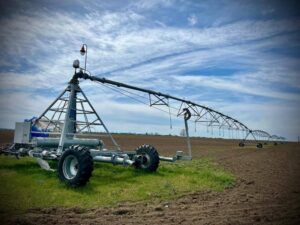
Deputy Prime Minister for Recovery, Minister of Community and Territorial Development Oleksiy Kuleba and Deputy Prime Minister, Minister of Foreign Affairs of Italy Antonio Tajani signed a grant agreement for EUR6 million in non-repayable aid for the reconstruction of two irrigation systems in the Odesa region,
according to the press service of the Ministry of Community and Territorial Development.
“This decision will improve the efficiency of agricultural production in southern Ukraine, stabilize water supply, and reduce resource losses in arid areas,” said Deputy Prime Minister for Recovery and Minister of Community and Territorial Development Oleksiy Kuleba.
The ministry added that the ministers signed a number of other agreements on financing key areas of recovery: agricultural infrastructure, cultural heritage sites, medical facilities, housing programs, and ensuring Ukraine’s access to Italian financial mechanisms.
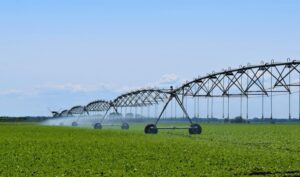
Agro-Region has increased its irrigated area to 580 hectares and installed another 100-hectare irrigation system in the Kyiv cluster in early 2025, the holding’s press service reports on Facebook.
“We installed the first irrigation system in 2018 on 140 hectares of Zimmatic, in 2019 we delivered two more irrigation machines – for 140 hectares of Zimmatic and 200 hectares of VALLEY. Currently, the irrigation equipment is installed by a Ukrainian manufacturer, in particular, the Kharkiv-based Variant Agro Bud plant,” said Oleksandr Morenets, irrigation project manager.
According to him, the company is irrigating seed crops and partially corn.
“We have already moved from the zone of sufficient moisture to the zone of insufficient moisture, so irrigation is an important prospect for the future,” added Morenets.
If we compare the same structure of land plots under irrigation and without, in Agro-Region these are sandy loam soils, then only commercial corn under irrigation can have a yield increase of 5-6 t/ha in dry weight, the expert says.
Agro-Region owns a land bank of 39 thousand hectares in Kyiv, Chernihiv, Zhytomyr, and Khmelnytsky regions. It specializes in crop production. It consists of 11 companies organized into four crop production clusters. It has two elevators – Boryspil elevator with a capacity of 73 thousand tons and Miropil elevator with a capacity of 52 thousand tons.
Agro-Region’s annual harvest of grains and oilseeds is 200 thousand tons.
In April 2021, the Swedish company Lobiu Sala AB, owned by former Minister of Economy of Ukraine Aivaras Abromavičius, received permission from the Antimonopoly Committee of Ukraine to buy the Swedish Agro Region Stockholm Holding, which manages the Agro-Region group of companies in Ukraine.



