
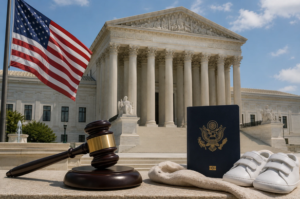
The U.S. Supreme Court ruled that children born on U.S. soil to parents who are in the United States illegally or on a temporary basis are U.S. citizens from the moment of birth. The decision effectively blocks President Donald Trump’s attempt to restrict the automatic granting of citizenship by birthright.
The case was heard in connection with Executive Order 14160, “Protecting the Meaning and Value of American Citizenship,” which Trump signed on January 20, 2025. The order proposed that children born in the U.S. to parents without permanent immigration status should not automatically be considered U.S. citizens.
The court concluded that such children are protected under the Fourteenth Amendment to the U.S. Constitution, which states that all persons born or naturalized in the United States and subject to its jurisdiction are citizens of the United States and of the state in which they reside.
The ruling is significant not only for immigration policy but also for the market for services related to childbirth in the United States. In practice, it means that U.S. passports obtained by virtue of birth on U.S. soil remain valid, and the right to citizenship by birth itself cannot be revoked by presidential decree.
However, the debate surrounding so-called “birth tourism” is not over. Following the court’s decision, the Trump administration may tighten controls over visa applications, travel by pregnant women, and cases of potential fraud upon entry into the United States. But this is a different legal matter: combating visa violations is not the same as revoking the citizenship of a child born on U.S. soil.
For foreigners who view the U.S. as a destination for childbirth, the main takeaway is this: the fundamental constitutional principle has been upheld, but immigration and visa risks may increase. U.S. authorities may scrutinize the purpose of travel, financial documents, medical plans, and any potential concealment of true intentions more closely when issuing visas or at the border.
For the international market for immigration and medical services, the Supreme Court’s decision means the preservation of one of the most well-known mechanisms of jus soli—citizenship by place of birth. The United States remains one of the key countries where the mere fact of being born on U.S. soil grants a child citizenship, regardless of the parents’ citizenship, with the exception of a few specific cases.
Thus, Trump’s executive order has not altered the fundamental principle of U.S. citizenship. Children born in the United States are still entitled to U.S. citizenship, but there will likely be more scrutiny, legal disputes, and political pressure surrounding travel for the purpose of giving birth.

Posting a hyperlink to another media outlet’s publication does not in itself imply dissemination of all information or automatic liability for disseminating false information, the Supreme Court notes.
“Material made public by placing a hyperlink to another media outlet’s publication and a brief summary thereof does not imply automatic liability for the entire content of the original source,” reads a statement on the Supreme Court’s website on Friday, citing the opinion of the panel of judges of the Cassation Commercial Court within the Supreme Court (CCC of the Supreme Court).
According to the Court, the proper defendants in cases concerning the protection of business reputation involving the dissemination of information on the Internet are the author of the material and the owner of the website on which the material is posted.
“It is the plaintiff who must determine the proper circle of defendants, taking into account the legal nature of the disputed legal relationship and the nature of the dissemination of information,” the statement notes.
The Court explains that a limited liability company (LLC) filed a lawsuit against another company regarding the protection of business reputation.
“The lawsuit was based on the fact that the defendant’s website featured a summary of a journalistic investigation and a hyperlink to a publication released by another media outlet, which, in the plaintiff’s opinion, led to the dissemination of false information,” the Court clarifies regarding the essence of the case considered by the Grand Chamber of the Supreme Court of Ukraine.
The Commercial Court, in a decision upheld by the ruling of the Commercial Court of Appeal, granted the claim.
“The courts concluded that the defendant had disseminated information belonging to the plaintiff, that the information was inaccurate, and that it had damaged the plaintiff’s business reputation. Disagreeing with these decisions, the defendant LLC filed a cassation appeal,” the Supreme Court notes.
In reviewing the case, the Grand Chamber of the Supreme Court noted that the mere fact of posting a hyperlink does not imply assuming responsibility for the full content of a third party’s publication.
“The Supreme Court noted that a hyperlink is a technical means of referring to another resource and is not equivalent to the independent dissemination of the entire content of such a resource. Liability is possible only to the extent that the information was directly reproduced or presented by the defendant as its own message,” the statement reads.
In addition, the Grand Chamber of the Supreme Court emphasized the need to distinguish between factual statements and evaluative judgments, as well as to determine whether the plaintiff has proven the inaccuracy of the specific information disseminated by the defendant.
The Supreme Court also emphasized the importance of determining the actual scope of information dissemination by a specific defendant and not holding them liable for the entire content of a third party’s material solely because of the presence of a hyperlink.
“The Grand Chamber of the Supreme Court of Ukraine noted that the proper defendants in cases involving the dissemination of information on the internet are the author of the material and the owner of the website on which it is posted. If the author is known, it is he who must be involved in the case,” the Court stated.
Based on the results of the cassation review, the Grand Chamber of the Supreme Court concluded that the findings of the lower courts regarding the defendant’s liability and the completeness of establishing the legal elements of the offense were premature.

The Supreme Court has ruled to terminate the private company’s right to own the embankment in the Berkovshchyna area, near the residential complex at 14 Dniprovska Embankment in the Darnytskyi district of Kyiv, according to the press service of the Kyiv City Prosecutor’s Office.
“This concerns the embankment near the residential complex at 14 Dniprovska Embankment Street in the Darnytskyi district of the capital. The owners of the hydraulic structures installed barriers and gates, blocking access to the river for people who want to walk there but do not live in the residential complex,” the press release said.
The River Stone residential complex is located at the specified address.
It is noted that the hydraulic structures in the form of an embankment with an area of almost 500 square meters serve as protection against erosion and are located on a communal land plot of the water fund with an area of over 3.1 hectares worth over UAH 67 million within the coastal protection strip of the Dnipro River.
At the same time, a private company registered ownership of the specified hydraulic structures, which threatened the removal of the land from the ownership of the territorial community and created restrictions on the access of Kyiv residents to the Dnipro embankment, the statement said.
“The Supreme Court agreed with the prosecutor’s arguments: ownership of a hydraulic structure cannot be registered to anyone. Thus, the court put an end to this case – access to the Dnipro embankment must be available to everyone, not just residents of one residential complex,” the prosecutor’s office concluded.
According to activist Oleg Symoroz, on August 22, the dismantling of the fence blocking access to the embankment began near the River Stone residential complex. After that, unknown persons began to restore the brick fence.
“In the Darnytskyi district of the capital, on the embankment near the River Stone residential complex, thugs are erecting a new wall that restricts free access for citizens. I remind you that the Supreme Court of Ukraine has ordered that free access for citizens be ensured on the embankment,” he said.
The construction of the River Stone business-class residential complex in the Darnytskyi district of the capital began in 2010. The project consists of nine 23-story buildings, the last of which was commissioned in 2021. The developer of the residential complex is UDP, the general contractor is Miskzhytlobud Construction Company LLC, and the customer is Livoberezhzhya Plus LLC.
According to LUN, the permit for construction work was issued in 2011, with amendments made to the document in 2017 and 2020.
Source: https://interfax.com.ua/news/general/1098583.html
Dnipro embankment, River Stone residential complex, SUPREME COURT

In Kyiv, barriers have been removed and free access has been granted to the coastal area of the elite River Stone complex at 14 Dniprovska Embankment (Darnitsky district). According to the Kyiv City Prosecutor’s Office, the Supreme Court has settled the dispute and ruled that restricting access to the Dnieper was illegal; the area of over 2,300 square meters has been returned to public use.
According to the agency, the developer had previously fenced off the coastline with barriers and gates, allowing access only to residents of the complex. Following the court ruling, the structures were dismantled and the passageway was opened to all Kyiv residents and visitors to the city.
The city authorities and the prosecutor’s office emphasize that the coastal zone is public space, and any attempts to block access to the water without legal grounds will be challenged in court.

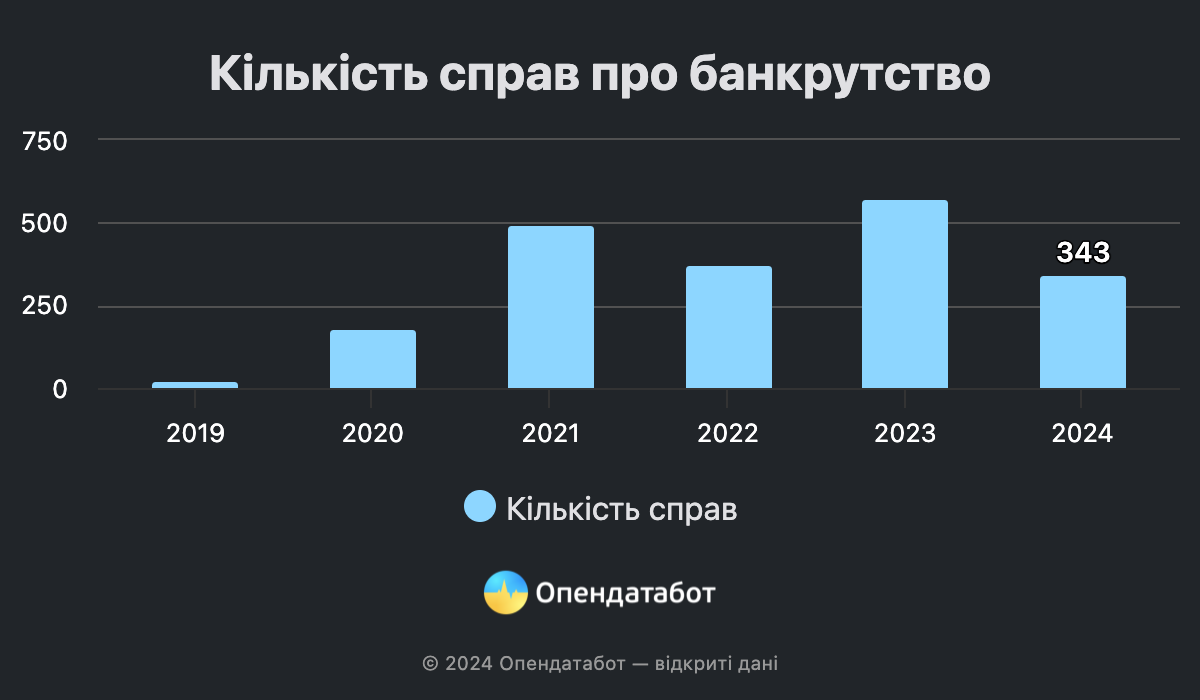
The number of bankrupts since the beginning of the year
343 Ukrainians filed for bankruptcy in the first 5 months of 2024, according to the Supreme Court. This is 2.2 times more than last year. In total, almost 2,000 bankruptcy cases have been opened in Ukraine over the past 5 years.
Since the beginning of the year, 343 Ukrainians have filed for insolvency. The number of bankruptcy cases increased by 2.2 times compared to the same period last year. By the way, 575 people received this status last year.
The fewest bankruptcy cases were opened in 2019. It was the first year when the law allowed citizens to declare themselves insolvent in court. Back then, 22 bankruptcy cases were opened. Since then, the number of people who wanted to declare themselves insolvent has been steadily increasing: 8.3 times in 2020 and 2.7 times in 2021.
“In my opinion, court statistics do not reflect the real number of debtors in difficulty who could benefit from bankruptcy proceedings. However, this procedure is not well-known and widespread among Ukrainians, and there are several reasons for this: it is expensive, complicated and incomprehensible without the help of a lawyer, for whom the debtor may simply not have the funds. In addition, creditors and financial institutions are not very willing to file their claims in such court cases, hoping to collect the debt after the person’s solvency is restored and save on legal fees, or vice versa, trying to torpedo the procedure by discrediting the debtor. On the other hand, citizens also need to realize that this procedure is not about writing off debts, but about trying to find an agreement with creditors through the court procedure and the insolvency officer,” comments Denys Likhopiok, attorney at law, insolvency officer, member of the Qualification Commission of Insolvency Officers, bankruptcy specialist.
In total, 1,993 bankruptcy cases have been opened against Ukrainians. Every second bankrupt is between the ages of 25 and 45: 58% or more than 1.1 thousand. A third of bankrupts are over 45 years old – 38.3% or 764 people. The lowest number of bankrupts is among young people under 25 – only 3.7%.
The gender distribution was almost equal. 54% of all bankrupts are men, and 46% are women.
Context.
The Verkhovna Rada allowed individuals to become bankrupt in October 2018. The procedure became fully operational in 2019. Since then, a person in a difficult financial situation can initiate bankruptcy and, after going through the entire procedure, get rid of debts.
https://opendatabot.ua/analytics/people-bankrupts-2024

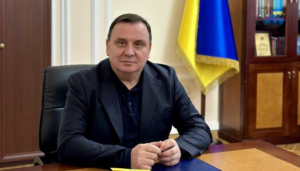
The plenum of the Supreme Court on Friday elected Stanislav Kravchenko, chairman of the Cassation Criminal Court within the Supreme Court, as chairman of the Supreme Court.
Kravchenko received the most votes among the four candidates for head of court: 108 Supreme Court justices out of 148 present at Friday’s plenum voted for him.
Judges Albert Ezerov, Natalia Kovalenko and Ivana Mischenko collected 2, 13 and 14 votes, respectively.
At the same time, according to the press service of the Supreme Court, the agenda of the plenum also included consideration of the issue of electing a deputy chairman of the Supreme Court.
“The issue of electing a deputy chairman of the Supreme Court will be considered after appropriate consultations with the judges of the Supreme Court at the next meeting of the plenum (the date is not specified – IF-U),” the message says.
Kravchenko has been chairman of the criminal court at the Supreme Court since December 2017. He graduated from the Ukrainian Law Academy named after F. E. Dzerzhinsky in 1991. F.E. Dzerzhinsky with a degree in jurisprudence (now the National Law University named after Yaroslav the Wise). In 1991-1992 he worked as a lawyer and notary.
During 1992-1993 he worked as a trainee-judge of the People’s Court of the Republic of Belarus. – In 1992-1993 he worked as a trainee-judge of the People’s Court of Kozeletsky District People’s Court of Chernigov Region. From 1993 to 2002, he was a judge of the Kozeletsk District Court in Chernihiv region. From 2002 to 2011, he served as a judge of the Court of Appeal in Kyiv. – From 2002-2011, she was a judge of the Kiev Court of Appeal.
Kravchenko was elected a judge of the High Specialized Court of Ukraine for Civil and Criminal Cases on May 19, 2011. On April 23, 2014, he was appointed deputy chairman of this court.
By presidential decree of November 10, 2017, he was appointed a judge of the Court of Cassation Criminal Court within the Supreme Court, and on December 8, he headed this court. On November 26, 2021, Kravchenko was re-elected as head of the Court of Criminal Cassation.
He has been a member of the Law Reform Commission since August 7, 2019.



