
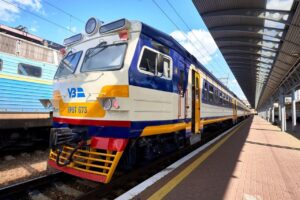
JSC “Ukrzaliznytsia” has launched 18 additional Kyiv City Express shuttle trips between the capital’s left and right banks, the company’s press service reported.
“From October 5 to 9, we are scheduling 18 additional Kyiv City Express shuttle trips on the Vydubychi–Darnitsa–Vydubychi route so that you can quickly and without traffic jams get to work, run errands, or return home amid the difficult traffic conditions on Kyiv’s bridges,” the Telegram message states.
As noted, the 18 shuttle trips will run during the morning and evening rush hours: from 6:00 a.m. to 9:00 a.m. and from 4:00 p.m. to 9:00 p.m. At the Vydubychi station, boarding and alighting will take place on three tracks. At the Darnytsia station, boarding and alighting will take place on one or two tracks (please listen carefully to station announcements). Additional trips will stop at the Bereznyaky station.
“In addition to the KSE shuttle trains, for trips between the right and left banks, you can use scheduled commuter and regional trains running to and from Nizhyn, Hrebinka, Konotop, and Slavutych. They make mandatory stops at the Vydubychi and Darnytsia stations, and commuter trains will also stop at the Bereznyaky station,” added Ukrzaliznytsia.
It is explained that thanks to the combination of additional shuttle services and scheduled trains with Kyiv City Express (KSE) trains, up to six trips will run between the two banks during peak hours, so passengers won’t have to wait long for the next train.
The company noted that tickets are available with just a few clicks in the UZ app.
KYIV, KYIV CITY EXPRESS, RAILROAD, TRANSPORTATION, UKRZALIZNYTSIA

“Ukrzaliznytsia” has added six new passenger cars, manufactured at a Ukrainian plant, to its train fleet, according to a company announcement on Telegram on Saturday.
“As is customary, the new cars are equipped with powerful batteries to ensure maximum autonomy when needed. In the event of a power outage, the batteries will keep the restrooms, lighting, air conditioning, and other systems running. So even if the car continues to travel under a diesel locomotive, all amenities will remain operational for as long as possible,” Ukrzaliznytsia noted.
It did not specify exactly which cars were being referred to, but the illustration shows a compartment car.
“Every new car, in the face of enemy attacks on rolling stock, is an opportunity to keep moving,” the company emphasized.
As previously reported, as part of a state funding program, Ukrzaliznytsia has contracted for 368 passenger cars since 2021. The main supplier is PJSC “Kryukiv Railway Car Building Works” (KVZ).
In late August of this year, Ukrzaliznytsia signed a contract with KVZ for the delivery of 10 new-generation passenger cars by the end of 2029, with a total value of 1.091 billion UAH including VAT, thereby bringing the total number of cars ordered in 2026 to 102.
In late May of this year, Ukrzaliznytsia reported that approximately 1,450 passenger cars are in service, of which 933 are air-conditioned sleeper cars and 100 are high-speed train cars.
CAR, MANUFACTURING, RAILROAD, TRANSPORTATION, UKRZALIZNYTSIA

Ukraine and Uzbekistan are introducing a “transport visa-free regime,” which provides for the abolition of permits and related quotas for direct and transit international freight truck transportation between the two countries.
A corresponding protocol between the governments of Ukraine and the Republic of Uzbekistan amending the bilateral Agreement on International Road Transport was signed on September 30, 2026, according to the Ukrainian Embassy in Uzbekistan.
According to the diplomatic mission, the preparation of the document took nearly a year.
The main change will be the simplification of direct and transit freight transport by eliminating the need to obtain permits, as well as quantitative quotas for such transport. This regime, by analogy with other agreements in the field of international road transport, is referred to as “transport visa-free travel.”
For Ukrainian and Uzbek carriers, this will mean the removal of one of the administrative barriers to organizing freight transport between the two countries and transit through their territories.
The embassy expects that the liberalization of road transport will contribute to the restoration of Ukraine’s trade and economic ties with Uzbekistan, which were partially disrupted due to logistical problems following the start of full-scale Russian aggression.
The agreement takes on particular significance amid the restructuring of Ukraine’s foreign trade and the search for alternative transport corridors to Central Asia.
“The removal of bureaucratic barriers should soon facilitate the restoration of full-fledged trade and economic ties between Ukraine and the Republic of Uzbekistan,” the embassy noted.
The diplomatic mission also described the new agreement as one of the steps toward Ukraine’s return to Central Asian markets via new logistics routes.
The protocol, signed on September 30, amends the existing intergovernmental Agreement between Ukraine and Uzbekistan on international road transport. Specifically, it concerns the liberalization of direct and transit freight transport by road. The embassy’s statement does not provide for the abolition of other customs, border, or transportation procedures required for the international transport of goods.
Original source – Embassy of Ukraine in the Republic of Uzbekistan.
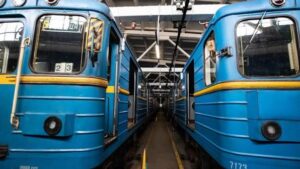
The European Bank for Reconstruction and Development (EBRD) is providing the city of Kyiv with a loan of 150 million euros to purchase new energy-efficient subway cars, spare parts, and maintenance and diagnostic equipment for the Kyiv Metro municipal enterprise, the bank’s press office announced on Wednesday.
The loan is backed by a partial guarantee from Spain and supplemented by grant funding from the bank’s internal resources.
“The new subway cars are expected to be up to 25% more energy-efficient than the outdated cars they will replace, ensuring a more environmentally friendly, safer, and more reliable subway service,” the statement said.
In addition to the purchase of rolling stock, the EBRD will fund an audit of the metro’s accessibility to develop an action plan for inclusive transportation throughout Kyiv, tailored to the needs of people with disabilities, veterans, elderly passengers, and parents with children. The bank will also support a three-year training program for female electric train drivers in partnership with UN Women’s “She Drives” initiative to address the labor shortage.
In total, since the start of Russia’s full-scale invasion in February 2022, the EBRD has allocated nearly 11 billion euros to support Ukraine’s real economy.
EBRD, KYIV, LOAN, METRO, TRANSPORTATION

Starting October 1, 2026, a new electronic toll system called TollRo will go into effect in Romania for freight vehicles with a maximum authorized mass exceeding 3.5 metric tons, according to the National Company for Road Infrastructure Administration of Romania (CNAIR).
The new system will apply to vehicles designed for the transport of goods with a maximum authorized mass exceeding 3.5 metric tons. For the purposes of TollRo, mixed-use vehicles will be treated as commercial vehicles.
Unlike the traditional vignette system, the fee for heavy freight vehicles will be based on actual use of the road infrastructure.
The fee amount will depend, in particular, on the distance traveled, the vehicle category, and its environmental characteristics. Thus, for international carriers that regularly transit through Romania, the cost of using the road network will increasingly depend on the specific route and the truck’s characteristics.
To administer the payments, Romania has established the STRR electronic toll collection system, which will operate through the national SETRE platform.
The introduction of TollRo is also significant for Ukrainian international trucking companies, as Romania is one of the key road routes for Ukrainian exports and imports to the EU, as well as for the transit of goods to Central and Southeastern Europe.
Accordingly, transportation companies using trucks weighing more than 3.5 metric tons in Romania must take the new road toll model into account when calculating transportation costs after October 1.
CNAIR clarifies that August 31, 2026, was the deadline for establishing the necessary STRR and TollRo infrastructure, while the actual collection of the new tolls, in accordance with the law, begins on October 1.
The next step will be the integration of the Romanian system with similar systems in other European Union countries. According to Romanian law, interoperability via the European Electronic Toll Service (EETS) is scheduled to begin on January 15, 2027.
The transition to distance-based tolling is in line with a general trend in the EU, where road tolls for heavy commercial vehicles are increasingly linked to actual infrastructure use and the environmental performance of vehicles.
Official information about the system’s launch and its operating rules is available on the SETRE National Electronic Registry platform.

In Romania, a new electronic road toll system called TollRo will take effect on October 1, 2026, for freight vehicles with a maximum allowable weight exceeding 3.5 metric tons, according to the National Company for Road Infrastructure Administration of Romania (CNAIR).
The new system will apply to vehicles intended for freight transport with a maximum authorized mass exceeding 3.5 metric tons. For the purposes of TollRo, mixed-use vehicles will be treated as freight vehicles.
Unlike the traditional vignette system, the fee for heavy freight transport will be based on actual use of the road infrastructure.
The amount of the fee will depend, in particular, on the distance traveled, the vehicle category, and its environmental characteristics. Thus, for international carriers that regularly transit through Romania, the cost of using the road network will increasingly depend on the specific route and the truck’s specifications.
To administer the charges, Romania has established the STRR electronic toll collection system, which will operate via the national SETRE platform.
The introduction of TollRo is also significant for Ukrainian international trucking companies, as Romania is one of the key road routes for Ukrainian exports and imports to the EU, as well as for the transit of goods to Central and Southeastern Europe.
Accordingly, transportation companies using trucks weighing more than 3.5 metric tons in Romania must take the new road toll model into account when calculating transportation costs after October 1.
CNAIR clarifies that August 31, 2026, was the deadline for establishing the necessary STRR and TollRo infrastructure, while the actual collection of the new tolls, in accordance with the law, begins on October 1.
The next step will be the integration of the Romanian system with similar systems in other European Union countries. According to Romanian law, interoperability via the European Electronic Toll Service (EETS) is scheduled to become operational on January 15, 2027.
The transition to distance-based tolling is in line with a general trend in the EU, where road tolls for heavy commercial vehicles are increasingly linked to actual infrastructure use and the environmental performance of vehicles.
Official information about the system’s launch and its operating rules is available on the SETRE National Electronic Registry platform.



