
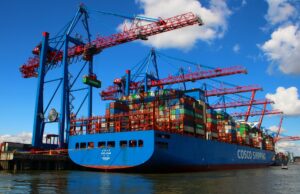
In April 2026, Ukrainian ports handled 35.8% more cargo than in April 2025—8.2 million tons, the Ukrainian Sea Ports Authority (USPA) reported on Telegram on Friday.
“This occurred despite a significant increase in attacks on port infrastructure,” the statement noted.
According to USPA data, in total, from January to April 2026, Ukraine’s seaports handled 29.5 million tons of cargo, which is more than during the same period last year.
It is noted that grain accounted for the bulk of the cargo flow—16 million tons, which is 7% more than last year.
In April, over 500 UAV attacks on logistics infrastructure were recorded.
“Despite security risks and regular shelling, port workers ensured the continuity of the industry’s operations and the fulfillment of foreign trade contracts,” the USPA emphasized.
As reported by Oleksiy Kuleba, Deputy Prime Minister for the Recovery of Ukraine and Minister of Community and Territorial Development of Ukraine, Ukrainian ports reduced cargo handling volumes by 8.3% in the first quarter of 2026 compared to the same period in 2025, down to 21.1 million tons.
Kuleba noted at the time that since the beginning of 2026, 193 port infrastructure facilities and 25 civilian vessels had been damaged.
Cargo turnover at Ukraine’s seaports in 2025 decreased by 15.9% compared to 2024—to 81.7 million tons, Kuleba noted. According to him, agricultural products accounted for the bulk of cargo turnover—44.2 million tons, which is 26.3% less than in 2024; at the same time, container traffic increased by 66.1%—to 215,750 TEU.
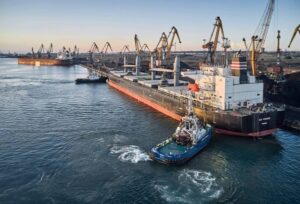
In January-March 2025, Ukrainian ports reduced the volume of cargo handled by 17.2% compared to the same period last year – to 23 million tons.
“In the first quarter of 2025, Ukrainian ports handled 23 million tons of cargo… For comparison, in the first quarter of 2024, Ukrainian ports handled 27.8 million tons of cargo, 4.8 million tons more than this year,” the state-owned Ukrainian Sea Ports Authority (USPA) said on Facebook on Wednesday.
“The decrease in cargo turnover is due to the reduction of farmland and a decline in production in export-oriented industries, in particular metallurgy, which exported up to 80% of its products before the war,” the USPA said.
It is noted that global cargo transshipment is also declining due to market volatility and logistics disruptions.
According to the report, the largest volumes of cargo were handled by the ports of Greater Odesa. Since the beginning of 2025, they have handled 20.7 million tons of cargo: Pivdennyi port – 10.6 million tons, Chornomorskyi port – 6.6 million tons, Odesskyi port – 3.5 million tons.
The ports of Izmail, Reni and Ust-Dunaisk in the Danube region handled over 2.3 million tons of cargo.
Despite the shelling and threats from the Russian army, the ports continue to operate steadily thanks to the coordinated work of port workers. The Armed Forces of Ukraine and the Navy of the Armed Forces of Ukraine ensure the safety of navigation, the USPA emphasized.
Earlier, Oleksiy Kuleba, Vice Prime Minister for the Restoration of Ukraine and Minister of Community and Territorial Development, said that as of April, 116 million tons of cargo had been transported through the Ukrainian sea corridor, including almost 73 million tons of grain. In early March, the Ministry of Development reported that 106 million tons of cargo had been transported through the Ukrainian sea corridor, including almost 70 million tons of grain.
Private companies are building new terminals in deep-water ports despite the surplus of transshipment capacity in 2024-2025 marketing year (MY), said Yuriy Vaskov, former deputy minister of development of grommads, territories and infrastructure (Ministry of Development).
“Regarding seaports today we have a surplus of transshipment capacity, but it is a difficult 2024-20525 marketing year … Even in the period of surplus capacity, several companies are building new terminals in deep-water ports, grain terminals. But, unfortunately, still do not have the opportunity to build their own berthing facilities on the lands of the water fund,” he said at the conference ‘Agro Sector 2025: Challenges and Opportunities in the New Realities’, organized by the analytical center We Build Ukraine on Thursday.
According to Vaskov, to increase the flow of private investment in the construction of port infrastructure, changes in legislation are needed, in particular, government decisions that will regulate the issue of construction on water fund lands.
“Tens, maybe even hundreds of millions of dollars now cannot be invested, I emphasize, in private business solely because of the uncertainty of this procedure,” Vaskov emphasized.

Companies from the United Arab Emirates (UAE) are ready to invest in the production of processed foods, grain transshipment and port development, the Ministry of Agrarian Policy and Food has reported.
According to the ministry, during a working visit to Saudi Arabia, Minister of Agrarian Policy and Food Vitaliy Koval and a government delegation headed by First Deputy Prime Minister and Minister of Economy Yulia Svyrydenko met with more than 20 leading UAE companies. Among them are port operators, investment, agricultural and trading companies interested in import and export cooperation with Ukraine.
“Ukraine and the United Arab Emirates have opened a new page in economic partnership. Among the UAE companies there are those that are ready to enter the Ukrainian market. In particular, to invest in the production of processed products, such as oilseeds, rapeseed, soybeans. As well as grain transshipment and port infrastructure development,” Koval said.
The Minister emphasized that the Ukrainian agricultural sector is already actively working with the UAE. In 2024, we exported more than $197 million worth of agricultural products. Among the most popular products were fats and oils of animal or vegetable origin, meat and edible offal, cereals, vinegar, etc.
As reported, the Comprehensive Economic Partnership Agreement between Ukraine and the UAE was signed in Abu Dhabi on February 17. It provides for free trade between the two countries and liberalization of access to the UAE market for Ukrainian agricultural products, including duty-free supplies of beef, lamb, dairy and processed foods. In addition, the Saudi side has expressed interest in joint development of beef cattle breeding and production of organic products.
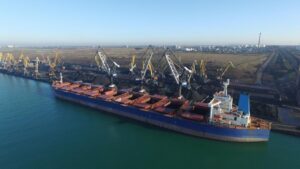
In January-July 2024, Ukrainian ports increased their transshipment volume by 1.7 times compared to the same period in 2023 – up to 59.9 million tons, according to the Ukrainian Sea Ports Authority (USPA).
“According to the operational data of USPA for January-July 2024, the ports of Ukraine handled 59.9 million tons of cargo, compared to 34.4 million tons in 2023,” the USPA said on its Facebook page on Monday.
In July, 7 million tons were handled, the same as in June. This figure exceeds the volume handled by ports in July 2023 by 2.2 times.
More than half (4.2 mln tons) was accounted for by agricultural products exported to 46 countries.
Earlier it was reported that amid an increase in transshipment volumes in the Black Sea ports and a decrease in the Danube ports in January-June 2024, Ukrainian ports increased transshipment volumes by 1.6 times compared to the same period in 2023, to 53 million tons.

Ukrainian ports handled 37.7 million tons in January-April, up 1.7 times compared to the same period in 2023, the Ukrainian Sea Ports Authority (USPA) reported on Facebook on Wednesday.
In April, port operators handled 9.9 million tons of cargo in seaports, almost twice as much as in the same period in 2023, the USPA said in a statement.
It is indicated that the largest share in April is the processing of grain cargo – 6.3 million tons against 3.9 million tons in 2023.
The cargo turnover of the Black Sea ports, thanks to the Ukrainian sea corridor, amounted to 7.7 million tons in April, of which 5.1 million tons were the products of Ukrainian farmers, the report says.
Earlier it was reported that since August 2023, the sea corridor created by the Navy has exported almost 45 million tons of cargo to 44 countries.



