

At the “Carpathian Eight” summit in Bukovel, JSC “Ukrzaliznytsia” proposed a project for the construction of a new 47-km section of European-gauge track from Chernivtsi to Vadul-Sireta on the border with Romania.
According to the project description published on the summit’s website, the investment needed for this project is estimated at $186 million, with grant funding being the preferred option.
“Ukrzaliznytsia” notes that the section is intended to be integrated into the new TEN-T transport corridor “Baltic Sea—Black Sea—Aegean Sea,” which will provide a direct connection between the Ukrainian network and EU infrastructure.
The project is in the final stages of its feasibility study, and implementation is planned to take four years.
In addition, Ukrzaliznytsia proposed at the summit a project to integrate Lviv Central Station with the future European-gauge line from Poland to Sknyliv Station. This involves the construction of a 5-kilometer European-gauge bypass section around Lviv, combined with the construction of a multifunctional passenger terminal at Sknyliv Station.
The funding requirement for this project—in which Poland has been invited to participate—is $100 million; grant funding is also desirable.
A preliminary feasibility study is currently being developed with support from JASPERS, and the project is expected to take five years to complete.
As previously reported, Ukrzaliznytsia has also proposed establishing, in partnership with investors, a low-cost passenger carrier operating on routes between Ukraine and the EU on European-standard tracks, with investments in share capital totaling approximately $441 million. According to the plan, the carrier’s routes will run from western Ukrainian railway hubs—including Uzhhorod, Lviv, and Kovel—to markets in Central and Eastern Europe, specifically Budapest, Bratislava, Warsaw, Vienna, and Berlin.
The first founding summit of the “Carpathian 8” (Carpathian 8 Summit) is taking place at the Bukovel ski resort in the Ivano-Frankivsk region from September 18 to 20.

At the “Carpathian Eight” summit in Bukovel, JSC “Ukrzaliznytsia” proposed a project to establish, in partnership with investors, a low-cost passenger carrier on routes between Ukraine and the EU using European-standard tracks, with investments in share capital totaling approximately $441 million.
According to the project description posted on the summit’s website, the carrier’s routes will run from western Ukrainian railway hubs—including Uzhhorod, Lviv, and Kovel—to markets in Central and Eastern Europe, specifically Budapest, Bratislava, Warsaw, Vienna, and Berlin.
As part of the project, there are plans to purchase modern trains for European-standard tracks.
It is noted that the project is in the advanced planning stage, and its implementation is expected to take approximately four years.
Ukrzaliznytsia hopes that this project will attract interest from rail and road carriers in Poland, Slovakia, Hungary, and Romania.
As previously reported, in late 2018 and in June 2019, trains operated by the state-owned railway companies MÁV-START of Hungary and ZSSK of Slovakia began running on routes from Mukachevo—where the European gauge track ends—to Budapest and Košice, respectively.
On the same route, starting in March 2024, the Czech private carrier RegioJet has been operating services from Chop to Prague; it also cooperates with Ukrzaliznytsia on services to the Polish city of Przemyśl, which borders Ukraine.
In addition, in October 2023, the Polish company SKPL (Stowarzyszenie Kolejowych Przewozów Lokalnych) became the first to launch passenger service on the standard-gauge route between Warsaw and Rava-Ruska, where passengers transferred to Ukrzaliznytsia trains bound for Lviv or Kolomyia. Starting in December 2024, the state-owned operator PKP Intercity also began operating on this route, and SKPL withdrew from it in September 2025.
Ukrzaliznytsia also has plans to extend the European-gauge track to Chernivtsi and Lviv; prior to the full-scale Russian invasion, the possibility of building a new high-speed rail line between Warsaw and Kyiv was also being considered.
As reported, Ukrainian President Volodymyr Zelenskyy noted that agreements on $1 billion in investments had already been reached during the first Carpathian Economic Forum.
The C8 Summit website lists about 90 projects across eight sectors. The energy sector has the most—33—followed by transportation and logistics with 11, industry and manufacturing with 17, and infrastructure and real estate with 12.
In terms of regions, the largest number of projects is listed in Lviv Oblast—30—followed by 14 in Zakarpattia, 13 in Chernihiv Oblast, 11 in Poltava Oblast, and 3 in Bukovina.
The first inaugural summit of the “Carpathian 8” (Carpathian 8 Summit) is taking place at the Bukovel ski resort in Ivano-Frankivsk Oblast from September 18 to 20.
European gauge, INVESTMENT, TRANSPORTATION, UKRAINE, UKRZALIZNYTSIA
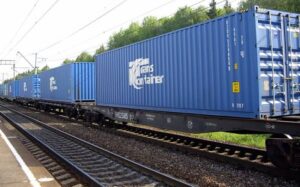
The volume of containerized freight transported by rail in January–August of this year totaled 202.73 thousand DFE (TEU), which is 33% higher than the figures for the same period in 2025, according to Valery Tkachov, deputy director of the Department of Transportation Technology and Commercial Operations at JSC “Ukrzaliznytsia,” on Facebook.
According to him, the business community considers the shortage of fitting platforms (FTPs) in Ukraine to be the main obstacle to further growth in container transportation volumes.
According to data provided by Tkachov, 27% of container traffic during the reporting period consisted of grain (26% for the first 8 months of 2025), 15% (21%) to ferrous metals, 12% (10%) to oilcake and meal, and 6% each to synthetic resins and oil (5% and 7%, respectively, last year).
The expert noted that, against the backdrop of an overall decline in shipments, the share of container traffic in the total cargo volume rose to a record high of 4.4% over the past year.
Tkachov added that the “Liski” branch of the Central Transport Service (CTS) presented a strategy for selling its own rolling stock, under which 60–80% of the FTL fleet is planned to be sold under long-term USTO contracts, and 20–40% through auctions or on general terms.
Currently, the operational fleet of the “Liski” branch of the Central Transport Service consists of 1,500 FTG units, of which 1,200 are 40-foot units, 265 are 60-foot units, and 48 are 80-foot units.
A representative of “Ukrzaliznytsia” noted that due to increased demand for fitting platforms, the branch has begun selling its scarce fleet through “Prozorro.Sales” auctions.
According to the post, business representatives raised concerns regarding the mechanisms for allocating the railcar fleet between long-term USTO contracts and auctions, suggesting that these mechanisms be revised to account for the specific nature of container transportation. To resolve the issue, meeting participants agreed to transition to long-term cooperation regarding the provision of container railcars under USTO contracts. Company representatives were asked to submit requests within a week detailing their FTT needs for 2026–2027, while “Ukrzaliznytsia” plans to conclude the relevant contracts with all interested companies as soon as possible.
“Having signed USTO contracts will allow us to plan the repair of Ukrzaliznytsia’s freight train fleet, taking into account existing repair capacities,” explained the director of Ukrzaliznytsia’s Department of Transportation Technology and Commercial Operations.
In addition, business representatives proposed considering the possibility of leasing FPTs from the non-operational fleet, assuming the costs of their repairs.
Among other issues, the business community cited incorrect preparation of accompanying documents and charges during export and import shipments at western border crossings, as well as congestion at the “Yagodin-Dorohusk” and “Mostyska-2-Medika” crossings, Tkachov reported.
CONTAINER, LOGISTICS, TRANSPORTATION, UKRAINE, UKRZALIZNYTSIA

JSC “Ukrzaliznytsia” (UZ) transported 8.14 million passengers over the three summer months, compared to 8.07 million during the same period last year and 7.94 million in the summer of 2024, according to a company announcement on its Telegram channel on Thursday.
According to UZ, 628,400 children and 90,000 military personnel visiting their families traveled by train between June and August this year. A total of 22,000 people with disabilities, including veterans, traveled in accessible railcars. A total of 357,000 passengers purchased tickets through the auto-renewal system.
“This result once again demonstrates a more efficient use of the rolling stock: additional ‘rotational’ trains and minimal downtime for cars, especially in frontline regions,” Ukrzaliznytsia noted.
It is noted that over the summer, “UZ” put 20 new railcars into service, while losing seven during this period.
According to Ukrzaliznytsia, there were four and a half passenger requests per seat in June–August. The top five most popular routes based on the number of ticket searches in the company’s app were Lviv–Kyiv, Przemyśl–Kyiv, Kyiv–Kharkiv, Kholm–Kyiv, and Kyiv–Dnipro.
Among other things, passengers exchanged more than 300 million “hugs” for discounts in the “Rail Friends” loyalty program during the summer and also earned about 500,000 rewards.
For its part, the Ministry of Recovery, Transport, and Infrastructure reported that the railway is entering the fall season with a schedule that has been updated and adapted to the current needs of Ukrainians, while also taking the security situation into account.
“This year’s summer season has been yet another challenge for the Ukrainian railway. Russia is attempting to disrupt domestic logistics. At the same time, railway workers continue to optimize operations in accordance with the security situation, quickly adjust logistics, and make the most of the available rolling stock,” the ministry emphasized.
As reported, citing data from “Ukrzaliznytsia,” since the start of the war, the enemy has carried out 6,100 attacks on its infrastructure, more than 1,500 of which occurred between January 1 and August 20, 2026.
PASSENGER TRAFFIC, railcar, RAILROAD, TRANSPORTATION, UKRZALIZNYTSIA
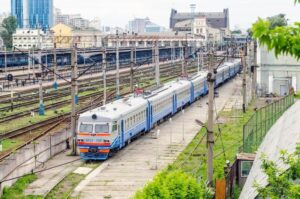
Kyiv Electric Railcar Repair Plant JSC (KEVRZ), a subsidiary of Ukrzaliznytsia, reported a loss of 4.48 million UAH for January–June 2026, which is 4.2 times less than the loss recorded in the first half of 2025.
According to the company’s interim financial report published in the disclosure system of the National Securities and Stock Market Commission (NSSMC), its net revenue decreased by 8.8% to 631.73 million UAH.
The plant reduced its gross profit by 27.6% to 33.3 million UAH, generating 7.4 million UAH in operating profit compared to 24.6 million UAH last year.
The company notes that during the reporting period, it sold 19 refurbished electric locomotive sections for 546 million UAH, 61 wheel sets for 24.4 million UAH, and 230 traction motors and auxiliary units for 37.8 million UAH.
As previously reported, the plant ended the first quarter of this year with a loss of 20.2 million UAH, compared to a net profit of 0.48 million UAH for the same period in 2025, despite a 14.6% increase in net revenue to 250.5 million UAH.
KEVRZ was founded in 1868. It specializes in the major overhaul of electric trains for Ukrainian railways, the repair of components and assemblies, electric machines, electric motors, and wheel sets, as well as the manufacture of spare parts.
The plant ended 2025 with a net profit of 70.2 million UAH—4.4 times more than the previous year—and a 34.2% increase in net revenue to 1.703 billion UAH. It repaired 51 electric sections, 223 wheel sets, 538 traction motors, and auxiliary machines.
From July 13 to 19, JSC “Ukrzaliznytsia” (UZ) transported 647,100 passengers, and the most popular train last week was the Kyiv–Przemyśl route, which carried 13,800 people, according to a company announcement on its Telegram channel.
According to the published data, the average number of passengers per car during the reporting period was 378.
Meanwhile, the number of passengers in children’s groups that week totaled 21,600.
“The most popular destination is the Carpathians. The vast majority of children traveled to Tatariv, Vorokhta, and Yasinya. Ensuring seats for organized groups of children is a priority, so when tickets are issued for these trips, they are the first to receive them,” Ukrzaliznytsia emphasized.
It is noted that the number of military personnel transported via the special reserve from July 13 to 19 was 3,600.
According to data provided by Ukrzaliznytsia, from July 13 to 19, the highest demand was observed on the Kyiv–Lviv route, where 173,200 requests were recorded and 32,700 passengers were transported.
On the Kyiv–Odesa route, the figures were 107,900 and 23,500 passengers, respectively; on the Kyiv–Przemyśl route, 76,600 and 14,700; on the Kyiv–Kharkiv route, 66,900, with 20,200 passengers transported; and on the Kyiv–Dnipro route—57,100 and 15,600, respectively
Ukrzaliznytsia clarified that there were five passengers vying for each seat on the Kyiv–Lviv, Kyiv–Odesa, and Kyiv–Przemyśl routes; four on the Kyiv–Dnipro route; and three on the Kyiv–Kharkiv route.
Among other things, the company evacuated 243 people from the Donetsk and Dnipropetrovsk regions that week and operated trains for representatives of 15 diplomatic delegations.
In early June, Ukrzaliznytsia told the Interfax-Ukraine news agency that this year’s summer passenger travel season would be more challenging than last year’s due to rising demand and a reduction in the number of railcars.



