
The government’s draft law “On the State Budget of Ukraine” for 2027 was registered with the Verkhovna Rada on Tuesday evening under No. 16000.
The relevant information has been published on the parliament’s website.
At this time, the text of the budget bill and accompanying materials are not yet available, nor is there a statement from the Cabinet of Ministers regarding its adoption at the meeting held on Tuesday evening.
According to the Budget Code, the government must submit the draft state budget for the following year to parliament by September 15 inclusive.
BUDGET, CABINET OF MINISTERS, DRAFT LAW, UKRAINE, VERKHOVNA RADA
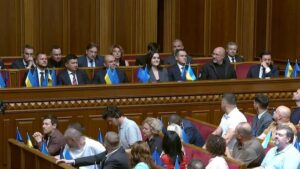
The Verkhovna Rada, upon the recommendation of newly appointed Prime Minister Serhiy Koretsky, approved the new composition of the Cabinet of Ministers of Ukraine.
During Thursday’s parliamentary session, 264 members of parliament voted in favor of this decision.
The votes in support of the new Cabinet were distributed as follows: the “Servant of the People” faction – 193, “European Solidarity” – 0, “Batkivshchyna” – 1, “Holos” – 2, the ‘Dovira’ deputy group – 17, “For the Future” – 14, “Platform for Life and Peace” – 16, “Reconstruction of Ukraine”—14, and non-affiliated deputies—7.
At Thursday’s plenary session, which was held as a package vote (with the exception of the Minister of Defense and the Minister of Foreign Affairs, whose nominations are submitted by the president), 264 members of parliament voted in favor of the resignation of the previous Cabinet and the appointment of the new government.
Specifically, the following were reappointed to the new Cabinet: First Deputy Prime Minister and Minister of Energy Denys Shmyhal; Deputy Prime Minister for Humanitarian Policy and Minister of Culture of Ukraine Tetyana Berezhna; Minister of Finance Serhiy Marchenko; Minister of Health Viktor Lyashko, Minister of Youth and Sports Matvey Bidny, and Minister of
Social Policy, Family, and Unity Denis Ulyutin.
At the same time, Vsevolod Chentsov, who previously served as Ukraine’s representative to the European Union, was appointed Deputy Prime Minister for European and Euro-Atlantic Integration of Ukraine.
Andriy Butenko, head of the National Agency for Quality Assurance in Higher Education (NAOKVO), has been appointed Minister of Education and Science.
Vitaliy Kim, head of the Mykolaiv Regional Military Administration, has become the new Minister for Veterans’ Affairs.
Additionally, Oleksandr Kravchenko, head of the Ukrainian office of McKinsey & Company, has been appointed to lead the restructured Ministry of Economy and Environment, while Taras Vysotsky, the current Deputy Minister of Economy, has been appointed to lead the Ministry of Agrarian Policy and Food.
Thus, the Ministry of Economy, Environment, and Agriculture will be divided into two separate agencies.
Meanwhile, the Ministry of Communities, Territories, and Internally Displaced Persons is now headed by MP Vitaliy Bezgin (Servant of the People faction), and the Ministry of Recovery, Infrastructure, and Transport is headed by Mykola Kalashnyk, head of the Kyiv Regional State Administration.
Consequently, the position of Deputy Prime Minister for the Reconstruction of Ukraine—Minister of Community and Territorial Development—no longer exists in the government and has been replaced by two specialized ministers.
In addition, Denys Maslov (Servant of the People faction), head of the Verkhovna Rada Committee on Legal Policy, has been appointed Minister of Justice, while Oksana Ferchuk, Ukraine’s Deputy Minister of Defense for Digital Development, Digital Transformation, and Digitalization, has been appointed Minister of Digital Transformation.
Ivan Vygivsky, head of the National Police, has also been appointed as the new Minister of Internal Affairs.
Furthermore, under the president’s quota, Andriy Sibiga is to be reappointed as Minister of Foreign Affairs, and a Minister of Defense is to be appointed; no candidates have been proposed for these positions yet.
Thus, the following individuals did not receive positions in the new government: Taras Kachka, Oleksiy Kuleba, Oleksiy Sobolev, Natalya Kalmykova, Oksen Lisovyi, Mykhailo Fedorov, and Ihor Klymenko (who may be nominated for the position of Minister of Defense).
As reported, on July 16, the Verkhovna Rada appointed Serhiy Koretsky, chairman of the board of Naftogaz of Ukraine, as Prime Minister of Ukraine.

The Verkhovna Rada has appointed Serhiy Koretsky, chairman of the board of NAK “Naftogaz of Ukraine,” as Prime Minister of Ukraine.
His nomination, put forward by President Volodymyr Zelenskyy, was approved by 289 members of parliament during a session on Thursday.
As prime minister, Koretskyi replaced the former head of the Ukrainian government, Yulia Svyrydenko, who had held the position for exactly one year, beginning on July 17, 2025.
Koretsky was born on March 14, 1978, in Lutsk. He received his higher education at Lutsk Technical University, majoring in “Mechanical Engineering” and “Business Economics,” as well as at the Ivano-Frankivsk National Technical University of Oil and Gas, where he majored in “Oil and Gas Production.”
He rose through the ranks from junior analyst at the Continuum Group of Companies (since 1999) to CEO of Continuum (since 2007).
From 2013 through the end of 2018, he developed the WOG gas station chain as CEO.
He then began working on his own projects. He was a co-founder and chairman of the board of the energy trader Centurion Group SA (Switzerland).
From November 9, 2022, he served as director of PJSC “Ukrnafta” and PJSC “Ukrtatnafta.” Since May 14, 2025, he has been chairman of the board of NJSC “Naftogaz of Ukraine.”
According to the “Chesno” movement, from 2002 to 2006 and from 2012 to 2014, he served as a volunteer assistant to Ihor Yeremeyev, a member of the Verkhovna Rada of the 4th and 7th convocations.
In 2006, he ran for the Volyn Regional Council of the 5th convocation as a candidate for the Lytvyn People’s Bloc, and also for the Verkhovna Rada of the 5th convocation as a candidate for the same bloc.
From 2007 to 2012, he served as a volunteer assistant to Kateryna Vashchuk, a member of the Verkhovna Rada of the 6th convocation elected from the Lytvyn Bloc.
Koretsky declared 32.3 million hryvnias in income for 2025, land plots with a total area of 261,600 square meters in the Donetsk Oblast, and six watches from the brands Rolex, Patek Philippe, Breguet, OPUS, and Ulysse Nardin, among others.
GOVERNMENT, Koretsky, NAFTOGAZ, PRIME MINISTER, VERKHOVNA RADA
The Verkhovna Rada adopted in the second reading and as a whole draft law No. 13200 ‘On Mentoring,’ which introduces the institution of individual and corporate mentoring for children aged 10 and older and young people from vulnerable groups.
As explained by the relevant committee, mentoring currently covers a very narrow circle of children, and there is a lack of clear mechanisms for organising mentoring – from the selection and training of mentors to support, accounting and control. The new law is intended to expand the circle of mentoring recipients and standardise procedures.
The document provides for two forms of mentoring – individual and corporate, establishes requirements for mentors (in particular, age 21 and Ukrainian citizenship), launches a social service for organising mentoring and defines the entities that organise and control the process. Mechanisms for accounting, monitoring, support and state supervision in the field of mentoring are also being introduced.
According to information from the materials for the second reading, an age threshold of 10 years has been set for children, and the mentoring agreement is to be tripartite: mentor, parents or legal representatives of the child and social service provider. Mentoring is only possible with the consent of the legal representatives and the child themselves.
Commenting on the adoption of the law to Interfax-Ukraine, lawyer Oleksiy Shevchuk emphasised the novelty of the mechanism for older children.
‘The key point is that it is not necessary to establish guardianship or custody for children aged 10 and older,’ he said.
The law will come into force after it is signed by the president and officially published in accordance with the established procedure.
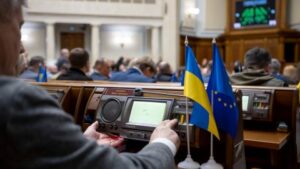
Ukrainian banks will pay income tax at a doubled rate of 50% in 2026.
The corresponding law (No. 14097) on amendments to the Tax Code of Ukraine regarding the specifics of income tax for banks in 2026 was adopted by the Verkhovna Rada on Wednesday with 272 votes in favor, with a minimum of 226 votes required, according to a correspondent from the Interfax-Ukraine news agency.
According to Yaroslav Zheleznyak, first deputy chairman of the relevant parliamentary finance committee, banks will pay tax at this rate on a quarterly basis next year and in the first quarter of 2027, which should bring an additional UAH 15-23 billion to the budget in 2026 and about UAH 5 billion in 2027.
This is the third tax increase for banks to 50% since the start of Russia’s full-scale invasion, but the first two times — in 2023 and 2024 — the Rada made this decision retroactively in the fall.
At its meeting on October 30, the Financial Stability Council (FSC) noted the systemic risks that could be created by the introduction of a 50% tax rate on bank profits from 2026.
“Raising the tax rate for banks to 50% creates risks of limiting lending to the economy and weakening financial stability in wartime,” the FSC emphasized.
Council members also noted that the expected fiscal effect of raising the rate to 50% may turn out to be significantly lower than publicly communicated estimates.
Among other risks, the FRS cited possible complications in the privatization of banks with state ownership, failure by some institutions to implement capitalization programs within the specified time frame, difficulties in timely compliance with capital adequacy requirements in accordance with EU standards, the risk of violating the obligations under the Memorandum with the IMF, as well as a reduction in incentives to de-shadow the economy.
The National Bank also noted that banks and financial companies already have a higher level of income taxation compared to other sectors of the economy – 25% versus 18%.
According to the NBU, Ukrainian banks earned UAH 131.7 billion in net profit in the first 10 months of 2025, which is 4.9% more than in the same period of 2024, and paid 2.1% more income tax – UAH 34.7 billion.
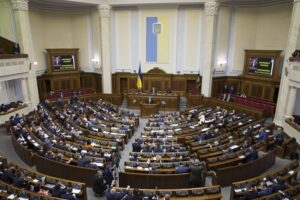
The Verkhovna Rada has recognized the results of education received by Ukrainian citizens abroad, MP Yaroslav Zheleznyak (Voice faction) said on Telegram. According to him, the relevant law No. 12375 was generally supported by 282 MPs at the plenary session of the Verkhovna Rada on Wednesday.
The MPs amended Article 6 of the law “On Complete General Secondary Education”.
The law formalizes the right of Ukrainian citizens to recognize the results of their formal and/or non-formal education in educational entities located abroad (except for the state recognized by the Verkhovna Rada as an aggressor or occupying state).



