
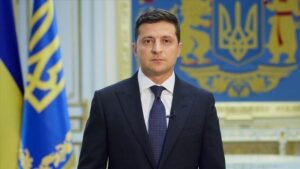
President of Ukraine Volodymyr Zelensky intends to submit to the Verkhovna Rada a bill on multiple citizenship for Ukrainians living in the countries of the European Union and the United States.
“An important component of our international policy is the support of world Ukrainianness. I know how important the issue of multiple citizenship is for Ukrainians living in the United States, Canada and the EU. Today I am submitting a relevant bill to parliament,” Zelensky said speaking in the Verkhovna Rada with his annual address on the internal and external situation of the country.
According to the president, this will for the first time allow Ukrainians from all over the world “to feel themselves not a diaspora, not just people of Ukrainian origin, but of Ukrainian citizenship.”
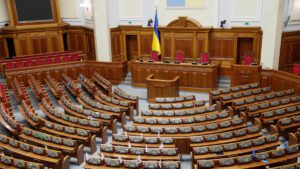
The Verkhovna Rada at its meeting on Tuesday, with 302 votes, supported bill No.3504 on mediation at second reading. The bill defines the legal framework and procedure for mediation in Ukraine. In particular, the mediation procedure will be applied in any conflicts (disputes) arising in civil, family, labor, economic, administrative legal relations, as well as in criminal proceedings when drawing up agreements on reconciliation between the victim and the suspect, the accused, and other areas of public relations.According to the explanatory note to the document, individuals and legal entities can apply to a mediator for mediation both before going to court, the Arbitration Court, International Commercial Arbitration, and during judicial, arbitration or arbitration proceedings or during the execution of the decision of the listed courts.Mediation will be carried out by mutual agreement of the parties to the mediation in accordance with the principles of voluntariness, confidentiality, independence and neutrality, impartiality of the mediator.The status of a mediator can be obtained by any individual who has a higher education and has completed basic training in the are of mediation in Ukraine or abroad.

The Verkhovna Rada of Ukraine adopted the law on ratification of the protocol between the government of Ukraine and the government of the Republic of Belarus on amendments to the agreement between the government of Ukraine and the government of the Republic of Belarus on international road traffic of December 17, 1992 (No. 0060).
The relevant document was supported by 281 MPs.
The Ministry of Infrastructure noted that this law will liberalize the conditions for carrying out freight traffic between Ukraine and Belarus, free irregular passenger road transport from the licensing system, and also unblock the work of Ukrainian road carriers in the Baltic and Scandinavian directions.
“The lack of the required number of permits from Poland and Belarus, additional conditions for transit through Russia led to a situation in which Ukrainian exporters were virtually cut off from the markets of Lithuania, Latvia, Estonia and Finland. Only due to the lack of Belarusian permits, the loss of income of carriers in November-December this year should amount to UAH 1 billion. If we also take into account the needs of producers, then the actual losses for the country would be even greater. Today, the parliament defended Ukraine’s national interests in the international freight market and protected Ukrainian exports,” Deputy Infrastructure Minister Mustafa Nayyem is cited on the ministry’s Facebook page.
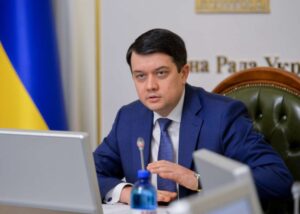
Head of the parliamentary faction “Servant of the People” David Arakhamia has requested signature lists to remove Dmytro Razumkov from the post of chairman of the Verkhovna Rada, the speaker himself said.
“As expected, my colleagues came for signature lists to recall me from the post of chairman of the Verkhovna Rada of Ukraine. The corresponding proposal was submitted by chairman of the Servant of the People faction David Arakhamia. I immediately copied a document for the Verkhovna Rada Administration. As I promised, I will not hesitate with the process. Today, colleagues will receive signature lists. I wish them Productive Work in Truskavets!” Razumkov wrote on his Facebook page.
He attached a photocopy of the corresponding appeal of Arakhamia to his post on Facebook. It notes that the Chairman of the Rada may be recalled from office in accordance with Article 76 of the Rules of Procedure, in particular, due to his unsatisfactory work or due to other circumstances that exclude the possibility of performing his official duties.
“In accordance with the first part of Article 76 of the Law of Ukraine On the Rules of Procedure of the Verkhovna Rada, the Chairman of the Verkhovna Rada may be recalled from office by the Verkhovna Rada at any time at his request, or due to his unsatisfactory work in this position, including in the case of suspension from holding plenary sessions three or more times during one regular session of the Verkhovna Rada, or for other reasons that make it impossible for him to perform his duties. The early termination of parliamentary powers by the chairman of the Verkhovna Rada results in the termination of his powers as chairman of the Verkhovna Rada,” the text of the appeal says.
Proposals to recall the speaker may be submitted to parliament by at least one third of the MPs from the constitutional composition of the Rada with their signatures.
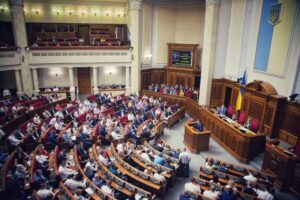
The Verkhovna Rada is proposed to introduce ceiling prices for certain types of export products, upon exceeding which exporting companies will be obliged to pay 50% of the revenues received in excess of the established limit to the state budget, which will make it possible to replenish the state budget for a total amount of $ 6.37 billion per year and redirect these funds to support the social sphere.
Corresponding bill No. 5666 was registered in the Verkhovna Rada on June 16 by MPs Oleh Dunda, Bohdan Yaremenko and Oleksandr Aleksiychuk (all of them are from the Servant of the People parliamentary faction).
According to an explanatory note to the bill, it is proposed to tax a portion of foreign currency earnings exceeding the limits established by the bill with a 50% tax. For wheat, the limit is proposed to be set at $ 230/tonne (as of June 1, its average export price is $ 283/tonne), corn – $ 170/tonne ($ 271/tonne), rapeseeds – $ 350/tonne ($ 568/tonne), oats – $ 230/tonne ($ 265/tonne), sunflower oil – $ 850/tonne ($ 1,300/tonne). Accordingly, if a 50% tax is imposed on part of the profits received by exporters in excess of the established limits, the state budget will receive $ 450 million from taxation of exported wheat, corn will bring $ 1.21 billion, rapeseeds – $ 440 million, oats – $ 10 million, sunflower oil – $ 1.57 billion, the document says.
It is also proposed to tax the profits exceeding the established limits for exporters of iron ore, steel scrap and rebar, aluminum, copper, zinc and nickel.
According to the explanatory note to the document, the taxation of “excess profits” in these commodity groups will make it possible to replenish the state budget for a total of $ 6.37 billion per year.
“The tax is levied on excess profits, that is, the profits that a business entity received by taking advantage of the favorable market conditions. Usually this is a temporary measure that is applied when the country’s budget is experiencing an acute deficit,” the authors of the bill explain.

The government has proposed that the Verkhovna Rada approves methods for calculating minimum tax applicability for land plots under cultivation being in so-called “domestic offshore,” for which taxes are not paid.
The formula for calculating the size of the tax is included in the so-called resource bill No. 5600 with amendments to the Tax Code on ensuring balanced budget receipts. The document was registered in parliament.
The document proposes to supplement Article 381 of the Tax Code with a formula according to which minimum tax applicability depends on the general standard pecuniary value of the land plot and the period during which the land plot was owned by the business entity.
The formula looks like this:
MTA = SPV × A × F × M / 12
Where:
MTA – minimum tax applicability;
SPV – standard pecuniary value of 1 hectare of a land plot;
A is the area of the land plot in hectares;
M is the number of calendar months during which the land plot was owned, leased or used on other terms by the taxpayer;
F – factor equal to 0.05.
According to the document, for a land plot that has not been evaluated it will be assessed as 1 hectare of arable land in the Autonomous Republic of Crimea or in the region, taking into account the indexation factor determined by the Code in the prescribed manner.
For sole proprietors, fourth group payers under the simplified tax system, the factor will be 0.025.
According to the bill, the minimum tax applicability is determined for allotments (allotments for construction); allotment cooperatives (societies) for vegetable growing and gardening; reserve lands; unclaimed plots at the disposal of local governments; sites exposed to radioactive contamination after the Chornobyl disaster in the exclusion zones.
“If an individual owns or uses one or more land plots, the total size of which does not exceed the size specified in Subparagraph 24 of Paragraph 1 of Article 165 of this Code, the minimum tax applicability for these land plots is not determined,” the authors of the bill said in the promulgated document.
When transferring to lease and sublease, inheritance or other use of land, the minimum tax applicability is determined for tenants and users in the manner prescribed in the Tax Code.



